In this part . . .
**IN a DROPCAP** Chapter 1
So What Exactly Is a Rottweiler?
In This Chapter
Taking a look at what makes the Rottweiler unique
Knowing the breed standards for the Rottweiler
Figuring out which of the breed standards your Rottweiler must meet
Getting a primer on the Rottweiler’s history and what it means to you today
If you’re taking the time to read this book, you’ve probably either seen a Rottweiler in the flesh or at least have seen pictures of the breed. You know what Rottweilers look like. But the Rottweiler is much more than his looks. So in this chapter, I take you through the basics of the breed. I help you understand not only why the Rottweiler looks the way he does, but also why he is able to perform in the many capacities that he’s bred for. How a Rottweiler behaves and his high level of trainability are as important as, if not more important than, what the individual dog looks like.
In this chapter, I take you through everything from the German breed standard and American Kennel Club (AKC) breed standard to what you can and should expect from a Rottweiler and why. You get a good picture here of what the Rottweiler is all about, which can help you in your quest to get to know this wonderful and challenging breed.
Understanding What Sets the Rottweiler Apart
The Rottweiler has a reputation for being tough, and deservedly so. But that doesn’t mean the breed is, or ever should be, mindlessly mean. The ideal Rottweiler’s character and temperament are the result of generations of controlled breeding and rigorous testing by the breed’s German developers. Although the Germans who framed the Rottweiler breed wanted a dog who was courageous and protective, the last thing they had in mind was a dog who couldn’t be controlled or one who went off half-cocked.
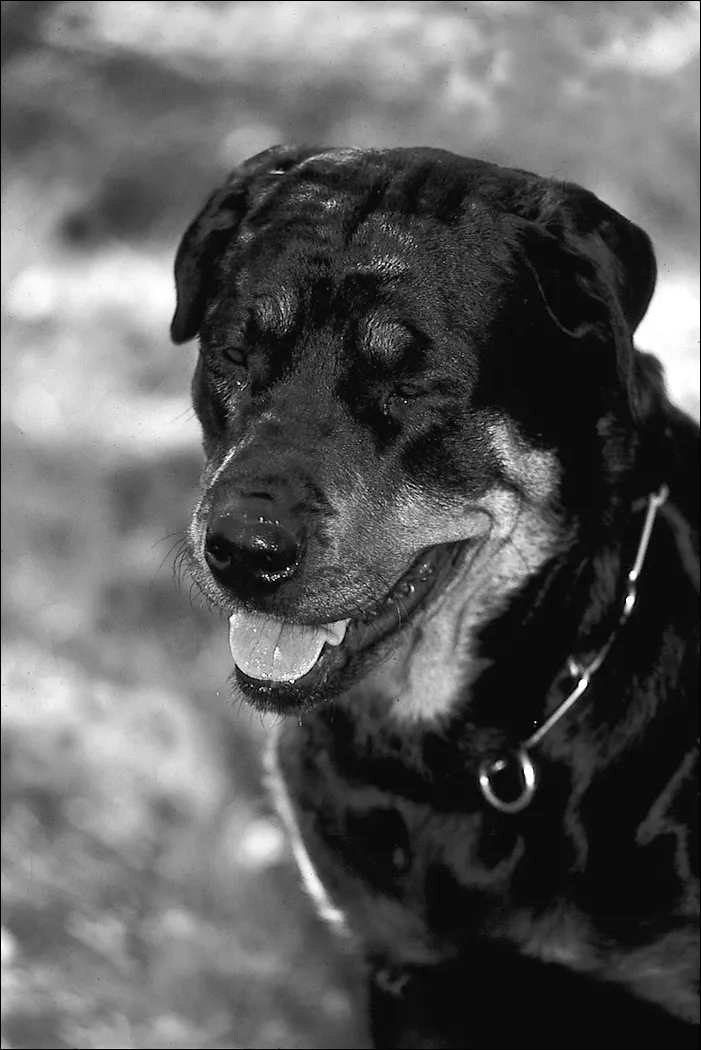
Mature Rottweilers can be as strong as most men, and probably a lot more agile. In the right hands, a Rottweiler can be the best security system in town and, at the same time, he can be a good friend the entire family can rely on for fun and games. The well-bred, well-trained Rottweiler, like the one shown in Figure 1-1, has the courage of a lion and is as willing to obey as the best-behaved child. In the wrong hands, the very same dog could just as easily be a complete menace. The Rottweiler has an amazing capacity to learn, but he also requires a capable teacher.
Everything in the Rottweiler’s history, including the guys in Germany who formulated the first breed standard, demands that the breed be bold, courageous and protective. Yet standing right alongside those requirements are demands that the breed be peaceable and of a good nature — cooperative and possessed of a willingness to learn and to abide by a master’s wishes. If the scale tips more to one side or the other, the essence of the Rottweiler is lost. However, if balance is achieved, you have Rottweiler perfection.
| Figure 1-1: A well-bred Rottweiler can make an excellent companion and a great family pet, as long as you’re willing to serve as his leader from the moment he enters your home. | |
Photograph courtesy of Judith E. Strom
Looking at the Purpose of Breed Standards
With all of this talk about what the Rottweiler should and shouldn’t be and how he should and shouldn’t act, you may be wondering, “Who says so?” The presiding kennel club of each country in the world has a system for registering the purebred dogs that are born and bred in that country. The American Kennel Club (AKC) is the recognized authority here in the United States. These clubs issue certificates of registration that are probably best described as canine birth certificates. These canine birth certificates are just as important as ours. The only way a dog can be considered a purebred and be registered is if the dog’s father and mother (sire and dam in dog parlance) are registered, and the only way they could have been registered is if their parents were registered, and so on.
For a breed to be accepted by one of the registering sources in the first place, the supporters of the breed must form a club and provide credentials certifying that their dogs were bred true to form and free of outcrosses (the introduction of other breeds) for at least five generations. Before a breed is given official recognition, the sponsoring club is also required to submit a written description of the breed that gives a word picture of both what the breed should look like and how it should interact with humans. This written description is called the breed standard. Rottweilers were granted recognition by the AKC in 1936.
The AKC currently offers the prospective dog owner 148 breeds to choose from, and there are probably upwards of 400 breeds recognized worldwide. They range from Chihuahuas — one of the tiniest toy breeds, weighing in under 6 pounds — to the giant breeds that include man-sized Great Danes and Irish Wolfhounds. Practically every one of these breeds was developed with a specific purpose in mind. Chihuahuas may have been developed for different reasons than Great Danes, but there was a reason for the development of each breed.
The toy breeds were meant to be companions, in most cases for the ladies who wanted a dog small enough and light enough to be carried around easily. Canine duties for larger dogs range from hunting small game to hauling large loads. The size, shape, and temperament of each breed has been carefully manipulated though many generations to conform to an ideal. To this day, in order for a purebred dog to be a good example of his breed, the dog must not only have a specific look, but must also behave in a manner typical of the breed.
Let’s face it, if you went out to buy a laid back kind of a dog like a Basset Hound and the dog behaved like a Jack Russell Terrier, you would understandably be somewhat upset. On the other hand, if you brought home a dog to guard the family jewels and it met intruders at the door with his tail wagging and a road map to the safe in his mouth — well, I think you see the point I’m trying to make.
Most breed standards explain how tall the average dog of the breed you are considering will grow by giving a height at the withers. That measurement is taken from the top of the shoulder to the ground. Some standards also give the average weight of full-grown dogs and bitches.
Many breeds have changed so drastically in both form and temperament from the original concept that they are barely recognizable today. Rottweiler breeders in the United States and throughout the world have made every effort to maintain the essence of the breed. A truly outstanding Rottweiler is respected and appreciated anywhere he goes — truly an international citizen.
The German standard
In Germany, dog breeding was never a case of taking your female dog down the street to get her hitched to the neighborhood male. As new breeds were created, German fanciers organized clubs to improve and protect their respective breeds. If people wanted to breed dogs, they had to join the club dedicated to the breed and abide by the club’s rules and regulations.
The club that was organized to oversee the breeding of Rottweilers was the Allgemeiner Deutscher Rottweiler...