eBook - ePub
Attention Games
101 Fun, Easy Games That Help Kids Learn To Focus
- English
- ePUB (mobile friendly)
- Available on iOS & Android
eBook - ePub
About this book
If you want to focus children's attention, you first have to capture their interest. Attention Games is filled with interesting and child-tested activities that can help children of all ages become better at focusing and paying attention. By sharing the upbeat, joyful activities in Attention Games, you can enhance your child's intelligence, boost his confidence, increase his ability to concentrate on one thing for long periods, and show that you care. Developed by Barbara Sher—parent, teacher, play therapy specialist and pediatric occupational therapist—these activities are specially designed to encourage kids to expand their powers of attention in ways that will help them throughout their lives.
Information
Edition
1Topic
Personal DevelopmentPART ONE
Games for Infants
The brain is not developed at birth. The heart has the same form from birth on, but the brain needs experiences to make pathways between the brain cells. We have one hundred billion brain cells at birth. The ones that aren’t used die. We use them when we connect them, with synapses, to each other in meaningful ways.
By age three, one thousand billion connections have been created by repeating things over and over. Repetition creates patterns as one experience is connected to many similar experiences. In order to form these patterns, children need interaction.
The relationship between parent and child is crucial to brain development. Parents and caregivers have a marked affect on creating connections, because the pathways between brain cells are reinforced by what the infant sees, smells, hears, touches, and does during the first years of life. Children raised in deprived sensory environments where there is minimal touching, sounds, sights, and experience actually develop smaller brains. Experience literally grows brains. Even rats raised in cages full of toys have more brain mass than rats with no toys.
The games in this part of the book help form patterns by giving babies a rich sensory environment to attend to. There are many games that stimulate the infant’s sensory systems of touch, sight, sound, and taste as well as games that give babies repeated experiences in mastering their motor skills. There are other games that encourage exploratory and dramatic play to help babies see connections in their daily environment.
All the games work on the principle of developing sustained attention by providing interesting age-appropriate experiences. The whole continuum of attention is stimulated, from narrow focusing, such as in the Ice Cube on a Tray activity, to global focusing, such as in the What’s out There? activity.
Of course, each game also produces the important pleasurable feelings that come from just having a good time, and all the games are easy to do, requiring nothing more than what you’d find around the house.
It’s easy to tell when babies are paying attention: their eyes widen; their bodies get very still. If they have enjoyed the experience before, their arms and legs will flail with excitement. When they have had enough stimulation, they will turn their heads and look away, maybe even making fussing sounds. You’ll soon learn how to read your baby’s cues so that you’ll know when to give him both fun times and rest.

Follow My Face
There is nothing more interesting to infants than a human face. They are just programmed that way, and for a very good reason: survival. Making eye contact with an adult human on whom your survival depends increases the possibility of being noticed and cared for. Whose heart isn’t tugged by the purposeful gaze of a newborn?
This is also one of the first experiences in focused attention that your newborn will have. Her instinct is to look at you. You expand that and increase her attention span by having her find your eyes again and again. The delightful part is that her attention is lovingly focused on you!
TYPE OF ATTENTION ENCOURAGED
Focused
MATERIALS
None
DIRECTIONS
Place your face close and directly in front of your infant’s face. Babies are a bit nearsighted at first and see best at about the distance from the crook of a mother’s cradling arm to her smiling face. Clever nature. Infants don’t yet know how to distinguish what is foreground and what is background. Getting up close ensures that your baby can see you and that she notices you. Research has shown that babies are the most attentive when looking at a human face, so it shouldn’t be hard to get her attention. Once you see that her eyes have widened and focused on you, give her praise, such as by saying, “Good, you see me!”
Now, slowly move your face so that it is at the side of her face. Softly call out her name until she moves her eyes and finds you again. Praise her some more: “You found me. Good for you!”
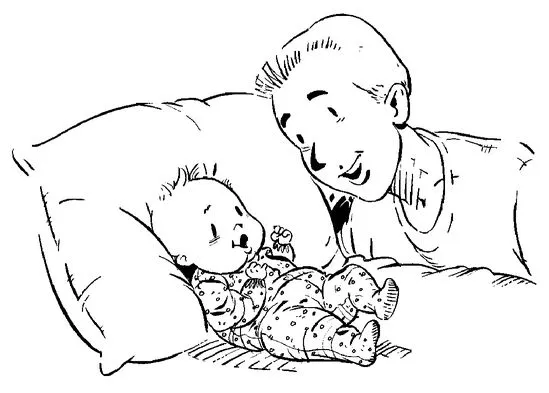
Next, slowly move your head to the other side and repeat the activity and the praise. Sometimes, instead of side to side, move your head closer and then farther away (near and far) or diagonally.
Continue the game until your child is tired of playing. You’ll know when she is done by paying attention to her signals. If your infant is very still, it means she is attending and is interested in the game. If she turns her head away and starts to squirm, it means she’s done for now.
Don’t worry; she will love to play this again later, and you’ll be helping her learn how to control the six muscles that control each eye and to coordinate the movements of both eyes together.
VARIATIONS
Here are some other ways to help your infant get a good eye workout and expand her ability to attend:
• Hang things above her bed that sway, such as wind chimes, scarves, and mobiles.
• Put a bird feeder outside her window.
• Reflect lights on the walls and ceiling of her darkened room.
• Place interesting designs or pictures on a nearby wall.
WHAT’S BEING LEARNED
A major lesson being learned, in addition to focusing, is developing eye control. Learning to control the muscles of the eyes, like any other muscle in the body, happens through practice. It is this control that will enable infants to scan their surroundings, notice different details, and thereby increase their awareness and intelligence.
Small movements of the eye also help the brain learn about space—for example, what is far, what is near, and what is on the side.
Cognitively, babies are also learning to distinguish what is the main figure and what is background.

Stick Out Your Tongue
One of the first ways I play with any infant is to stick out my tongue. It may make some parents wonder about me, but it never fails to fascinate the little one. Think about it. The tongue looks like some lively little snake coming out of your mouth.
I’ve done this game with infants as young as three months, and they always respond by thrusting out their own tongue in imitation, even if only the tip. Having control over the tongue’s movement ensures that the infant will develop the ability to form different sounds and eventually words. Try it.
TYPE OF ATTENTION ENCOURAGED
Focused
MATERIALS
None
DIRECTIONS
Get your child’s attention by softly calling to him and smiling. Once he notices you, stick out your tongue and waggle it a little. Tell him what you are doing: “It’s my tongue.” Tell him about his: “You have a tongue, too. Open your mouth. Let’s see it,” or words to that effect.
Keep wagging and maybe even add some soft sounds to keep his attention engaged. If you want, you can even gently touch his tongue to give him some sensory feedback on what part you are talking about.
Play the game ...
Table of contents
- Title Page
- Copyright Page
- Dedication
- Acknowledgments
- Introduction
- How to Contact the Author
- PART ONE - Games for Infants
- PART TWO - Games for 1- to 3-Year-Olds
- PART THREE - Games for 3- to 6-Year-Olds
- PART FOUR - Games for 6- to 12-Year-Olds
- PART FIVE - Games for Teens
- Index
Trusted by 375,005 students
Access to over 1.5 million titles for a fair monthly price.
Study more efficiently using our study tools.
Frequently asked questions
Yes, you can cancel anytime from the Subscription tab in your account settings on the Perlego website. Your subscription will stay active until the end of your current billing period. Learn how to cancel your subscription
No, books cannot be downloaded as external files, such as PDFs, for use outside of Perlego. However, you can download books within the Perlego app for offline reading on mobile or tablet. Learn how to download books offline
Perlego offers two plans: Essential and Complete
- Essential is ideal for learners and professionals who enjoy exploring a wide range of subjects. Access the Essential Library with 800,000+ trusted titles and best-sellers across business, personal growth, and the humanities. Includes unlimited reading time and Standard Read Aloud voice.
- Complete: Perfect for advanced learners and researchers needing full, unrestricted access. Unlock 1.5M+ books across hundreds of subjects, including academic and specialized titles. The Complete Plan also includes advanced features like Premium Read Aloud and Research Assistant.
We are an online textbook subscription service, where you can get access to an entire online library for less than the price of a single book per month. With over 1.5 million books across 990+ topics, we’ve got you covered! Learn about our mission
Look out for the read-aloud symbol on your next book to see if you can listen to it. The read-aloud tool reads text aloud for you, highlighting the text as it is being read. You can pause it, speed it up and slow it down. Learn more about Read Aloud
Yes! You can use the Perlego app on both iOS and Android devices to read anytime, anywhere — even offline. Perfect for commutes or when you’re on the go.
Please note we cannot support devices running on iOS 13 and Android 7 or earlier. Learn more about using the app
Please note we cannot support devices running on iOS 13 and Android 7 or earlier. Learn more about using the app
Yes, you can access Attention Games by Barbara Sher,Ralph Butler in PDF and/or ePUB format. We have over 1.5 million books available in our catalogue for you to explore.