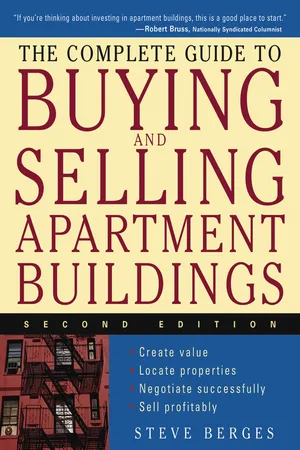
Whether you?re a first-time real estate investor or a seasoned professional, The Complete Guide to Buying and Selling Apartment Buildings helps you map out your future, find apartment buildings at a fair price, finance purchases, and manage your properties. Now revised and expanded, this Second Edition includes tax planning advice, case studies of real acquisitions, and appendixes that add detail to the big picture. Plus, it includes a handy glossary of all the terms investors need to know, helpful sample forms that make paperwork quick and easy, and updated real estate forecasts. With this comprehensive guide at hand you?ll find profits easy to come by.
- English
- ePUB (mobile friendly)
- Available on iOS & Android
eBook - ePub
The Complete Guide to Buying and Selling Apartment Buildings
About this book
CHAPTER 1
The Light of Integrity
The soul is dyed the color of its thoughts. Think only on those things that are in line with your principles and can bear the full light of day. The content of your character is your choice. Day by day, what you choose, what you think, and what you do is who you become. Your integrity is your destiny . . . it is the light that guides your way.
—HERACLITUS
Introduction to Multifamily Ownership
Introduction
The systematic acquisition of real estate properties over time is unquestionably one of the surest means of accumulating wealth. While building a respectable real estate portfolio is a process that can take months, or even years, the patient and diligent investor enjoys a high probability of earning above-average returns for his or her efforts. Careful analysis, however, is required for each and every property considered. Proper analysis is not limited to a simple review of the property’s condition and location. To be successful in this business requires a more exhaustive approach.
This book is intended as a guide to developing a format for a thorough examination of each and every property you are considering. This format, when properly applied, will provide you with a significant competitive edge. It is my intent that by following the guidelines in this book, you will no longer arbitrarily determine value as it applies to real estate; rather, you will truly understand it. By the time you are finished reading this book, you will know why a multifamily complex, for example, is worth only $700,000 instead of the $950,000 the seller is asking. Proper understanding of this single principle can be the difference between success and failure.
While readers of this book are likely to have broad and diverse backgrounds, you do share one thing in common—your interest in real estate. I will attempt to be as thorough as possible, because some readers are likely to have little to no experience, while others are seasoned professionals searching for that edge. This being the case, those readers who have a great deal of experience may find some of the material to be a bit basic. It is crucial, however, to lay the proper foundation for those who are not as experienced. Many readers have most likely purchased single-family houses at one time or another and have at least a minimal degree of rental property experience.
Holistic Approach
In addition to providing a comprehensive approach to analyzing, buying, and selling apartments, this book also offers a holistic approach that will enable you to more fully achieve your true potential. Personal examples, inspiring stories, anecdotes, and quotes are used throughout to stir your mental faculties and encourage you to reach deep within yourself to fulfill your dreams, whatever they may be. While understanding the mechanics of multifamily transactions plays an important role in the level of your success, it is my personal belief that the stories and examples used throughout the book are what will truly enable you to become successful, not only in real estate, but in life as well.
I cannot help but feel that the hand of Providence guides my writing from time to time, as thoughts flow freely from my heart and mind with little or no effort. After the first edition of this book was published, I received overwhelmingly positive responses from readers who were inspired for one reason or another by portions of it. For example, one kind lady named Melinda was so inspired, she felt compelled to contact me, which she did only a month ago. Melinda, who is from New York, had just suffered the loss of her husband a few short weeks before. I listened to Melinda’s story for well over an hour with empathy as she described how despondent she had felt after her husband died. Not sure where to turn, she happened across my book and after reading it thoroughly, felt a renewed sense of hope, knowing that somehow everything would be all right. Melinda’s kind words of gratitude left me feeling appreciative that in some small way, I had been instrumental in lifting her spirit, even if only for a moment.
Recently, I received a call from a gracious gentleman named Lambis who lives in Athens, Greece. Like Melinda, he, too, had just finished reading this book and felt compelled to contact me. Lambis explained how he had been in one of the largest bookstores in Athens searching for a book on real estate investing. When he asked one of the employees where the real estate section was, he was told the bookstore did not have one. Lambis explained to me this was due to the fact that there really is no real estate market in Athens because families rarely move. In other words, once a family purchases a house, they stay there for most of their lives and often pass the house down from one generation to the next. As Lambis was perusing the economics section of the bookstore, however, he came across a single real estate book, which just happened to be this one.
Lambis then proceeded to tell me that he would be flying to the States in two weeks and would like to meet with me. Feeling honored at such a request, I readily agreed. While Lambis arranged his flight schedule, I arranged my work schedule to set aside an entire day for him. In fact, it was just last Friday that the two of us met. Lambis, a most remarkable man, shared many fascinating stories with me over the course of the day. He told me of his grandfather, a prominent engineer, well-known for his numerous contributions to major projects throughout the city of Athens. He told me of his father, another distinguished engineer, who built one of the most respected companies in Athens employing over 4,000 men and women. He also told me of the devastating setbacks his father experienced due to the oil embargo during the late 1970s.
Lambis explained that although his father had built a vast empire, there was one primary flaw that contributed to the ultimate demise of the family’s business. His father’s management style was extreme control in every facet of the organization. It was this unwillingness to relinquish control and delegate responsibility to his senior managers that set the stage for the inevitable collapse of the business. When the oil crisis occurred, it was as if one leg, and then another, was knocked out from underneath a three-legged stool. When one leg is removed, the stool becomes very unstable, and when the second leg is removed, the stool has no choice but to fall. Rather than declaring bankruptcy, Lambis’ father spent the next decade liquidating the company’s assets in an effort to repay as many of the debts as possible. During that period, his father, once a Greek icon of monumental stature, suffered a series of no less than 10 heart attacks. He passed away in 1991 with his majestic honor, his noble character, and his impeccable integrity fully intact. Saddened by this tragic loss, Lambis vowed not to repeat his father’s mistakes in his own business affairs. It was apparent to me that he had indeed learned from his father, as Lambis is today a successful businessman in his own right, with a management team in place that allows him to freely come and go without the day-to-day oversight required by most business owners.
Background
A confluence of events from my own life experiences over the past 20-plus years has provided me with unique insights on the real estate market. Three primary components have contributed to my experience.
First and foremost, like many of you, I have bought and sold a number of both single-family and multifamily properties over the years. As principal of Symphony Homes (www.symphony-homes.com), a residential construction company, I am a current and active investor.
Second, my experience as a financial analyst at one of the largest banks in Texas has provided me with a comprehensive understanding of cash-flow analysis. Working in the bank’s mergers and acquisitions group, I reviewed virtually every line item of the financial statements of related income and expenses for numerous banks that were potential acquisition candidates. I spent 8 to 10 hours a day using a fairly complex and sophisticated model to determine the proper value of these banks, given a specific set of assumptions. Since leaving the bank some years ago, I have developed my own proprietary model, which I now use to assist me in determining the value of multifamily properties. The beauty of understanding cash-flow analysis is that once you grasp the concept, it can be applied to anything that generates some type of cash flow, whether it be banks, apartment complexes, manufacturing businesses, or fast-food restaurants.
Finally, my experience as a commercial mortgage broker has provided me with an inside look at the lending process—more specifically, what the lenders’ underwriting departments typically look for. This book devotes an entire chapter to this subject, and I am confident that it will enable you to present a property in its most favorable light when you are seeking funding.
Although I had bought and sold real estate for a number of years prior to my experience at the bank in Texas, it was after I gained a more complete understanding of the principles of finance learned during my graduate studies at Rice University and my tenure at the bank that I was able to significantly accelerate my investment goals. I developed my own proprietary financial models that enabled me to more fully analyze an asset’s value based on its cash flows and price relationship to similar assets. The combination of these financial analysis tools and a sound understanding of valuation principles has allowed me to increase my personal real estate investment activities from a meager $25,000 in volume a year to a projected $8 to $10 million this year alone. I am confident that the culmination of my own skill sets and life experiences will be of great benefit to you as you seek to enlarge and develop your own real estate holdings.
Market Outlook
With interest rates at 40-year record lows, more people than ever are enjoying the benefits of home ownership. On the surface, this would seem to have a negative impact on the apartment industry. After all, if a greater number of families are purchasing homes, then surely there must be a fewer number of families who are renting houses and apartments, right? The answer is, not necessarily. In fact, research conducted by several leading analysts of the multifamily industry suggests the market outlook for apartments is actually quite favorable for several reasons. According to a report by the chief economist of the National Multi Housing Council, Mark Obrinsky, changes in population, demographics, and household composition will each have a positive impact on the apartment industry (January 29, 2004 issue). Obrinsky supports his assertions in the following excerpt.
When John F. Kennedy famously said “a rising tide lifts all boats,” he wasn’t talking about the apartment industry. He wasn’t even talking about housing. Yet, his sentiments apply very nicely to our industry today. Conventional wisdom tells us that low interest rates and government incentives are driving home ownership rates up, and that those increases are bad news for apartments. Not so, according to NMHC analysis. The rising tide in this case is our country’s rising population, which will raise demand for both owner- and renter-occupied housing. Housing, in other words, is not a zero-sum game, and home ownership’s gains are not the apartment sector’s losses thanks to demographics, immigration and population gain.
While banking changes and the investment climate drove home ownership rates up in the 1990s, the key factor driving housing demand in the next decade is demographics. Population growth—through natural population increase, continued high levels of immigration, and increased life spans—will increase demand for owner- and renter-occupied housing.
And some demographic trends will clearly favor rental housing, especially the swell of echo boomers and the continuing shift toward single-person households. After declining for two decades, the population in the traditional renting years (ages 20-29) is expected to increase 11 percent between now and 2010. Eventually more than 80 million “echo boomers” (ages 8-27) will move into the housing market, most likely as renters first. And there is no “baby bust” expected behind this generation, just a plateau.
Then there are the changes in household composition underway. The households most likely to own—married couples with children—are declining in number and now account for less than one-quarter of all households. Meanwhile, two-thirds of all new households in the past decade were nonfamily households, which have the lowest home ownership rates. This demographic shift alone would cause the overall home ownership rate to drop by 70 basis points by 2010.
Immigration will create even more new renters. Over two million legal immigrants have entered the U.S. since the beginning of this decade. In fact, fully 50 percent of the expected population growth in the U.S. will be immigrants, and half of all immigrants are renters.
Data taken from the United States Census Bureau also suggests that increases in the population are all but certain. Based on current growth projections, the population is expected to increase from its current level of 285 million people to a level of 315 million by 2010. This represents a phenomenal increase of 30 million residents over the next few years. The increase in growth will necessitate an increase in demand for housing, which is likely to place upward pressure on prices since the supply and demand ratio already remains fairly tight. Furthermore, with increasingly strict environmental and governmental regulations and concern over so-called “urban sprawl,” supply will become increasingly constrained as builders find it more and more difficult to construct new housing. This, too, will place upward pressure on prices for housing.
Obrinsky also makes a convincing argument that addresses the issue of low interest rates. Although a low-interest-rate environment will initially have a negative impact on the rental market due to a shift of renters opting to become homeowners, this shift will eventually taper off as home prices increase, thereby making them less affordable, and as rental prices soften, thereby making them more affordable. Evidence of the balance between home ownership and the rental market moving into equilibrium is already apparent as new home sales have begun to moderate while rental occupancy rates are strengthening. In the following excerpt, Obrinsky contends:
What if interest rates remain low? Won’t that draw renters out of apartments? Our research mirrors the findings of a study by two professors at the University of California: interest rates play no discernible role in increasing home ownership rates in the short- or long-run. Housing affordability can worsen even with low interest rates if house prices are appreciating faster than household income, a situation that describes many current markets.
Many analysts believe the pressure on apartments from home ownership is moderating. As rising house prices make them less affordable, renting becomes a more competitive option. According to the Harvard University’s 2003 State of the Nation’s Housing report, if the recent run up in housing prices makes home ownership too expensive, the number of new renters expected in the next decade could easily grow from one million to five or six million.
Interest rate changes and home ownership incentives aside, housing is not the win-lose game many analysts would have you believe it is. The rising tide created by population growth and demographic changes will lift all boats—regardless of whether they are docked at a single-family or a multifamily residence.
In the meantime, apartment firms are successfully competing with single-family houses by offering better locations, larger apartments, more userfriendly floor plans, cutting edge technologies, new amenities and abundant conveniences. The multifamily sector will continue down the path of offering not just a housing alternative, but a lifestyle alternative that many young professionals and empty nesters find attractive.
So there you have it. Obrinsky makes a convincing case for the apartment industry over the coming decade. The culmination of an increase in population of over 30 million residents, changes in demographic trends and household composition, a tight supply and demand ratio, and equilibrium between affordability of home ownership and the rental market all contribute to the positive outlook for multifamily property owners.
Regional Trends
In order to maximize the return on invested capital, investors also should be aware of regional trends. On a national level, as Obrinsky claims, the rising tide will lift all boats. Not all boats will be lifted as hig...
Table of contents
- Title Page
- Copyright Page
- Dedication
- Acknowledgements
- CHAPTER 1
- CHAPTER 2
- CHAPTER 3
- CHAPTER 4
- CHAPTER 5
- CHAPTER 6
- CHAPTER 7
- CHAPTER 8
- CHAPTER 9
- CHAPTER 10
- CHAPTER 11
- CHAPTER 12
- CHAPTER 13
- CHAPTER 14
- APPENDIX A
- APPENDIX B
- GLOSSARY
- INDEX
Trusted by 375,005 students
Access to over 1.5 million titles for a fair monthly price.
Study more efficiently using our study tools.
Frequently asked questions
Yes, you can cancel anytime from the Subscription tab in your account settings on the Perlego website. Your subscription will stay active until the end of your current billing period. Learn how to cancel your subscription
No, books cannot be downloaded as external files, such as PDFs, for use outside of Perlego. However, you can download books within the Perlego app for offline reading on mobile or tablet. Learn how to download books offline
Perlego offers two plans: Essential and Complete
- Essential is ideal for learners and professionals who enjoy exploring a wide range of subjects. Access the Essential Library with 800,000+ trusted titles and best-sellers across business, personal growth, and the humanities. Includes unlimited reading time and Standard Read Aloud voice.
- Complete: Perfect for advanced learners and researchers needing full, unrestricted access. Unlock 1.5M+ books across hundreds of subjects, including academic and specialized titles. The Complete Plan also includes advanced features like Premium Read Aloud and Research Assistant.
We are an online textbook subscription service, where you can get access to an entire online library for less than the price of a single book per month. With over 1.5 million books across 990+ topics, we’ve got you covered! Learn about our mission
Look out for the read-aloud symbol on your next book to see if you can listen to it. The read-aloud tool reads text aloud for you, highlighting the text as it is being read. You can pause it, speed it up and slow it down. Learn more about Read Aloud
Yes! You can use the Perlego app on both iOS and Android devices to read anytime, anywhere — even offline. Perfect for commutes or when you’re on the go.
Please note we cannot support devices running on iOS 13 and Android 7 or earlier. Learn more about using the app
Please note we cannot support devices running on iOS 13 and Android 7 or earlier. Learn more about using the app
Yes, you can access The Complete Guide to Buying and Selling Apartment Buildings by Steve Berges in PDF and/or ePUB format, as well as other popular books in Business & Real Estate. We have over 1.5 million books available in our catalogue for you to explore.