Praise for Shared Services A Manager's Journey
"In Shared Services: A Manager's Journey, Dan presents the real business cultural challenges along with human factors when taking on such a change in a company's processes. A must-read for any executive, manager, or team member who is considering, decided to, or is already in the process of converting a company from a decentralized organization to a shared services environment."
-Katherine M. Ericsson Vice President of Membership, Project Management Institute of South Florida and director of a project management office, in a shared services environment within the distribution industry
"A how-to/survival guide for those thinking about entering shared services or beginning the journey...for the rest of us, an entertaining look back at our journey both professionally and personally. A great read!"
-Steve K. Stone Senior Vice President and CFO, Newspapers and Shared Services Morris Communications Company
"Over the past fifteen years, I've had the pleasure of working directly with hundreds of companies who are implementing shared services. What is striking is how very different 'real experiences' are from the stories spun by consultants or keynote speakers at conferences. Getting to the 'real truth' of how to put the pieces together will help you keep consulting fees low and the probability of success high. This book is a practical guide created by someone who has been there. It is the truth!"
-Mike Hostetler Managing Director, Shared Services Roundtable Corporate Executive Board
- English
- ePUB (mobile friendly)
- Available on iOS & Android
eBook - ePub
CHAPTER 1
BROWN FIELDS, GREEN FIELDS, AND HAZEL FIELDS
Dennis was happy to be driving home at 7:00 pm, which for him was a decent hour. Thursdays were also nice because every Thursday he ate dinner with the entire family since the kids’ activities were all scheduled for other nights. Jennifer, his wife, enjoyed dinner with the family and looked forward to hearing about everyone’s day. His 40-minute commute usually allowed him to think about things other than work, but lately Dennis was feeling a little uneasy about his job.
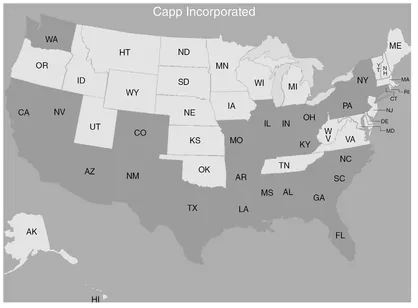
Three months ago he had been slated to head up Capp’s Shared Services division. Dennis was chosen because he came to Capp from an established Shared Services center, where he worked his way up to director of Shared Services over the course of seven years. Publicly he was hired to be the corporate controller, but only two months into the job he was given the task of analyzing the potential move to a Shared Services environment. The analysis phase proved to be very successful and showed the results Dennis expected. Capp was founded in 1954 as a lumber company and had evolved into a large building materials company selling everything from lumber, drywall, and shingles to cabinets and plumbing fixtures. Because of Capp’s numerous plants and geographic spread, a decentralized administrative organization was costly and very inefficient. Capp had 150 wholesale warehouses in 23 states (see Exhibit 1.1).
EXHIBIT 1.1 Capp’s Geographical Locations by State
John Phelps, the chief executive officer, and Donna Angelo, Dennis’s boss and chief financial officer, agreed to move forward with the Shared Services initiative. Everyone agreed they would begin with the El Paso division, since it was one of the smaller divisions but was as diverse as most at Capp. While they all agreed which division would go first, they could not agree on where to locate the Shared Services division. John wanted to put Shared Services in the corporate offices in Tampa, Florida; Donna preferred a green field (i.e., a center in a city where the company did not already operate) in Des Moines; and Dennis thought they should be in Tampa but not at the corporate office, which would be a hazel field (a brown field would be a center in an existing Capp office). An analysis by a staffing firm suggested that Donna was correct; Capp would get quality employees at a very fair price in Des Moines. The analysis also mentioned that while Tampa could be a viable site, it was not as economically advantageous as Des Moines. Being in a hurricane zone also did not help Tampa’s rating. If nothing else, John, Donna, and Dennis all agreed they would not consider setting up an offshore center. Deciding on the location seemed to be taking longer than it should, and Dennis was not sure if they could agree. Most likely John would simply listen to their arguments for one more week and then make a decision. He hoped it would be made soon.
Dennis rounded the corner of Palm Avenue and slowly made his way up the street. Some of the neighborhood children were usually playing kickball, Wiffle ball, or tag, so he drove extra slowly. As he pulled into the driveway, he noticed Samantha, his youngest daughter, sitting on the stoop playing with Shorty, the family beagle. Seeing both of them made Dennis forget all about green fields, brown fields, or hazel fields.
Walking in the door, Dennis was followed closely by Shorty as he held Samantha in one arm and hugged his youngest son, Danny, with the other. He looked around for Jackie, his oldest daughter, but did not see her. He assumed, like most times, she was in her room. The smells of homemade spaghetti sauce and garlic rolls reminded Dennis why he liked eating with his family so much. Andrew, their oldest son, was a senior in high school and was talking on the phone. Dennis was not sure if Andrew enjoyed the family dinners at his age, but he sure ate plenty and never complained.
Jennifer gave Dennis a kiss on the cheek. “Dinner will be ready in a bit. How was work?” “We are three weeks late in making a decision on the location of the Shared Services center, but I’m sure John will either press us or make it himself this week.” “Well, let’s not worry about that tonight, we just need to enjoy dinner. Besides, you have to help Jackie with her homework tonight, so you’d better reserve your brainpower,” Jennifer said with a chuckle. After Andrew hung up the phone and Jackie came out of her room, they all sat down to eat.
“Andrew, so two more months and you’ll be eating mac and cheese and frozen pizzas every night,” said Dennis. Andrew was two months from going away to college.
“Well, at least I’ll be able to come home on weekends so you and Mom can do my laundry,” Andrew replied with a grin.
“Not if our service center ends up in Des Moines,” Dennis replied, reminding the family that they might have to move.
“Why can’t you just have the center here? I don’t understand why you would want to move everyone to Des Moines,” said Jackie.
“Well, it’s complicated, honey, but it really comes down to money. The cost of living is cheaper in Des Moines, and it’s not in a hurricane zone, so we can save some money on the redundancy of our infrastructure.” As he spoke, Dennis realized that he was starting to buy into Donna’s argument.
“What about the people who work here in Tampa: are they all going to move? They must have a lot of sun and beaches in Des Moines or else everyone wouldn’t want to move,” Danny said. Everyone smiled at his naiveté.
“Dad,” Andrew said. “We’ve talked about this before and I still don’t get it. When I was looking at colleges, you always told me it’s not the college that makes you, it’s what you make of the college.”
“Yeah, I remember saying that.”
“Well, doesn’t the same thing apply here? No matter what city you choose, your success is going to come from the people you hire to run it and the way you actually run it. I’m sure there are just as many qualified people here in Tampa. What is the actual difference in wages? Let’s just say you have 200 employees and the average pay is $45,000 versus $55,000, the savings is $2 million.”
“So Mr. Math Major or is it Charley Money Bags? Two million isn’t a lot of money?”
“I’m not saying that, but remember you said you are going to start small and then bring in other businesses. If that’s the case, then you won’t be up to the $2 million difference for more than two years. Also, won’t it be easier for the owners to make sure things are going as planned when the center is in the same town? You say it’s going to be cheaper in Iowa, but isn’t that all you are really saving? I mean, what about the people who are going to be out of work? I assume you’ll have to pay a severance.”
“You make good points, and we’ve considered all of them. I’m just not sure which way John is leaning. I tend to agree with you though.”
Dennis was proud that Andrew gave him something to think seriously about. He was feeling pretty good as he drove to work the next day because Andrew reminded him that the ultimate success factor was not in choosing the proper location but in choosing the right people. After last night’s discussion, Dennis felt John and Donna were not putting enough emphasis on the people, especially those who were already working for Capp. John and Donna usually arrived around the same time as Dennis, and it would be pretty easy to have a quick chat about his new thoughts regarding the location of the Shared Services center.
Dennis pulled into his assigned parking space and noticed that John and Donna were already there. Of the 300 employees in the building, only 10 had assigned parking spaces. It was a nice perk, considering that it rains frequently in Tampa and the 10 spots were not only covered but also very close to the door.
Dennis got in the elevator and pushed the button for the fourth floor. Since he had arrived at Capp and was assigned to analyze Shared Services, some of the employees were a little uptight when they saw him. He figured it was a natural reaction: The employees did not know if they were even going to have a Shared Services center, much less where it was going to be located.
As he got off of the elevator, he noticed John and Donna were having a discussion in John’s office. Dennis walked there. “Morning, guys.”
“Hey, Dennis, come in here. We have some thoughts about the location,” said John.
Dennis sat down at the round table where Donna was drinking her coffee. John had the consultant reports spread on the table.
“You know, we spent a decent amount of money on this study for a good reason. We are new to this, and the consultants cover all aspects and are objective. It seems a bit silly to spend the time and money to get their opinion and then not use it. I agree with the consultants and Donna and think we should go with Des Moines.”
As John was talking, Dennis was looking at the reports. John was right in saying they at least covered all of the variables. Each location was evaluated on eight criteria:
1. Quality of workforce
2. Cost of workforce
3. Cost of real estate
4. Convenience of travel from current locations
5. Local taxes
6. Government assistance or grants
7. Probability of natural disasters or emergencies
8. Time zone relative to the other business units
Because Capp would not consider going out of the country, criteria such as language compatibility and political stability were not evaluated.
Dennis looked at Donna and then John before speaking. “I agree that we should definitely consider the evaluation, but I’ve been giving this a lot of thought as well. Quite honestly, I think we’re overevaluating and overthinking the issue. I ate dinner with my family last night and had an interesting discussion with my son. I was talking about the location and how important the decision was, and he asked one question: Why? Why is it so important? He reminded me that when he was evaluating colleges, I told him the college he chooses will not make him, he will make the college. By the same token, the people we choose to operate the center will determine our success. It will not come down to location or even the difference we might have to pay in Tampa versus Des Moines. Our success will simply be a product of the people we hire.”
Dennis waited for a response. Neither John nor Donna said anything immediately, which meant either that they were considering what he had said or they were trying to figure out how to tell him it was too late, they had made their decision.
“Having said that, does that mean you are okay with any of the proposed sites, or do you have a preference?” Donna asked.
“I do have a preference, but it’s not based on any of the criteria listed. We’ve considered all of the labor costs, including severance if necessary, and we’ve talked about, but not quantified, the cultural impact on our current staff if we displace workers.”
“Well, that is a little tough to quantify,” said John.
“I agree, but that doesn’t mean we can discount it. Remember, our success depends not only on our center but also on the cooperation and assistance of our divisions. While we are mandating Shared Services, we will get a lot of mileage out of selecting Tampa as a site and hiring some employees from the Tampa business unit.”
Donna and John looked at each other and said, “So you’re saying we should locate the center in Tampa?”
“It’s important to have people in our organization who understand some level of the day-to-day operations that are completed in the divisions and why it is being done a certain way today. Also, one of the biggest statements that each division will make as we bring them on board is ‘we did it better, cheaper, and never had any problems.’ Without someone who was involved in the day-to-day on our side to defend us, we won’t be able to counter that argument.”
“But, Dennis,” John said forcefully, “this is not about sides. We aren’t here to divide our company. Shared Services will allow us to be more efficient and allow our divisions to concentrate on sales and operations. This is not an option, and everyone will fall in line.”
“With all due respect, John, just because you mandate something doesn’t mean that every person will embrace it. We have to attack it on multiple fronts, and your mandate is the most powerful and best way to do that, but we also need front-line soldiers, so to speak, to combat propaganda and rumors. There is no one better to have on our side than a former division employee who believes in what we are doing and will help sell it.”
Dennis and John were used to debating issues forcefully; that is what helped them make good decisions. Neither man took these discussions personally. John sat back for a second thinking. “Donna, so what do you think?” he asked.
“Well, as we were discussing before he came in, we did pay good money for this study, but we also pay good money for Dennis,” she said with a little laugh. “He’s been working in the Shared Services world for some time, so we should probably pay a bit more attention to him than a consultant with a study.”
She looked at Dennis and said, “Let me ask you something, and I need an honest answer. We decided to undertake this study before we hired you. If we had hired you first, would you have agreed to hire a consultant to complete this study, or would we have just made the decision ourselves?”
“We would have made the decision ourselves. I mean, if we were really at odds over this, maybe we bring in someone to help us, but I would not bring them in at the beginning. Of all of the Shared Services operations I have looked at, the location ultimately had very little to do with the success or failure of the operation. I’ve seen brown field, green field, and hazel field operations all succeed and I’ve seen them all fail. I’ve also seen them everywhere in between.”
John started to laugh. Donna and Dennis both looked at him in surprise. “Dennis, that actually sounded a bit poetic.” John started to sing “I’ve seen brown fields, green fields, and hazel fields. . . .”
All three started to laugh. The one thing Dennis liked about working at Capp was the fun nature of both John’s and Donna’s personalities. Even though they worked very hard and were very driven, they knew enough to not take everything too seriously.
After the laughter died down, John made a decision, sort of. “I’ll tell you what. Let me think for one more night and I’ll come in tomorrow morning with a guaranteed decision. Just do me a favor, whatever it is, all three of us have to walk the walk and talk the talk. Agreed?”
Donna and Dennis looked at each other...
Table of contents
- Title Page
- Copyright Page
- Dedication
- Foreword
- PREFACE
- Acknowledgments
- CHAPTER 1 - BROWN FIELDS, GREEN FIELDS, AND HAZEL FIELDS
- CHAPTER 2 - FINALLY
- CHAPTER 3 - YOU ARE ONLY AS GOOD AS THOSE YOU ARE SURROUNDED BY
- CHAPTER 4 - DECISION TIME
- CHAPTER 5 - THE JOURNEY BEGINS
- CHAPTER 6 - THE JOURNEY CONTINUES
- CHAPTER 7 - MISSION ACCOMPLISHED
- CHAPTER 8 - LOCATION, LOCATION, LOCATION
- CHAPTER 9 - A TOUGH CONVERSATION
- CHAPTER 10 - EL PASO GOES LIVE
- CHAPTER 11 - TEAMWORK
- CHAPTER 12 - END-TO-END PROCESS
- CHAPTER 13 - PROCESS STEERING TEAMS
- CHAPTER 14 - PREPARATION
- CHAPTER 15 - DINNER AND A MEETING
- CHAPTER 16 - MEASURE, MEASURE, MEASURE
- CHAPTER 17 - BONUS TIME
- CHAPTER 18 - PAY UP
- CHAPTER 19 - ALLOCATION TIME
- CHAPTER 20 - ALLOCATION DETAILS
- CHAPTER 21 - PERCEPTION IS REALITY
- CHAPTER 22 - THE DEVIL IS IN THE DETAILS
- CHAPTER 23 - THE NEXT STEPS
- CHAPTER 24 - SMOOTH RUNNING
- CHAPTER 25 - THE MEETING CONTINUES
- CHAPTER 26 - BEST-LAID PLANS
- CHAPTER 27 - TIME FOR A CHANGE
- CHAPTER 28 - OPPORTUNITY
- CHAPTER 29 - GROWTH
- CHAPTER 30 - HELLO AND GOOD-BYE
- CHAPTER 31 - THE CONFERENCE
- CHAPTER 32 - THANKSGIVING
- INDEX
Trusted by 375,005 students
Access to over 1.5 million titles for a fair monthly price.
Study more efficiently using our study tools.
Frequently asked questions
Yes, you can cancel anytime from the Subscription tab in your account settings on the Perlego website. Your subscription will stay active until the end of your current billing period. Learn how to cancel your subscription
No, books cannot be downloaded as external files, such as PDFs, for use outside of Perlego. However, you can download books within the Perlego app for offline reading on mobile or tablet. Learn how to download books offline
Perlego offers two plans: Essential and Complete
- Essential is ideal for learners and professionals who enjoy exploring a wide range of subjects. Access the Essential Library with 800,000+ trusted titles and best-sellers across business, personal growth, and the humanities. Includes unlimited reading time and Standard Read Aloud voice.
- Complete: Perfect for advanced learners and researchers needing full, unrestricted access. Unlock 1.5M+ books across hundreds of subjects, including academic and specialized titles. The Complete Plan also includes advanced features like Premium Read Aloud and Research Assistant.
We are an online textbook subscription service, where you can get access to an entire online library for less than the price of a single book per month. With over 1.5 million books across 990+ topics, we’ve got you covered! Learn about our mission
Look out for the read-aloud symbol on your next book to see if you can listen to it. The read-aloud tool reads text aloud for you, highlighting the text as it is being read. You can pause it, speed it up and slow it down. Learn more about Read Aloud
Yes! You can use the Perlego app on both iOS and Android devices to read anytime, anywhere — even offline. Perfect for commutes or when you’re on the go.
Please note we cannot support devices running on iOS 13 and Android 7 or earlier. Learn more about using the app
Please note we cannot support devices running on iOS 13 and Android 7 or earlier. Learn more about using the app
Yes, you can access Shared Services by Daniel C. Melchior, Jr. in PDF and/or ePUB format, as well as other popular books in Business & Management. We have over 1.5 million books available in our catalogue for you to explore.