All students and researchers in environmental and biological sciences require statistical methods at some stage of their work. Many have a preconception that statistics are difficult and unpleasant and find that the textbooks available are difficult to understand.
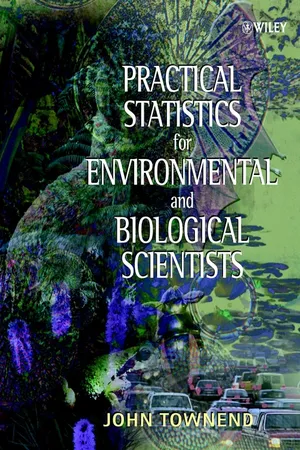
Practical Statistics for Environmental and Biological Scientists provides a concise, user-friendly, non-technical introduction to statistics. The book covers planning and designing an experiment, how to analyse and present data, and the limitations and assumptions of each statistical method. The text does not refer to a specific computer package but descriptions of how to carry out the tests and interpret the results are based on the approaches used by most of the commonly used packages, e.g. Excel, MINITAB and SPSS. Formulae are kept to a minimum and relevant examples are included throughout the text.
- English
- ePUB (mobile friendly)
- Available on iOS & Android
eBook - ePub
Practical Statistics for Environmental and Biological Scientists
About this book
Information
PART I
STATISTICS BASICS
Chapters 1 to 6 introduce the ideas behind statistical methods and how practical studies should be set up to use them. They aim to give the required background for using the methods in Part II. Readers who are new to statistics or in need of a short refresher might find it useful to read this part in its entirety.
1
Introduction
If your first love was statistics, you probably wouldn’t be studying or working in environmental or biological sciences. I am starting from this premise.
1.1 Do you need statistics?
Somebody who is trying to sell you a statistics textbook is probably not the best person to ask whether you need statistics. Maybe you have opened this book because you have an immediate need for these techniques or because you have to study the subject as part of a course. In this case the answer for you is clearly yes, you need statistics. Otherwise, if you want to know whether statistics is really relevant to you, ask people who have been successful in your chosen area – academics, researchers or people doing the kind of job you want to do in the future.
Some use it more than others, and certainly you will find some very successful people who are not confident with statistics and possibly dislike any involvement with it. I don’t believe being a brilliant statistician is a necessary condition for being a brilliant biologist or environmental scientist. However, you will probably find that most of the people you ask would have found it useful to understand statistics at some stage in their career, perhaps very regularly. Even if you do not need it to present results yourself, you will need to understand some statistics in order to understand the real meaning of almost any scientific information given to you.
The fact that most university degrees in environmental and biological sciences include a compulsory statistics course is simply a recognition of this. However, do not think that understanding statistics is all or nothing. Even a basic understanding of why and when it is used will be very valuable. If you can grasp the detail too, so much the better.
1.2 What is statistics?
Football scores, unemployment rates and lengths of hospital waiting lists are statistics, but not what we commonly think of as being included in the subject of statistics. An interesting definition I heard recently was that statistics is ‘that part of a degree which causes a sinking feeling in your stomach’. I don’t have an all-encompassing definition myself, but it will be helpful if you can keep in mind that more or less everything in this book is concerned with trying to draw conclusions about very large groups of individuals (animate or inanimate) when we can only study small samples of them. The fact that we have to draw conclusions about large groups by studying only small samples is the main reason that we use statistics in environmental and biological science.
Supposing we select a small sample of individuals on which to carry out a study. The questions we are trying to answer usually boil down to these two:
- If I assume that the sample of individuals I have studied is representative of the group they come from, what can I tell about the group as a whole?
- How confident can I be that the sample of individuals I have studied was like the group as a whole?
These questions are central to the kind of statistical methods described in this book and to most of those commonly used in practical environmental or biological science. We are usually interested in a very large group of individuals (e.g. bacteria in soil, ozone concentrations in the air at some location which change moment by moment, or the yield of wheat plants given a particular fertilizer treatment) but limited to studying a small number of them because of time or resources.
Fortunately, if we select a sample of individuals in an appropriate way and study them, we can usually get a very good idea about the rest of the group. In fact, using small, representative samples is an excellent way to study large groups and is the basis of most scientific research. Once we have collected our data, our best estimate always has to be that the group as a whole was just like the sample we studied; what other option do we have? But in any scientific study, we cannot just assume this has to be correct, we also need to use our data to say how confident we can be that this is true. This is where statistics usually comes in.
Almost all experimental results are as described above. They state what is the case in a small sample that was studied, and how likely it is to be true of the group it was taken from. Elementary textbooks often quote results leaving out any indication of how much confidence we can place in them for the sake of clarity. However, most of the results they quote originally come from papers published in scientific journals. If you look at the results presented in a scientific journal, you will see statements like:
Big gnomes catch more fish than little gnomes (P = 0.04)
The study would have been carried out using samples of big gnomes and small gnomes and the statement is really shorthand for:
- In our samples, on average, big gnomes caught more fish than little gnomes, so we expect that big gnomes in general catch more fish than little gnomes.
- Based on the evidence of our samples, we can really only be 96% confident that big gnomes in general do catch more fish than little gnomes.
You can see that the second, qualifying, statement (which comes from the P = 0.04) is really quite important to understanding what the researchers have actually shown. It is not as clear-cut proof as you might otherwise think.
We will look in more detail at how to interpret the various forms of shorthand as we go through the different statistical techniques, but notice that when the result is stated in full we have (i) a result for the whole group of interest assuming that the samples studied were representative, and (ii) a measure of confidence that the samples studied actually were representative of the rest of the groups. This point is easy to lose sight of when we start to look at different techniques.
Textbooks tend to emphasize differences between statistical techniques so that you can see when to use each. However, these same ideas lie behind nearly all of them. Statistical methods, in a wide variety of disguises, aim to quantify both the effects we are studying (i.e. what the samples showed), and the confidence we can have that what we observed in our samples would also hold for the rest of the groups they were taken from. If you can keep this fact in mind, you already understand the most important point you need to know about statistics.
1.3 Some important lessons I have learnt
Statistics as a science in its own right can be very complicated. The statistics you need to be a good environmental scientist or biologist is only a small and fairly straightforward subset of this. Even a general understanding of the basic ideas will be a great asset when you come to interpret other people’s experimental results. When you know some of the shorthand, like the example of the gnomes, you will see that very many scientific ‘facts’ are not as clear-cut and certain as we often imagine. Understanding just this already gives you statistical and scientific skills beyond those of the general public. You will quickly learn to be more discerning about what scientific ‘facts’ you really believe.
There is no denying that a skilled statistician would have methods in his or her armoury beyond those I have included in this book. There are not statistical techniques available for every eventuality, but there are techniques for a good many of them. However, it takes rather a long time to learn about them all and probably you want to get on with some environmental or biological science too. I have therefore selected in this book a range of techniques that I consider most relevant and useful, and I believe these are sufficient to allow you to conduct most types of environmental or biological study with a little careful planning. Now here’s the bit that a lot of people find difficult to grasp. The thing that separates competent environmental scientists and biologists from incompetent ones, in terms of statistical skills, is not numeracy, but careful planning. The chances are that a computer will do all of your calculations for you.
By the time you sit down at the keyboard with your data you will have already made most of the mistakes you are likely to make. Just when you think you are about to start the statistical part of your project, your part in the statistics is really coming to an end. If you have planned carefully, formed a clear idea of what you are investigating, followed the layout of appropriate examples from this or other books, and carried out your survey or experiment accordingly, the analysis and interpretation will be plain sailing. Please don’t leave all thought of statistical analysis to the point where you sit down with your data already in hand. You would be unlikely to find the analysis plain sailing then. This is an important lesson I have learnt.
1.4 Statistics is getting easier
Until the 1980s most statistical calculations were done using a pocket calculator or by hand. Nowadays almost all calculations are carried out by computer. We need only know which test to use and how to enter the data in order to carry it out. I have heard concerns that many students nowadays just quote the output without understanding it. This is probably true, but it was always thus. As far as I can see, the only difference with precomputer days is that then you would spend two hours struggling with the calculations so there was a feeling you had earned the right to give the result. I don’t believe the average user of statistics either knew or cared what the calculations were actually doing any more then than they do now.
Although I do not think that as users of statistics we need to do the calculations ourselves, we do lose a lot if we take the results without understanding anything about the methods. Until recently it was necessary to teach the calculations behind statistics because without them you could not use statistics, whether you understood them or not. To someone who is comfortable with mathematical concepts, the formulae are also a satisfactory explanation of what is going on, so teachers often believed they had covered method and understanding at the same time.
An aunt of mine used to say, ‘There are liars, damn liars and sadistics. Most of the liars and damn liars go into law or advertising so don’t bother us much, but most of the sadistics teach numeracy skills. That’s why maths and statistics are hard.’ It is my belief that because statistics has traditionally been taught as a mathematical skill, although most students got by with the methods, very few picked up the understanding along the way. There is a great challenge here for teachers of statistics. Rather than seeing the removal of the calculations as a sad loss to understanding, we should take advantage of this to try to make the meaning and value of statistics more accessible to all.
1.5 Integrity in statistics
Scientific research relies on the integrity of the people conducting the research. Most of the time, we just have to believe that researchers have been honest in their work as there is no way to tell if results have been made up. In fact, in my experience very few people do lie about the actual values they have collected, even if they are disappointing. Most scientists, I think, have a fairly strong sense of conscience. We also need to have this attitude to carrying out an appropriate statistical analysis. Some kinds of analysis are easier to do than others and some may appear to g...
Table of contents
- Cover
- Contents
- Title page
- Copyright page
- Preface
- PART I STATISTICS BASICS
- PART II STATISTICAL METHODS
- APPENDICES
- Bibliography
- Index
Trusted by 375,005 students
Access to over 1.5 million titles for a fair monthly price.
Study more efficiently using our study tools.
Frequently asked questions
Yes, you can cancel anytime from the Subscription tab in your account settings on the Perlego website. Your subscription will stay active until the end of your current billing period. Learn how to cancel your subscription
No, books cannot be downloaded as external files, such as PDFs, for use outside of Perlego. However, you can download books within the Perlego app for offline reading on mobile or tablet. Learn how to download books offline
Perlego offers two plans: Essential and Complete
- Essential is ideal for learners and professionals who enjoy exploring a wide range of subjects. Access the Essential Library with 800,000+ trusted titles and best-sellers across business, personal growth, and the humanities. Includes unlimited reading time and Standard Read Aloud voice.
- Complete: Perfect for advanced learners and researchers needing full, unrestricted access. Unlock 1.5M+ books across hundreds of subjects, including academic and specialized titles. The Complete Plan also includes advanced features like Premium Read Aloud and Research Assistant.
We are an online textbook subscription service, where you can get access to an entire online library for less than the price of a single book per month. With over 1.5 million books across 990+ topics, we’ve got you covered! Learn about our mission
Look out for the read-aloud symbol on your next book to see if you can listen to it. The read-aloud tool reads text aloud for you, highlighting the text as it is being read. You can pause it, speed it up and slow it down. Learn more about Read Aloud
Yes! You can use the Perlego app on both iOS and Android devices to read anytime, anywhere — even offline. Perfect for commutes or when you’re on the go.
Please note we cannot support devices running on iOS 13 and Android 7 or earlier. Learn more about using the app
Please note we cannot support devices running on iOS 13 and Android 7 or earlier. Learn more about using the app
Yes, you can access Practical Statistics for Environmental and Biological Scientists by John Townend in PDF and/or ePUB format, as well as other popular books in Biological Sciences & Biology. We have over 1.5 million books available in our catalogue for you to explore.