![]()
Part I
Introduction to Basic Principles of Pumps and Hydraulics
![]()
Chapter I
Basic Fluid Principles
Pumps are devices that expend energy to raise, transport, or compress fluids. The earliest pumps were made for raising water. These are known today as Persian and Roman waterwheels and the more sophisticated Archimedes screw.
Mining operations of the Middle Ages led to development of the suction or piston pump. There are many types of suction pumps. They were described by Georgius Agricola in his De re Metallica written in 1556 A.D. A suction pump works by atmospheric pressure. That means when the piston is raised, it creates a partial vacuum. The outside atmospheric pressure then forces water into the cylinder. From there, it is permitted to escape by way of an outlet valve. Atmospheric pressure alone can force water to a maximum height of about 34 feet (10 meters). So, the force pump was developed to drain deeper mines. The downward stroke of the force pump forces water out through a side valve. The height raised depends on the force applied to the piston.
Fluid is employed in a closed system as a medium to cause motion, either linear or rotary. Because of improvements in seals, materials, and machining techniques, the use of fluids to control motions has greatly increased in the recent past.
Fluid can be either in a liquid or gaseous state. Air, oil, water, oxygen, and nitrogen are examples of fluids. They can all be pumped by today’s highly improved devices.
Physics
A branch of science that deals with matter and energy and their interactions in the field of mechanics, electricity, nuclear phenomena, and others is called physics. Some of the basic principles of fluids must be studied before subsequent chapters in this book can be understood properly.
Matter
Matter can be defined as anything that occupies space, and all matter has inertia. Inertia is that property of matter by which it will remain at rest or in uniform motion in the same straight line or direction unless acted upon by some external force.
Matter is any substance that can be weighed or measured. Matter may exist in one of three states:
• Solid (coal, iron, ice)
• Liquid (oil, alcohol, water)
• Gas (air, hydrogen, helium)
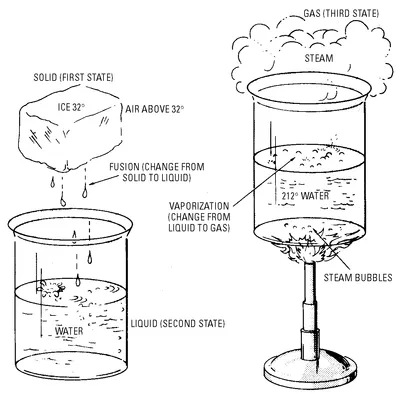
Water is the familiar example of a substance that exists in each of the three states of matter (see Figure 1-1) as ice (solid), water (liquid), and steam (gas).
Figure 1-1 The three states of matter: solid, liquid, and gas. Note that the change of state from a solid to a liquid is called fusion, and the change of state from liquid to a gas is called vaporization.
Body
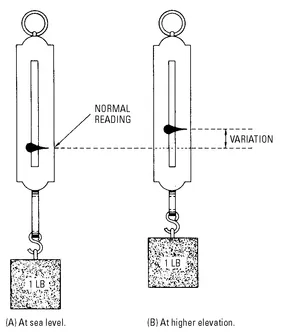
A body is a mass of matter that has a definite quantity. For example, a mass of iron 3 inches × 3 inches × 3 inches has a definite quantity of 27 cubic inches. It also has a definite weight. This weight can be determined by placing the body on a scale (either a lever or platform scale or a spring scale). If an accurate weight is required, a lever or platform scale should be employed. Since weight depends on gravity, and since gravity decreases with elevation, the reading on a spring scale varies, as shown in Figure 1-2.
Figure 1-2 Variation in readings of a spring scale for different elevations.
Energy
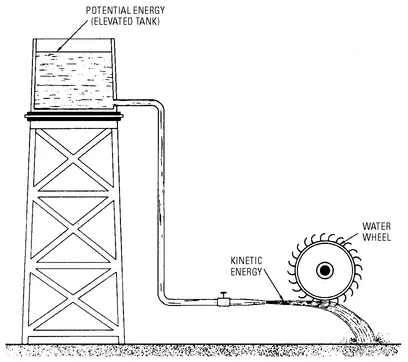
Energy is the capacity for doing work and overcoming resistance. Two types of energy are potential and kinetic (see Figure 1-3).
Potential energy is the energy that a body has because of its relative position. For example, if a ball of steel is suspended by a chain, the position of the ball is such that if the chain is cut, work can be done by the ball.
Kinetic energy is energy that a body has when it is moving with some velocity. An example would be a steel ball rolling down an incline. Energy is expressed in the same units as work (foot-pounds).
As shown in Figure 1-3, water stored in an elevated reservoir or tank represents potential energy, because it may be used to do work as it is liberated to a lower elevation.
Conservation of Energy
It is a principle of physics that energy can be transmitted from one body to another (or transformed) in its manifestations, but energy may be neither created nor destroyed. Energy may be dissipated. That is, it may be converted into a form from which it cannot be recovered (the heat that escapes with the exhaust from a locomotive, for example, or the condensed water from a steamship). However, the total amount of energy in the universe remains constant, but variable in form.
Figure 1-3 Potential energy and kinetic energy.
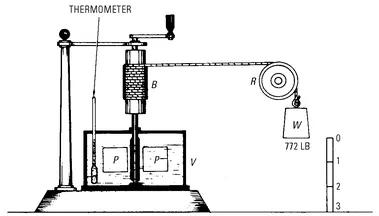
Joule’s Experiment
This experiment is a classic illustration (see
Figure 1-4) of the conservation of energy principle. In 1843, Dr. Joule of Manchester, England, performed his classic experiment that demonstrated to the world the mechanical equivalent of heat. It was discovered that the work performed by the descending weight (
W in
Figure 1-4) was not lost, but appeared as heat in the water—the agitation of the paddles having increased the water temperature by an amount that can be measured by a thermometer. According to Joule’s experiment, when 772 foot-pounds of work energy had been expended on the 1 pound of water, the temperature of the water had increased 1°F. This is known as
Joule’s equivalent: That is, 1 unit of heat equals 772 foot-pounds (ft-lb) of work. (It is generally accepted today that ft-lb. be changed to lb.ft. in the meantime or transistion period you will find it as ft-lb. or lb.ft.)
Figure 1-4 Joule’s experiment revealed the mechanical equivalent of heat.
Experiments by Prof. Rowland (1880) and others provide higher values. A value of 778 ft-lb is generally accepted, but 777.5 ft-lb is probably more nearly correct, the value 777.52 ft-lb bei...