- English
- ePUB (mobile friendly)
- Available on iOS & Android
eBook - ePub
About this book
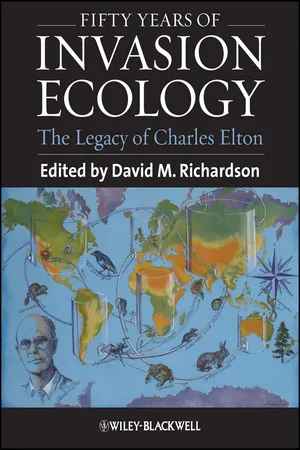
Invasion ecology is the study of the causes and consequences of the introduction of organisms to areas outside their native range. Interest in this field has exploded in the past few decades. Explaining why and how organisms are moved around the world, how and why some become established and invade, and how best to manage invasive species in the face of global change are all crucial issues that interest biogeographers, ecologists and environmental managers in all parts of the world. This book brings together the insights of more than 50 authors to examine the origins, foundations, current dimensions and potential trajectories of invasion ecology. It revisits key tenets of the foundations of invasion ecology, including contributions of pioneering naturalists of the 19th century, including Charles Darwin and British ecologist Charles Elton, whose 1958 monograph on invasive species is widely acknowledged as having focussed scientific attention on biological invasions.
Information
Part 1: Historical Perspectives
Chapter 1
A World of Thought: ‘The Ecology of Invasions by Animals and Plants’ and Charles Elton’s Life’s Work
1.1 INTRODUCTION
In this chapter, I present a personal view of the Elton canon: the body of work created by Charles Elton during his whole working life. The Ecology of Invasions by Animals and Plants (hereafter abridged as ‘Ecology of Invasions’ or ‘EIAP’) was produced something like two-thirds of the way through this long period of productivity. I suggest its origins and impacts are best appreciated when viewed as part of Elton’s overall intellectual contribution. That EIAP may be regarded as foundational to a whole subsequent field of study is indisputable (Richardson & Pyšek, 2007, 2008; but see Simberloff, this volume, for a different view) and yet, I shall show that this is only one of several highly productive and important areas of work that originated within the body of work for which Elton was responsible during his long life.
1.2 THE ECOLOGIST AND THE MAN
Charles Sutherland Elton (1900–1991) did not invent the discipline of animal ecology: that evolved from the many musings of earlier naturalists, beginning to precipitate into modern scientific form courtesy of Charles Darwin, Alfred Russel Wallace and Victor Shelford, among others. Indeed many of the concepts usually associated with Elton’s ideas had existed in more or less nascent form in earlier years. The idea of a food chain (although not the phrase) had been described well over 100 years earlier (Bradley 1718; Egerton 2007). The general notion of a pyramid of numbers or at least the underlying ‘rule of ten’ had been stated clearly and generally by Karl Semper in 1881. The broadening of these simplifications of trophic interactions into food webs began with a series of specific diagrams as early as 1912 (Pierce et al. 1912) and these early efforts are described in detail by Egerton (2007). Even the term ‘niche’, so often now eponymic with Elton, had been used by Grinnell as early as 1904 and developed significantly in his famous article on the California thrasher (Grinnell 1917). It was Charles Elton, though, who gathered up, clarified and connected these ideas into a cogent whole in his 1927 book Animal Ecology and, to my way of thinking, so set an agenda for the entire emerging field of animal ecology. It also established ecological ground rules that subsequently underpinned the emergence of formal conservation agencies in both the UK and USA.
This short text remains vital reading for all ecologists and is a model of clear thinking, pithy writing and penetrating insight. As well as incorporating the concepts already mentioned he also built substantially on Shelford’s ideas on succession within natural communities. The insights presented so well in Animal Ecology had derived from Elton’s years as a general naturalist during his youth and early adulthood in England. In addition, he had spent three very formative seasons before and after graduating from Oxford on expedition in Spitzbergen and Norwegian Lapland observing the ecological communities and animal populations in that almost canonical landscape where, perhaps, the grand patterns can be perceived more clearly because the component parts, so confusing and diverting in less extreme environments, are relatively few in number.
Elton’s career has been described at length by his thorough and sympathetic obituarists (Macfadyen 1992; Southwood & Clarke 1999). I repeat here only the observations that Elton’s scientific contributions during a long scientific career were marked by a series of contrasting but perhaps surprisingly coherent set of major books, each in itself a landmark for the developing subject. Animal Ecology (1927) was succeeded by Voles, Mice and Lemmings (1942), The Ecology of Invasions by Animals and Plants (1958) and, finally, The Pattern of Animal Communities (1966). These undoubtedly seminal contributions should, in my view, be joined by his swansong paper on tropical rainforest biodiversity published in the Journal of Animal Ecology in 1967. I shall return to this last major publication towards the end of this account.
From 1932 until his retirement in 1967, Elton worked with a small group of other ecologists and graduate students in the Bureau of Animal Population (the BAP), within but not physically part of the Department of Zoology of the University of Oxford (Crowcroft 1991). It was my privilege to join that group as a doctoral student in October 1966: one of two ‘final’ students of the BAP. I was supervised, formally, by H.N. Southern but my entry to the Bureau and progress within it were closely directed by Elton himself. Elton’s influence within the Bureau was all pervasive. A quiet, even unprepossessing, man, Elton nevertheless imposed his style and philosophy on the life of the Bureau and those of us who were part of the enterprise were willing participants in what we took to be a noble endeavour. I for one have not deviated from that view in the ensuing 40 years.
Life in the Bureau revolved around afternoon tea. Coffee was indeed taken in the mornings but was a low-key affair, usually huddled within the small kitchen. Coffee was an event of small meetings: for us students it was full of surprises. ‘Roger, I wonder if I could introduce you to our visitor … this is Julian Huxley’ was just one of several unexpected encounters, later to be treasured as an era in biology gradually passed away. But afternoon tea was of greater splendour altogether. The library of the BAP, normally open to questing undergraduates, would be closed. Elton would preside at the head of the long scrubbed table and the rest of us – staff, students, technicians, distinguished visitors and assistants – would range down either side. If there was some event to be marked, the ‘boss’ (Elton) would shyly slide a large bag of cream buns onto the table alongside the giant teapot. It was at one such event that I arrived early and discovered that, briefly at least, Elton and I were the only ones at table. ‘Tell me’, he said, ‘what do you do for exercise?’ I diffidently said that I played a little squash but his retort took me not a little by surprise. ‘I used to box, you know. I knocked a man out once’. All this presented in a quiet, near whisper and emanating from this small balding man renowned, among we postgraduates, for routinely wearing at least one of his several, concurrent, sleeveless pullovers, inside out.
Perhaps this anecdote, though, captures Elton’s intellectual impact as well as the man himself. Intellectually speaking he produced knockout blows from what some thought of as an unlikely source. Indeed his impact is, in my view, still not fully appreciated. Much later, while I was a Bullard Fellow at Harvard in 1998, Ernst Mayr, after grilling me about my intellectual antecedents actually said, ‘Ah yes, Elton … we expected so much more of him!’ It was not exactly clear in this conversation exactly who ‘we’ were but I can only say that most of the current trends in animal ecology now owe much to Elton: so pervasive are these debts that most do not question their actual foundations.
1.3 ECOLOGY OF INVASIONS IN CONTEXT
Ecology of Invasions, as much of this book testifies, is a work of lasting impact (see also Richardson & Pyšek 2008). I have heard it said that the book was ‘ahead of its time’, but this is misleading. It was, in fact, very much of its time, harking back to the very beginnings of what was then seen as the modern renaissance in biology, reviewing and critiquing the current state of play and then setting a research agenda which is, only now, receiving the attention it demands. Elton presents his thoughts in EIAP very much as part of the ecological sub-science of biogeography. It is significant that Elton begins his thesis in EIAP with a reprise of Wallace’s views of biogeography. Bear in mind that, in 1954, the prevailing paradigm in biogeography was an entirely dispersalist one. Wegener’s (1915) ideas of continental drift were still considered by most as part of the lunatic fringe (indeed, so I was taught during my undergraduate years at Imperial College as late as 1965, admittedly by a very conservative and elderly teacher). It was not until 1959 that Heezen, Tharp and Ewing first published their findings confirming the existence of the mid-Atlantic ridge which finally began the process which eventually led to mainstream acceptance of the ideas of a dynamic Earth with vicariant continents (see Miller 1983, for a full, popular account of this process). Of course, this is not to say that Elton was unaware of Wegener’s ‘crazy’ idea. According to Macfadyen (1992) he was actually a keen proponent and advocate for the ideas of vicariance.
However, in 1954, Elton stated that the set of continents was to be regarded as always having been an archipelago. Accordingly his preoccupation with natural and anthropogenic animal movement was to be seen as the very core of biogeography: spatial patterns were to be understood only by examination of past and present movements of organisms (or their ancestors) across the face of the Earth. Davis et al. (2001) draw a long bow (in my view) when claiming that the 1958 book was an entirely new direction in Elton’s work. Notwithstanding the fact that Elton’s choice for a prize before his (unsuccessful) school graduation, was a set of the works of A.R. Wallace (Southwood & Clarke 1999), his earlier works are redolent with ideas of animal movement across landscapes, and the process of what we would now call community assembly. Indeed, as pointed out by Sir Alister Hardy (1968), Elton compared the processes of dispersal among locations (Elton 1930) with the Mendelian rearrangements of genes that take place within organisms. This was part of a set of ideas in which Elton suggested that animals selecting habitats through re-location should be regarded as a complement to the environmental selection of individuals that is at the heart of ideas of natural selection. Certainly in EIAP he emphasizes the subset of species that have been particularly effective at invading new territory, especially if given a helping hand by humans. However, I suggest this is simply the spin he chose to put on this particular phase of his ongoing synthetic work rather than a new direction of thought.
Preparation for this chapter has brought me into contact with the (to me) more or less arcane activities of historians of science. Two doctoral dissertations have concerned themselves largely with the prelude to, genesis of and consequences arising from EIAP and Elton’s associated work (Cox 1979; Chew 2006). I have had access only to Chew’s work. There has been a, perhaps inevitable, hagiographic tone to most of the recent writings about Elton. Chew, though, presents his analyses as a sort of ‘anti-hagiography’ (to coin a word) belittling Elton’s achievements, originality, even the world-view of those who have created the field of invasion biology subsequent to EIAP. Of course Chew is entitled to his opinion and his accounts of the surviving private and professional correspondence of Elton, particularly with the American proto-conservationist Aldo Leopold, are both insightful and useful – even to a hagiographer!
It true to say that Elton was a man of his time and, in the English sense, of his class. He emerged from an intellectual middle-class background, grew up and lived in a time of global conflicts, and was deeply moved and changed by early personal tragedies. That all of this could be true without affecting his work is not to be imagined. Yet to suggest that a preoccupation with biotic invasions and clear contradistinctions between ‘native’ and ‘exotic’ biotas reflected both an inbuilt militarism and, even, an incipient xenophobia is, to my mind, overegging the pudding. Chew describes EIAP as ‘Elton’s idiosyncratic jeremiad’ and an ‘alarmist book’.
One other ‘yes, but …’ comment comes to my mind from Chew’s writing. He suggests that Elton ‘seldom played the public intellectual’. I suggest that this is not the case but that the public nature of Elton’s contribution – in popular writing, broadcasting and committee work – was of a different kind from that we associate with ‘public intellectuals’ currently. The social structure of intellectual life in early to mid-century Britain was both well established and formal. There remained a tendency still to speak of ‘the Universities’ – meaning Oxford and Cambridge (only) – and those who occupied senior positions within them commanded both public respect yet, themselves, followed an unwritten code of behaviour both within and beyond academe. Elton’s position as a reader within the Oxford system was senior indeed – probably most closely to be compared to a research chair currently. Accordingly, his ‘public’ impact was subtle and political rather than highly visible and vocal. I return to this point when discussing his role in the establishment of the Nature Conservancy within the UK.
Ecology of Invasions was the first of Elton’s major works that concerns itself entirely with an ecological process rather than classifying, describing and hypothesizing about the patterns he observed on the landscape. Perhaps the other outstanding and out-of-time innovation in the book is its conclusions about conservation. Conservation as an activity devoted to the preservation of natural landscapes (in contrast to the maintenance of populations of game animals for hunting) was not a mainstream activity in the early 1950s. Although advocated by Wallace as early as 1910, the British Nature Conservancy had been established only nine years before the publication of EIAP. In no small part the establishment of this body, now known as English Nature, resulted from the report of a committee of...
Table of contents
- Cover
- Companion website
- Title page
- Copyright page
- Contributors
- FOREWORD
- Introduction
- Part 1: Historical Perspectives
- Part 2: Evolution and Current Dimensions of Invasion Ecology
- Part 3: New Takes on Invasion Patterns
- Part 4: The Nuts and Bolts of Invasion Ecology
- Part 5: Poster-Child Invaders, Then and Now
- Part 6: New Directions and Technologies, New Challenges
- Part 7: Conclusions
- Index
- Color plates
Trusted by 375,005 students
Access to over 1.5 million titles for a fair monthly price.
Study more efficiently using our study tools.
Frequently asked questions
Yes, you can cancel anytime from the Subscription tab in your account settings on the Perlego website. Your subscription will stay active until the end of your current billing period. Learn how to cancel your subscription
No, books cannot be downloaded as external files, such as PDFs, for use outside of Perlego. However, you can download books within the Perlego app for offline reading on mobile or tablet. Learn how to download books offline
Perlego offers two plans: Essential and Complete
- Essential is ideal for learners and professionals who enjoy exploring a wide range of subjects. Access the Essential Library with 800,000+ trusted titles and best-sellers across business, personal growth, and the humanities. Includes unlimited reading time and Standard Read Aloud voice.
- Complete: Perfect for advanced learners and researchers needing full, unrestricted access. Unlock 1.5M+ books across hundreds of subjects, including academic and specialized titles. The Complete Plan also includes advanced features like Premium Read Aloud and Research Assistant.
We are an online textbook subscription service, where you can get access to an entire online library for less than the price of a single book per month. With over 1.5 million books across 990+ topics, we’ve got you covered! Learn about our mission
Look out for the read-aloud symbol on your next book to see if you can listen to it. The read-aloud tool reads text aloud for you, highlighting the text as it is being read. You can pause it, speed it up and slow it down. Learn more about Read Aloud
Yes! You can use the Perlego app on both iOS and Android devices to read anytime, anywhere — even offline. Perfect for commutes or when you’re on the go.
Please note we cannot support devices running on iOS 13 and Android 7 or earlier. Learn more about using the app
Please note we cannot support devices running on iOS 13 and Android 7 or earlier. Learn more about using the app
Yes, you can access Fifty Years of Invasion Ecology by David M. Richardson in PDF and/or ePUB format, as well as other popular books in Biological Sciences & Biology. We have over 1.5 million books available in our catalogue for you to explore.