![]()
1
CHROMATOGRAPHY—A NEW DISCIPLINE OF SCIENCE
Robert L. Wixom
Department of Biochemistry, University of Missouri, Columbia
Charles W. Gehrke
Department of Biochemistry and the Agricultural Experiment Station Chemical Laboratories, College of Agriculture, Food and Natural Resources, University of Missouri, Columbia
Viktor G. Berezkin
A. V. Topchiev Institute of Petrochemical Synthesis, Russian Academy of Sciences, Moscow
Jaroslav Janak
Institute of Analytical Chemistry, Academy of Sciences of the Czech Republic, Brno
An essential condition for any fruitful research is the possession of suitable methods. Any scientific progress is progress in the method.
—M. S. Tswett [3]
Science has been defined in different ways at different times. Nowadays it typically involves forming an idea of the way something works, and then making careful measurements, experiments or observations to test the hypothesis. If the evidence keeps agreeing, the hypothesis grows more believable. If even one observation contradicts it, the entire hypothesis is falsified and the search begins again. Gradual refinements of hypotheses leads to the development of a theory …. A theory is a set of hypotheses that have stood the test of time, so far at least have not been contradicted by evidence and have become extremely trustworthy….
—C. Suplee, Milestones of Science, 2000
CHAPTER OUTLINE
1.A. Introduction
1.B. Literature on Chromatography
1.C. What is Chromatography?—A Definition (by Viktor G. Berezkin)
1.D. Evaluations of Definitions
1.E. Pathways of Modern Chromatography (by Jaroslav Janak)
1.F. Some Thoughts on the Chromatographic Process (by Jaroslav Janak)
1.G. Chromatography as a Scientific Discipline—Attributes (by Robert L. Wixom and Charles W. Gehrke)
1.H. Relation of Seminal Concepts in Chromatography and the Awardees and Contributors (by the Editors)
1.I. Summary (by the Editors)
References
1.A. INTRODUCTION
Chromatography has developed over the past century [1,2] and has major input into many areas of modern science [1,2]. The main original work of M. S. Tswett was published in the book Chromatographic Adsorption Analysis [3]. For a review of the beginnings of chromatography, see the description of the “pioneer of chromatography,” Mikhail Semenovich Tswett, born of an Italian mother and Russian father in Italy (1872), educated in Switzerland in botany, and his later research on plant pigments—all of which led to his fundamental development of adsorption chromatography [1,3]. K. I. Sakodynskii made also a great contribution to the research and description of M. S. Tswett’s life [4,5]. A special reference is made to the book Michael Tswett—the Creator of Chromatography, published by the Russian Academy of Sciences, Scientific Council on Adsorption and Chromatography (2003) [6]. The book was released on the occasion of the 100th anniversary of the discovery of chromatography and is consulted by a wide range of readers interested in the history of science and culture. The book is a study of the famous Russian researcher Michael Tswett (1872-1919)—the creator of the method of chromatography, which is now widely used both in science and technology. Finally, it was the merit of Eugenia M. Senchenkova, an associate of the S. I. Vavilov Institute of the History of Science and Technology of the Academy of Science in Moscow, who compiled the life story of Tswett into a book [6].
Later contributions in adsorption chromatography were made by the pioneers: Leroy S. Palmer (1887-1944) at the University of Missouri, Gottfried Kränzlin (1882), Theodor Lippmaa (1892-1944), and Charles Dhére (1876-1955) [1, Chaps. 1, 2]. Later three Nobel Prizes in Chemistry were awarded to five Nobel Laureates in Chemistry for their research in chromatography; these discoverers of chromatography in science were Arne W. Tiselius, Archer J. P. Martin, Richard L. M. Synge, Stanford Moore, and William H. Stein (see Chapter 3). The subsequent advances by Richard Kuhn and several other Nobel awardees are also described in Chapter 3.
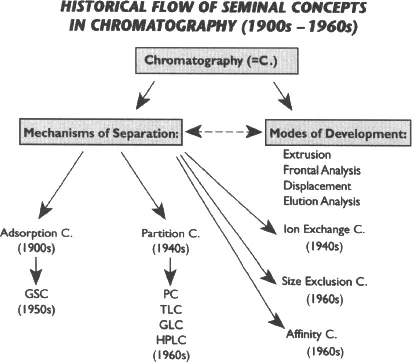
Most readers are familiar with the subsequent development of partition chromatography (liquid-liquid partition chromatography and gas-liquid partition chromatography), paper chromatography, thin-layer chromatography, and ion-exchange chromatography [1, Chap. 1]. This detailed knowledge led to the sketch of historical relationships (shown in Fig. 1.1).
Over subsequent years, the subject of chromatography has become prolific with respect to the number and variety of papers published. A brief reference to the earlier seminal concepts (see Section 1.H) in the current report will assist in building the needed bridge of communication.
1.B. LITERATURE ON CHROMATOGRAPHY
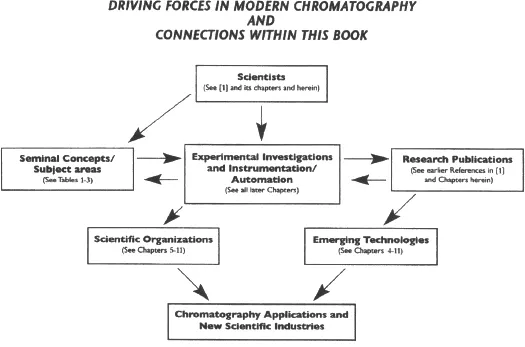
Books, to be understandable, need to be written in a linear pattern—paragraph by paragraph, chapter by chapter. However, the complexity of history, whether for chromatography or other subjects, requires the depiction of overall relationships, such as shown in Fig. 1.2.
Such close coherence or limited association persists for multiple investigations, many institutions, many professional societies [1, Chap. 3], and the many journals of original papers, abstract journals, review journals, books, and trade journals. For a detailed guide to the now very extensive field of chromatography literature, see Section 1.G in Ref. 1, the Appendixes in Ref. 7, and Ref. 8.
1.C. WHAT IS CHROMATOGRAPHY?—A DEFINITION
Figure 1.1 suggests that chromatography is a collection of methods. Yes, there is a considerable overlap and transfer of procedures, equipment, and instruments. Hence some scientists consider information on chromatography as a “branch of science” as described in Table 1.1 (definitions 1 and 2). Does that description suffice? No, as it does not answer the question of definition. A clear definition of the scientific content of any vigorously developing scientific field is an important condition for revealing its principal features, major results of its development and structural evolution, including delineation of its boundaries [9]. Solving this problem is complicated by the fact that chromatography, like most other scientific disciplines, is continuously evolving. The most widespread definitions of chromatography, unfortunately, are not adequate. Therefore, it is the principal task of this section to elaborate a new definition of contemporary chromatography.
TABLE 1.1. Definitions of Chromatography
Source: V. G. Berezkin [9].
1. Chromatography is a physical method of separation in which the components to be separated are distributed between two phases, one of which is stationary (stationary phase) while the other (the mobile phase) moves in a definite direction [10].a | IUPAC, 1993, International Commission [10] |
2. Chromatography is a: (a) Science of intermolecular interactions and transport molecules or particles in a system of mutually immiscible phases moving relative to each other. (b) Process of multiple differentiated repeated distribution of chemical compounds (or particles), as a result of molecular interactions, between mutually immiscible phases (one of which is stationary) moving relative to each other leading to formation of concentration zones of individual components of original mixtures of such substances or particles. (c) Method of separation of mixtures of substances or particles based on differences in velocities of their movement in a system of mutually immiscible phases moving relative to each other [11].b | Scientific Council on Chromatography (Russian Acad. Sci.), 1997, National Commission [11], V. A. Davankov (Chair) |
3. Chromatography is a scientific discipline (scientific field) that investigates formation, change, and movement of concentration zones of compounds (particles) of a studied sample in a flow of mobile phase, moving under conditions of interphase exchange relative to another (stationary) phase with sorption and/or sieve properties. A variant in separation is the use of selective influence on components of the analyzed mixture by one or a number of force fields [9]. | V. G. Berezkin [9] |
4. For a modified definition of chromatography by the Editors, see the text in Section 1.D. | The Editors |
Chromatography was realized for the first time as an analytical “technological” process over a hundred years ago, but only in the more recent decades, investigators have noticed that many natural processes are, in fact, chromatographic. However, up to now, there is no commonly accepted logically valid definition of chromatography, although, as Socrates noted, “Precise logical definitions of concepts are the most essential conditions of true knowledge” [9]. Figuratively speaking, a definition is the shortest and, simultaneously, the most comprehensive characteristic of a given concept. Therefore, the best answer to the question “What is chromatography?” is primarily its definition [9].
On the basis of recommendations for cons...