eBook - ePub
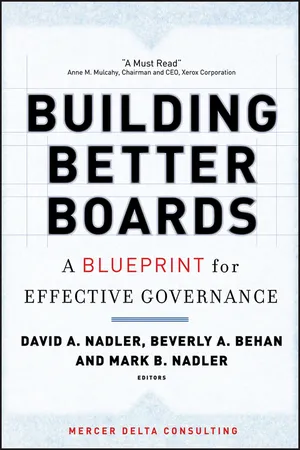
Building Better Boards
A Blueprint for Effective Governance
- English
- ePUB (mobile friendly)
- Available on iOS & Android
eBook - ePub
Building Better Boards
A Blueprint for Effective Governance
About this book
Praise for Building Better Boards "Building Better Boards bridges the gap between talk and action. A must-read for board members, CEOs, governance experts - really for anyone who cares about the future of the corporation." Anne M. Mulcahy, chairman and CEO, Xerox Corporation "Building Better Boards covers all the key issues facing boards in the post-Sarbanes-Oxley era. It provides practical advice based on the authors' wide-ranging experience with major companies that have built successful boards." Marty Lipton, Wachtell, Lipton, Rosen Roger W. Raber, president and CEO, National Association of Corporate Directors "This book provides a comprehensive review and effective guide to making any board an effective team, and thus an asset, for their company." Richard H. Koppes of Counsel, Jones Day, and former general counsel, CalPERS "A balanced, insightful, thoughtful, and, above all, useful look at what can be done to create excellent boards." Edward E. Lawler III, director, Center for Effective Organizations, Marshall School of Business, University of Southern California "Improving board effectiveness is easier said than done. Building Better Boards lays out the how-tos in a clear and compelling way that is of practical value for directors and CEOs alike." Kenneth W. Freeman, former chairman and CEO, Quest Diagnostics Inc.
Information
PART ONE
Board Leadership and Dynamics
CHAPTER ONE
A Blueprint for Building Better Boards
David A. Nadler Mark B. Nadler

That pretty well sums up the low esteem in which boards have been held over the years. It certainly captures the disdain harbored by many CEOs who viewed their boards as inconsequential at best, and at worst, as meddlesome obstacles to the efficient exercise of executive power. The possibility that boards might actually contribute some element of value just didn’t factor into the equation.
It’s time for some new math.
Today, boards have reached a historic fork in the road. In the wake of an unprecedented series of corporate scandals in both the United States and Western Europe, maintaining the status quo simply isn’t an option. We’ve known for years that traditional boards were generally passive, compliant, and unproductive assemblages of individuals who would gather periodically to rubber-stamp the CEO’s edicts. It turns out that was the best scenario. The corporate scandals of recent years aimed the spotlight on one board after another where the pervasive cronyism, cowardice, and collusion produced a toxic combination of sloth and sleaze. Those revelations, and the public demand for corporate reform, are forcing boards to look in the mirror and ask themselves profound questions about what role they should play in governing their organizations and how to constructively manage the shifting balance of power between the board and the CEO.
Every board faces a choice. On one hand, they can take the path of least resistance—minimal compliance with the new technical requirements imposed by legislators and stock exchanges. To be sure, compliance is important, but in our view it represents nothing more than the lowest common denominator of sound governance, a corporate version of the Hippocratic oath: “Above all, do no harm.”
Our firm belief—and the premise of this book—is that directors and CEOs should choose the more difficult but ultimately more rewarding path of building better boards that actually contribute substantial value to the organizations they serve and the shareholders they represent.
It’s easy to understand the overwhelmingly legalistic thrust of the so-called reforms enacted in recent years. Yet, although they might provide comfort to those whose main concern is ensuring that boards do no harm, they do little to help boards create value. Transparency in financial reporting, appropriate expertise on the board audit committee, and an explicit code of ethics represent little more than the “table stakes” of adequate governance; they’re aimed at forcing boards to meet the basic legal requirements they should have been living up to all along. There’s no added value in any of that.
Now, as CEOs experience a diminution of their “imperial” powers and boards contemplate the best way to fill the leadership vacuum, there’s a unique opportunity for directors to commit themselves to a higher standard of performance. We are absolutely convinced that active and appropriately engaged boards, drawing on their members’ collective experience, insights, and intellect, can partner with senior management in an environment of constructive contention to produce better decisions than management would have made on its own.
Here’s the rub: boards can do that only if they learn to operate as high-performance teams, a role that represents a fundamental, even radical, departure from their deeply entrenched customs and practices. As we’ll explain throughout this book, building a better board is a transformational exercise, one specifically designed to overcome the inherent and powerful obstacles to the board’s capacity to function well as a team. Our goal here is to provide a blueprint for doing just that: for creating boards composed of the right people using the right processes to do the right work in an environment shaped by the right culture.
Here’s an example of what we mean by boards adding value.
Henry Schacht, the retired chairman and CEO of Lucent Technologies, recalls that when Lucent was spun off by AT&T in 1995, the new company set up shop in the Bell Labs headquarters, a serviceable but somewhat outdated building that had seen better days. Schacht, something of an architecture buff, asked world-renowned architect Kevin Roche to begin working on plans for a brand-new headquarters building. After months of planning, Schacht proudly took his proposal to the Lucent board, which essentially asked him if he was out of his mind in light of all the other issues Lucent was dealing with at the time. “You know what? They were right,” Schacht told us later. “We had a tough discussion, and we ended up making a different decision than I would have made on my own, and that’s a good thing. That’s an operational definition of value-added.”
It’s more than an academic question to ask how much value Enron’s board would have contributed if it had questioned the bewildering off-the-books partnerships management was creating, or if WorldCom’s board had halted top management’s questionable accounting practices or loans to themselves, or if Disney’s board had exercised some control over Michael Eisner’s hiring and firing of top executives, or if Time-Warner’s board had stood up to Gerald Levin and blocked the merger with AOL, a move that ultimately erased more than $200 billion in shareholder value.
In each of those cases, the board not only failed to add value, it even failed to preserve value. The good news is that in recent years we’ve seen more and more opportunities where boards have been adding value—at TRW, for instance, where the board stepped in and held the company together following the new CEO’s sudden departure to Honeywell; at Lucent, where the board prevented Schacht’s successor from making a series of potentially disastrous acquisitions; at Best Western International, where a badly fragmented board came together to block the CEO’s proposed spin-off of the company’s non-U.S. operations and then took an active role in working with management to rethink the strategy, design robust new performance metrics, and reshape the corporate culture.
THE DUELING PHILOSOPHIES OF GOVERNANCE
Just to be clear: the idea that boards can be a source of value isn’t new. There’s long been a school of thought that the board—or more specifically, its individual members—might constitute a resource. Through their personal networks, directors could help the company establish contact with new customers or partners, tap into new sources of capital, or gain a foothold in new markets or technologies. Ideally, some directors might actually provide the CEO with sound advice and wise counsel from time to time.
But the resource perspective has traditionally taken a distant backseat to the prevailing view that the board’s central purpose is control—to act as a watchdog to make sure that the shareholders aren’t robbed blind by “the agency,” the hired managers who run the company. The control perspective has provided the philosophical underpinnings for the governance reform movement in the United States. That movement surfaced quietly in the late 1980s, then took on new urgency with the boardroom revolts of the early 1990s, which saw the ouster of CEOs at iconic U.S. institutions such as General Motors, American Express, and Kodak. Shareholder activism gained momentum throughout the 1990s, fueled by the manic merger and acquisition activity that resulted in so many ill-considered, poorly executed deals that erased billions of dollars of shareholder wealth.
And then came the opening years of the new century. The tech bubble burst, the post-9/11 economy went into a tailspin, and the unraveling of artificially inflated corporate results revealed an alarming pattern of questionable business schemes, fraudulent accounting practices, and appalling management excesses. At first, the unprecedented scandals seemed to be a U.S. phenomenon, involving a nowfamiliar list of corporate culprits—Enron, Tyco, WorldCom, Adelphia, Rite-Aid, HealthSouth, and Hollinger, to name a few. But Europe saw its own share of scandals at leading companies such as ABB, Skandia, Ahold, and Parmalat, while Canada added Nortel to the list.
Society’s ire was targeted both at the CEOs who had abused their positions, either for financial gain or personal aggrandizement, and at the boards that had failed to stop them from running amok. It seemed that one board after another had either been bedazzled by a larger-than-life CEO, befuddled by business schemes they barely understood, or simply were asleep at the switch.
The response was swift and harsh, and it clearly reflected the control theory advocated for years by self-described governance watchdogs. The Sarbanes-Oxley legislation and the new listing requirements adopted by the New York Stock Exchange and Nasdaq had one clear purpose: to impose new structures and formal procedures that would minimize opportunities for financial mismanagement and conflicts of interest. Nearly all the reforms were about maintaining tighter control through tougher oversight.
At one level, it’s hard to argue that reforms weren’t needed. No one disputes that the governance process was badly broken at some companies. Yet so much of the public discourse and institutional response to the governance crisis has been shaped by the control theory and fixated on legal compliance as the source of good governance. For us, that creates some real concerns.
First, we reject the underlying notion that you can legislate board effectiveness. You can’t mandate independent judgment, intellectual curiosity, constructive dissent, broad participation, or any of the other hallmarks of truly great boards. To quote Bill George, the highly respected retired CEO/chairman of Medtronic, Inc., “A lot of people who have not served on the inside think the reforms can be imposed from the outside. These are necessary, but not sufficient conditions for good governance.”2
Second, the governance reform dogma rests on some shaky articles of faith; for example, the conventional wisdom is that boards dominated by a majority of independent directors are superior to those that aren’t. In fact, a widely cited meta-analysis of fifty-four different studies “showed no statistical relationship” between board independence and company performance.3 The same holds true of splitting the chairman and CEO roles, an arrangement that prevails in the United Kingdom and Canada but is still resisted by more than 70 percent of U.S. boards. There are good arguments for both models, but no clear evidence that bifurcating the roles results in better performance. In fact, a recent study by Booz Allen Hamilton found that companies in both North America and Europe in which the roles were split actually averaged lower returns for investors.4
Third, the obsession among some governance watchdogs and journalists with the technical aspects of corporate reform perpetuates a “governance by the numbers” mind-set that directs attention away from the most meaningful elements of sound governance. Take Business Week’s annual ranking of the “Best and Worst Boards,” which is partly based on a point system that rewards compliance with various good governance criteria. Using those standards, both Sunbeam (1997) and Lucent (2000) made the list of best boards just as their CEOs were driving them to the brink of disaster. Yet Apple Computer was named one of the worst boards in 2002 because CEO Steven Jobs flunked Business Week’s requirement for purchasing his own company’s stock—although Jobs somehow went on to mastermind one of the most stunning turnarounds in recent corporate history.
Perhaps the most extreme example of governance by the numbers is the continuing campaign to have Warren Buffet, perhaps America’s most astute investor, removed from the Coca-Cola board’s audit committee. The argument goes that Buffet, the chairman of Berkshire Hathaway, can’t properly represent Coke’s shareholders because two of Berkshire’s units have purchased $185 million in Coke products. The implication that Buffet is somehow a management stooge who can’t look out for the shareholders’ best interests ignores the fact that Buffet’s company is itself Coke’s biggest shareholder (owning stock valued at more than $8 billion) or that Buffet personally played a key role in the board’s ouster of CEO Douglas Ivester. The campaign defies logic and common sense, but it illustrates the dangers of the watchdog mind-set at its most rigid and unreasonable.
Our fourth concern is that the new regulations may be forcing boards to spend disproportionate time on activities that aren’t likely to create value. Our own research, for example, found that more than 40 percent of directors feel they’re now spending more time on compliance and less time on corporate strategy.5 We’re also finding the Sarbanes-Oxley reporting requirements shower directors with more financial data than they can possibly put to good use, exacerbating the growing concern that directors are choking on meaningless data but starved for useful information.6
Our final concern is that a narrow focus on compliance can actually prove dangerous if it creates a false sense of security. There’s a risk that far too many companies will spend way too much time and money convincing themselves and their shareholders that they have created good governance when, in point of fact, they’ve done little to reduce the risk of meltdowns or improve their leadership and governance. It’s all too easy to have good governance on paper and bad governance in practice; let’s...
Table of contents
- Title Page
- Copyright Page
- Foreword
- Preface
- PART ONE - Board Leadership and Dynamics
- PART TWO - Critical Areas of Work
- PART THREE - Emerging Issues Outside the United States
- Conclusion
- Appendix: 2004 NACD Blue Ribbon Commission on Board Leadership
- Notes
- References
- Acknowledgments
- The Authors
- Index
Trusted by 375,005 students
Access to over 1.5 million titles for a fair monthly price.
Study more efficiently using our study tools.
Frequently asked questions
Yes, you can cancel anytime from the Subscription tab in your account settings on the Perlego website. Your subscription will stay active until the end of your current billing period. Learn how to cancel your subscription
No, books cannot be downloaded as external files, such as PDFs, for use outside of Perlego. However, you can download books within the Perlego app for offline reading on mobile or tablet. Learn how to download books offline
Perlego offers two plans: Essential and Complete
- Essential is ideal for learners and professionals who enjoy exploring a wide range of subjects. Access the Essential Library with 800,000+ trusted titles and best-sellers across business, personal growth, and the humanities. Includes unlimited reading time and Standard Read Aloud voice.
- Complete: Perfect for advanced learners and researchers needing full, unrestricted access. Unlock 1.5M+ books across hundreds of subjects, including academic and specialized titles. The Complete Plan also includes advanced features like Premium Read Aloud and Research Assistant.
We are an online textbook subscription service, where you can get access to an entire online library for less than the price of a single book per month. With over 1.5 million books across 990+ topics, we’ve got you covered! Learn about our mission
Look out for the read-aloud symbol on your next book to see if you can listen to it. The read-aloud tool reads text aloud for you, highlighting the text as it is being read. You can pause it, speed it up and slow it down. Learn more about Read Aloud
Yes! You can use the Perlego app on both iOS and Android devices to read anytime, anywhere — even offline. Perfect for commutes or when you’re on the go.
Please note we cannot support devices running on iOS 13 and Android 7 or earlier. Learn more about using the app
Please note we cannot support devices running on iOS 13 and Android 7 or earlier. Learn more about using the app
Yes, you can access Building Better Boards by David A. Nadler, Beverly A. Behan, Mark B. Nadler, David A. Nadler,Beverly A. Behan,Mark B. Nadler in PDF and/or ePUB format, as well as other popular books in Business & Leadership. We have over 1.5 million books available in our catalogue for you to explore.