eBook - ePub
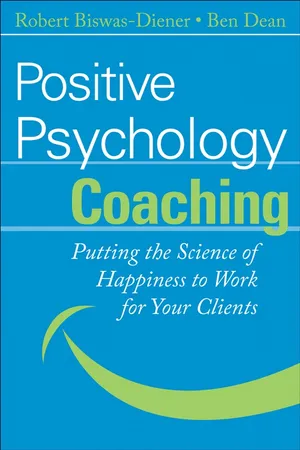
Positive Psychology Coaching
Putting the Science of Happiness to Work for Your Clients
- English
- ePUB (mobile friendly)
- Available on iOS & Android
eBook - ePub
Positive Psychology Coaching
Putting the Science of Happiness to Work for Your Clients
About this book
Positive psychology moves psychology from a medical model toward a strengths model to help clients shore up their strengths and thereby lead happier, more fulfilling lives. Positive Psychology Coaching: Putting the Science of Happiness to Work for Your Clients provides concrete language and interventions for integrating positive psychology techniques into any mental health practice.
Information
CHAPTER ONE
The Coaching Paradox and the Positive Psychology Solution
Coaching, as a profession, is at an exciting turning point. The work of the brave and talented people who pioneered the field has finally paid off: Coaching is widely accepted as an important tool in the business world, coach training programs are improving their curricula in an effort to meet more rigorous standards for credentialing, and private practices are flourishing. Even universities are beginning to take notice of our profession, and graduate degree and certificate programs in coaching are popping up on several continents. The tiresome days of explaining the difference between athletic coaching and working as a personal change agent are rapidly drawing to a close. We, as coaches, are no longer struggling to find basic acceptance as a legitimate profession. In so many ways, we have arrived, and it feels good. It feels good to open major newspapers and see articles on the benefits of coaching and profiles of leading coaches. We experience vicarious pride when we see the success of our peers who design and implement coaching workshops for organizations, or witness the financial success of a colleague. It can be tremendously rewarding to speak with enthusiastic new students in coach training programs, a sign that our profession is growing. At last, we can bask in the same optimism that we attempt to instill in our clients.
Yes, we have finally arrived. But, now that we are here, what are we going to do? As a group of individuals and as a profession, we are just too energetic, too dynamic, and too motivated to sit idly for long. You probably recognize that achieving one goal, while cause for celebration, also clears the way to begin working toward the next. Change is inevitable, and what could be more interesting than considering the ways in which coaching might change over the next decade? In which directions coaching might move, and how our interventions and services might evolve in the near future. The possibilities are fascinating to consider. Advances in technology, for instance, will undoubtedly affect the professional tides. Similarly, widespread public understanding and acceptance of the coaching endeavor and its many benefits will impact our chosen vocation in exciting new ways, as will breakthroughs in psychological research. The field of psychology, our professional cousin, is a wonderful resource for sophisticated assessments, clever interventions, and research validation that can—and will—advance our work by leading to better service and “proof” that coaching works. This book describes one such breakthrough—the new field of positive psychology—and explains the many ways in which positive psychology can inform coaching practices of all kinds. Positive psychology is the first of many stimulating answers to the question: “Where do we, as a profession, go from here?”
Coaching has long been a powerful force for transformation in people’s lives. Whether conducted with executives, schoolteachers, graduate students, work-from-home Internet entrepreneurs, or small business owners, coaching is about harnessing the best in people and inspiring them to live out their potential. Coaching is a wake-up call, challenging folks to tap their inner abundance. Because of this natural leaning toward positivity, growth and optimism coaching has attracted practitioners who value service work and clients who are achievement oriented. If you consider the ways in which you and your clients are similar, it is likely that placing a premium on self-growth is one area of common ground. Those of us who have worked with or worked as coaches recognize the frequent times in sessions when a self-imposed limit is lifted, when an “aha” moment is reached, or when we catch an emotional second wind. These are the gems of coaching and, when coaching is done well, they tend to be common. It is this proof of positive change in action that makes coaching a worthwhile endeavor for both the practitioner and the client.
But beneath this veneer of positivity and effectiveness, there is an irony in the profession that we think of as the coaching paradox: For a profession that systematically helps people aspire to and reach their innate potential, coaching has not yet reached its own potential. In fact, although coaching—in its modern form—is a couple of decades old, it is still in its relative professional infancy. Indeed, the hallmarks of youth are readily apparent. Coaching lacks a coherent, widely agreed on definition, coach training varies in content (although less now than in recent years), and coaching interventions differ greatly. Some coaches work with inspirational stories and games, others rely heavily on assessments, and still others focus on goals and behaviors. In short, coaching is still a broadly defined endeavor in need of refining. The profession of coaching is fortunate to have so many skilled and imaginative people working toward this end. But our chosen line of work needs more than isolated breakthroughs and good ideas that are implemented in only a handful of private practices. Coaching is just too good to be undermined by a sense that we are “winging it.” Our professional service—whether it takes the form of executive, entrepreneurial, or life coaching—will improve when we develop an agreed on definition for coaching and systematic sharing of the high quality interventions in our craft.
To be sure, progress has been made in these areas. The International Coach Federation (ICF), the largest governing body of the profession, has made gains in establishing both a code of ethics for practice and standards for the training of new coaches. Steve Mitten, former president of the ICF, made the professionalization of coaching a major part of his presidential platform. Mitten was invested in establishing coaching as a bona fide profession, with clear standards for training and practice.1 Similarly, in England, members of the British Psychological Society have formed a special working group to advance a program of coaching psychology. 2 Despite this forward progress, even seasoned coaches agree that the profession is in its formative stages. Carol Kaufman, for instance, a coach and psychologist at Harvard’s medical school, distinguishes between “first and second generation coaching.”3 The first generation of coaches, according to Kaufman, was made up of the visionary and courageous individuals who helped to establish their services as a viable enterprise. Now, says Kaufman, we are on the brink of the second generation of coaching, in which the discipline needs to grow through the development of explicitly defined theories of human development and research on coaching effectiveness. Just as medicine has advanced through the discovery of viruses and the use of antibiotics, coaching is ready for sophisticated theories and exciting new interventions.
One of the recent pushes toward the development of a more mature coaching profession has been increased attention to the many benefits of science. In 2003, Anthony Grant, a coach who teaches at the world’s first university-based coaching psychology program in Sydney, Australia, issued a call to ICF members to turn to science as a method and body of knowledge to help guide practice.4 The ICF responded by sponsoring annual research symposia, in which the scientific method was used to investigate issues ranging from the effectiveness of working with cultural minorities to understanding client perceptions of coaching.5 In later years prominent coaches such as Diane Stober6 and W. Barnett Pearce7 have echoed the original call to embrace research as a powerful tool to improve the practice and effectiveness of coaching. In 2006, ICF president Pamela Richarde spoke with the heads of Accredited Coach Training Organizations (ACTO), reaffirming the organization’s commitment to supporting a research program on coaching.8 Similarly, psychologists and coaches in London, Sydney, Philadelphia, and New York have looked at the role of science in coaching by forming special coaching psychology task forces, hosting academic conferences, launching peer reviewed journals, and developing university-based curricula. Simultaneously, professional books on evidence-based coaching or those adapting well-researched psychological theories and techniques have begun appearing. If these trends are any indication of the direction in which coaching is moving, it is reasonable to assume that at least one arm of the profession, in the future, will be scientifically grounded coaching, in which many practitioners will have graduate degrees from accredited universities, and in which many clients will want to see empirical validation of coaching services. We do not mean to imply that this is the only direction in which the coaching profession will evolve, but this is one likely route. Regardless of the background of individual coaches, now or in the future, it is certain that those on the cutting edge of science will have additional tools in their professional toolboxes.
In this book, we propose that the dynamic new field of positive psychology—described in detail next—is a branch of science that shows tremendous potential as a natural interface with the profession of coaching. Because it is grounded in sophisticated scientific methodology, positive psychology offers an answer to the call for an increased role of research in coaching. What’s more, as an applied science, positive psychology offers theories, interventions, and assessments that form a valuable addition to current coaching tools. Among the most elegant aspects of a marriage of coaching and this new science is the fact that positive psychology is not dogmatic, proprietary, or incompatible with existing approaches to coaching. Positive psychology is a body of theory, research, and practical tools that can be added to any coaching practice, regardless of theoretical orientation, or whether you conduct life coaching or work with executives. Further, we argue here that such an addition is good for individual coaches as well as for the profession as a whole.
Although we are attracted to the creativity that permeates the profession of coaching, we argue that the movement toward empirically-based interventions and solid theoretical frameworks for practice is in the best interest of both individual practicing coaches and the coaching profession. Coaches Dianne Stober and Anthony Grant argue that such a trend will boost the credibility of the profession and provide the foundation for higher quality coach training.9 We live in an age where science is the pre-eminent system of inquiry. The claims of science are testable, and the results of careful studies are both replicable and generalizable. Because the scientific method is so widely accepted, coaching practices that are grounded in science will be easier to “sell” to a skeptical public or potential clients, and especially to organizations that want reassurances that the service will be effective. Susan David, founding member of Evidence Based Psychology, a consultancy firm with corporate clients in the United States, Australia, and Asia, encourages coaches to set their services on a foundation of solid empiricism. “Companies and executives have gotten savvier when talking about psychological topics,” she told us in a recent interview. “It makes sense to them that mood can affect worker performance. The people I deal with at pharmaceutical companies and accounting firms ask intelligent questions about the research behind my services, and I have to be ready with answers.” Our prediction is that coaches who can honestly claim to work from a foundation of the latest scientific research and theory will have a tremendous market advantage over their peers. Not only will prospective employers look favorably on them, they will enjoy the comfort of knowing that their interventions are tested, effective, and—where possible—appropriate to their unique client base. The addition of a scientific basis to coaching is one of the greatest potential growth areas for second-generation coaches.
The importance of science to our field was recently noted in a dramatic way by Jim Clifton, the CEO of the Gallup Corporation, the company famous for its polling services. In late 2005, Clifton addressed a large group of psychologists and coaches at a meeting at the Gallup office in Washington, DC. Clifton has a sharp mind and a flair for strong, provocative words. “Gallup uses positive psychology,” he began, “because positive psychology works. If the data showed that yelling at my employees was more effective, then I would do that instead.”10 Regardless of how literally Clifton intended this statement to be taken, his point was clear: Businesses and other clients want to invest in workshops, trainings, and services that work. They want proof that the methods and assessments they buy are actually valuable, and not simply the flavor of the month. In this way, coaches can make science, and psychological science in particular, work for us as we develop our profession.
What might a scientifically driven coaching practice look like? Anthony Grant and others originally trained in clinical psychology have pointed to the “scholar-practitioner” model in which most psychologists are trained.11 In this educational model, students are taught to design research studies, analyze statistics, and evaluate the relative merits of other people’s research in addition to developing clinical acumen. The underlying rationale for this model is that graduates will enter the workplace as informed consumers of the research that guides their own clinical practices. Unfortunately, as sensible as this strategy is for psychologists, it is not easily applicable to coaching. Many coaches do not have a background in research methods or statistics, nor a background in psychology, and an emphasis on these skills is unlikely to have newcomers flocking to our profession. Although it is likely that in the future many coaches will hold master’s degrees in coaching psychology from major universities, it seems doubtful that in the short term all coaches—or even the majority of coaches—will have a background in psychology. Therefore, evidence-based coaching ought to rest on the aspects of science that are accessible to coaches of diverse educational backgrounds. We have identified three areas in which coaches of any educational or professional background can easily employ science:
1. Survey readings of relevant background material could greatly benefit coaches. We have great faith in the intelligence of coaches and believe that they can easily understand versions of major studies. This allows for the fact that not everyone attracted to the profession thinks in the rigorous, questioning way common to researchers. For those with a primary interest in the direct contact with clients and an emphasis on the service aspect of the work, a general familiarity with relevant background research is probably adequate. But basic knowledge of the scientific literature may also be necessary. In our experience, the most innovative coaches are those individuals who challenge themselves by reading and learning about the change process. Whether it is essays by Abraham Maslow, leadership books by Robert Quinn, or professional journal articles, keeping up with major theories and new interventions gives coaches a competitive edge. We encourage coaches of all stripes and persuasions to become acquainted with the relevant psychological research literature, if even in a cursory way. We encourage you to extend this learning well beyond the covers of this book and into other informative domains such as trusted web sites and professional journals.
2. The second natural intersection of science and coaching is to be found in well-validated measurement tools. Empirically validated and widely used assessments can be enormously useful to coaches. Many coaches are already familiar with tools like the Myers-Briggs Type Indicator (MBTI) and Firo-B, and know that these instruments can help the work of coaching in important ways. But, formal measures of personality, ability, preferences, and other related assessments have historically been the domain of psychologists—created by psychologists, administered by them, and interpreted by them. In addition to the information they provide, formal assessments can be interventions when they are used to identify strengths or areas needing attention, and they can also guide practice by measuring outcomes of interest. Although it is true that many coaches currently use some stock-in-trade assessments, such as the MBTI, many coaches are unaware of other useful measures available to them, including many that are easy-to-take, easy-to-interpret, and free of charge.
3. Research is fundamentally important to coaching because it can provide a basis for evaluating interventions. Studying the nuts and bolts of our actual work can tell us much about why certain interventions work, when they work, and with whom they are most effective. Take, for instance, the research conducted by Suzy Green on the effectiveness of Solution-Focused Life Coaching, in which she and her colleagues found that coaching produced appreciable gains in hope, happiness, and goal striving for the clients in their study. 12 Without this kind of careful, systematic evaluation of our interventions, coaching is reduced to a series of well-meaning hunches and guesswork. Knowledge of the empirical underpinnings of interventions actually allows coaches to break out of a one-size-fits-all mindset. Results from studies can tell us how gender, culture, or educational background might play an important moderating role in the coaching process. Familiarity with such research makes coaches both responsible and increasingly competitive. Science can help us understand the nuances of interventions, an awareness that might separate good coaches from great coaches.
Science is much more than artificial laboratory studies and boring, structured results. The scientific process includes the development, testing, and revision of important theories. Now, at a time when the coaching profession is growing—both intellectually and in terms of number of practitioners—theoretical foundations for practice are more necessary than at any point in the profession’s history. Theoretical orientations are world-views that guide practice. For example, the “medical model,” an orientation subscribed to by most modern doctors, holds that a physician’s job is to diagnose illness, discover the cause of the symptoms, and develop and implement treatments. While there is no question that modern medicine under this model has produced amazing gains in the treatment of illness it is also unclear whether this is the best, or only, way to look at the mission of doctors. For example, Albert Schweitzer, the Nobel Prize-winning medical missionary, often spoke of his desire to collaborate with patients in an effort to “awaken the healer within.” We suggest that the underlying view of our work is as important as the practical strategies of coaching itself, and encourage coaches to continually evolve their own theories of change and human nature. Unfortunately, although coaches share, at the broadest level, a common vision of coaching as including a focus on helping clients achieve their goals, there is much that remains uncertain about our task as facilitators of change. What is the best way to ...
Table of contents
- Title Page
- Copyright Page
- Introduction
- Acknowledgements
- CHAPTER ONE - The Coaching Paradox and the Positive Psychology Solution
- FOUNDATION I - Happiness and Positivity
- FOUNDATION II - Character Strengths
- Special Topics in Positive Psychology Coaching
- APPENDIX - Planning Positive Psychology Coaching Sessions
- Notes
- Index
Trusted by 375,005 students
Access to over 1.5 million titles for a fair monthly price.
Study more efficiently using our study tools.
Frequently asked questions
Yes, you can cancel anytime from the Subscription tab in your account settings on the Perlego website. Your subscription will stay active until the end of your current billing period. Learn how to cancel your subscription
No, books cannot be downloaded as external files, such as PDFs, for use outside of Perlego. However, you can download books within the Perlego app for offline reading on mobile or tablet. Learn how to download books offline
Perlego offers two plans: Essential and Complete
- Essential is ideal for learners and professionals who enjoy exploring a wide range of subjects. Access the Essential Library with 800,000+ trusted titles and best-sellers across business, personal growth, and the humanities. Includes unlimited reading time and Standard Read Aloud voice.
- Complete: Perfect for advanced learners and researchers needing full, unrestricted access. Unlock 1.5M+ books across hundreds of subjects, including academic and specialized titles. The Complete Plan also includes advanced features like Premium Read Aloud and Research Assistant.
We are an online textbook subscription service, where you can get access to an entire online library for less than the price of a single book per month. With over 1.5 million books across 990+ topics, we’ve got you covered! Learn about our mission
Look out for the read-aloud symbol on your next book to see if you can listen to it. The read-aloud tool reads text aloud for you, highlighting the text as it is being read. You can pause it, speed it up and slow it down. Learn more about Read Aloud
Yes! You can use the Perlego app on both iOS and Android devices to read anytime, anywhere — even offline. Perfect for commutes or when you’re on the go.
Please note we cannot support devices running on iOS 13 and Android 7 or earlier. Learn more about using the app
Please note we cannot support devices running on iOS 13 and Android 7 or earlier. Learn more about using the app
Yes, you can access Positive Psychology Coaching by Ben Dean,Robert Biswas-Diener in PDF and/or ePUB format, as well as other popular books in Psychology & Psychotherapy. We have over 1.5 million books available in our catalogue for you to explore.