eBook - ePub
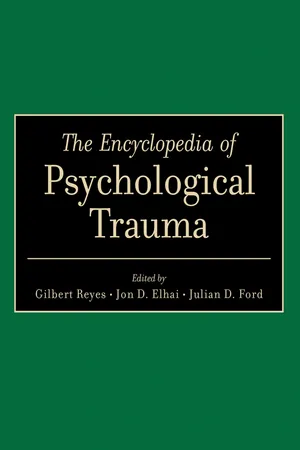
The Encyclopedia of Psychological Trauma
- English
- ePUB (mobile friendly)
- Available on iOS & Android
eBook - ePub
The Encyclopedia of Psychological Trauma
About this book
The Encyclopedia of Psychological Trauma is the only authoritative reference on the scientific evidence, clinical practice guidelines, and social issues addressed within the field of trauma and posttraumatic stress disorder. Edited by the leading experts in the field, you will turn to this definitive reference work again and again for complete coverage of psychological trauma, PTSD, evidence-based and standard treatments, as well as controversial topics including EMDR, virtual reality therapy, and much more.
Information
P
PAIN
See: Medical Illness, Adult; Medical Illness, Child; Somatic Complaints
PARENT-CHILD INTERVENTION
Parents play a crucial role in children’s recovery from psychological trauma. The parent’s ability to provide safety, reassurance, and guidance is one of the best predictors of a positive outcome when a child experiences psychological trauma. It is not possible for the parent of a trauma-exposed child to be emotionally unaffected. In rare instances, parents may appear to be indifferent or even angry and blaming toward their child in the aftermath of psychological trauma, and this is associated with a high risk of adverse outcomes for the child (e.g., posttraumatic stress disorder [PTSD] or other anxiety disorders, depression, pathological dissociation, externalizing behavior problems such as oppositional-defiant disorder or substance use disorders).
When a child is traumatized, even if they do not actually witness the child’s traumatic experiences, the parent(s) often feel a sense of emotional shock and disbelief, fear, helplessness, or horror that may constitute a psychological trauma for them as well as for their child and that can be temporarily incapacitating for the parent(s). When psychological trauma impacts a child, it also impacts the parent-child relationship. Misperceptions and unrealistic expectations may develop on the part of either the child or parent(s). Parents may be at a loss of how they can best help their child. They may inadvertently reinforce problematic feelings (such as despair or fear), beliefs (e.g., about who is to blame and who is responsible), or behaviors (e.g., acting like they are much younger or behaving aggressively) on the part of their child(ren). Even if the child’s traumatic experiences and their aftermath are not psychologically traumatic for the parent(s), these experiences are inevitably stressful and require a substantial adaptation by and deliberate efforts by the parent(s) to provide their child(ren) with the sense of security, nurturance, and healthy encouragement of growth that has been shown to be vital in helping the child(ren) to recover (E. Cohen, in press). Without parental involvement in treatment with the child, the outcomes may not be as positive. Parents rarely seek their own treatment after a trauma has touched their family. However, when parents are involved in their child’s treatment, they also will learn information and skills that can aid in their own recovery and in their ability to sustain a positive parent-child relationship in the aftermath of traumatic events.
Therefore, models of psychotherapy for psychologically traumatized children typically include the parent(s) in some (although not necessarily all) sessions (see: Family Therapy). Some psychotherapy models for traumatized children specifically utilize parent-child intervention as the primary, or a central, aspect of treatment, such as child parent psychotherapy (CPP) or parent-child interaction therapy. Other psychotherapies for traumatized children such as trauma-focused cognitive behavior therapy, include parents as integral participants in treatment, with a primary emphasis on helping the child directly through individual therapy and involving parents secondarily to support the child’s therapy gains. In the latter case, parents receive education to help them understand their child’s posttraumatic symptoms (such as anxiety, depression, or problems with aggressive or impulsive behavior) and to enable them to adapt their parenting to support their child in recovering from the symptoms.
In the immediate aftermath of psychological trauma, children and families are likely to experience many common reactions (see: Child Development; Family Systems). The first intervention recommended is Psychological First Aid (PFA; see: Crisis Intervention, Child; Early Intervention; Prevention, Child; Psychological First Aid, Child and Adolescent). PFA is a response to help people who are feeling stress as a result of a disaster situation. Through PFA, a compassionate and caring environment can be provided allowing for an assessment of what the individual may need at the time, offering support, helping the individuals cope, and reducing adverse reactions to the traumatic event. One PFA model, Listen, Protect, and Connect (LPC; Schreiber & Gurwitch, 2006) has been designed specifically for parents to help their children after a disaster. As parents may not know what to expect or how to help their children, LPC provides basic information and guidance to parents. This model provides information about common reactions to disaster and traumatic events. It recommends to parents that they be willing to listen and validate what the child has experienced. LPC provides parents with suggestions to help their children including maintaining stability and predictability in their daily routines at home, in the neighborhood, and in school and other activities, with clear expectations, consistent rules, and immediate feedback as well as a return to past routines and activities as soon as the situation and the child’s and family’s recovery allows. The LPC model stresses the importance of relationship connections and support from adults and peers who are important to the child, especially the parents who may need to be patient and understanding after traumatic event(s), and ensuring that key people “checking in” with the child on a regular basis. LPC encourages parents to help children return to extracurricular and school activities and to recognize and praise their children when they use positive coping strategies. Finally, LPC gives parents information about when and how to seek professional services such as counseling.
Beyond the immediate aftermath of psychological trauma, parent-child interventions for traumatized children have been developed for two age groups: young children (i.e., infants, toddlers, and preschoolers), and school-age children, preadolescents, and adolescents. While there are similarities in interventions across these age cohorts, there are sufficient developmental differences to warrant describing the interventions separately for each of the three age cohorts.
Parent-Child Interventions for Traumatized Young Children
In CPP, a therapist guides the parent in playing with her or his child in ways that enable the child and parent to recognize, understand, and manage or overcome traumatic stress reactions (Van Horn & Lieberman, in press). CPP helps parents recognize developmental milestones and benchmarks (such as language, learning, and self-control skills) that are expectable at different ages for young children, and how they can help their child to overcome barriers or problems in attaining these developmental gains that have resulted from psychological trauma or posttraumatic symptoms. CPP integrates several psychotherapy approaches, including the attachment, psychoanalytic, emotion-focused, and cognitive-behavioral models. Goals of CPP include the encouragement of normal development, emotion regulation, normalizing and gradually modifying posttraumatic symptoms, placing traumatic experience(s) in perspective as harmful events that can nevertheless be recovered from, and building reciprocity in the parent-child relationship. Through spontaneous activities involving play, games, physical contact, and language, the therapist guides, models, and helps parents to understand, feel confident, and participate nurturantly and effectively while interacting with their child. Reenactments by the child of traumatic events are acknowledged and both the child and parent are helped to give voice to their feelings and thoughts about traumatic events without becoming preoccupied with a sense of helplessness, fearfulness, guilt, blame, shame, or anger.
The average length of CPP treatment is 50 sessions, typically conducted on a weekly basis. Through the therapist’s guidance as the parent and child naturally interact with each other, the child and parent create (or regain) a sense of mutual trust, liking, and love. The child and parent also are helped to create a narrative—often primarily nonverbally by the child through play or creative arts such as drawing—that expresses their shared understanding of the bad (traumatic) things that have happened to the child and how they together are making life safe, fun, and rewarding again. CPP provides parents with education about child development, PTSD, and individualized parenting skills primarily through informal interactions and guidance by the therapist rather than by having therapists use a preset structured didactic skills curriculum.
Randomized clinical trial studies from two clinical research groups have demonstrated that CPP is more effective than case management or ordinary supportive services in reducing PTSD symptom severity for both parents and children, helping children to modify problematic behaviors, and in enhancing secure parent-child attachment (Lieberman, Ghosh Ippen, & Van Horn, 2006).
Parent-child interaction therapy (PCIT) is a specific form of behavioral parent training. More than 30 randomized clinical trial research studies have evaluated PCIT with a variety of populations of children and families seeking help for socioemotional and behavioral problems. PCIT has been shown to decrease children’s conduct problems and oppositional behaviors, improve children’s self-esteem, improve other siblings’ behavior, improve parental interaction styles with their children, reduce parenting stress and maternal depression (from the clinical to the normal range), and to have positive effects observed in the child’s day-care, preschool, and elementary school settings for as long as 6 years after the treatment (Hood & Eyeberg, 2003). In contrast to CPP, PCIT does not directly address psychological trauma memories or PTSD, and PCIT also has not been tested specifically with traumatized children in a randomized controlled clinical trial research study.
Unlike CPP, PCIT takes a structured didactic behavioral approach to teaching parents skills for encouraging positive behavior (such as prosocial behaviors and compliance with parental rules and requests) and reducing negative behaviors (such as defiance, aggression, or impulsivity) during parent-child play sessions and in generalization sessions in which the parent and child practice their new skills at home and in public. Unlike traditional behavioral parent training, caregivers and children meet together with the PCIT therapist in all but two sessions (in which parent[ ] receive education about parenting skills). The behavior management skills are practiced by the parent(s) in sessions with their child, with ongoing coaching by the therapist who...
Table of contents
- Cover
- Table of Contents
- Title
- Copyright
- Dedication
- PREFACE
- GUIDE FOR READERS
- ACKNOWLEDGMENTS
- EDITORIAL BOARD
- ADVISORY BOARD
- EDITORIAL ASSISTANTS
- CONTRIBUTORS
- A
- B
- C
- D
- E
- F
- G
- H
- I
- J
- K
- L
- M
- N
- O
- P
- Q
- R
- S
- T
- U
- V
- W
- AUTHOR INDEX
- SUBJECT INDEX
- End User License Agreement
Trusted by 375,005 students
Access to over 1.5 million titles for a fair monthly price.
Study more efficiently using our study tools.
Frequently asked questions
Yes, you can cancel anytime from the Subscription tab in your account settings on the Perlego website. Your subscription will stay active until the end of your current billing period. Learn how to cancel your subscription
No, books cannot be downloaded as external files, such as PDFs, for use outside of Perlego. However, you can download books within the Perlego app for offline reading on mobile or tablet. Learn how to download books offline
We are an online textbook subscription service, where you can get access to an entire online library for less than the price of a single book per month. With over 1.5 million books across 990+ topics, we’ve got you covered! Learn about our mission
Look out for the read-aloud symbol on your next book to see if you can listen to it. The read-aloud tool reads text aloud for you, highlighting the text as it is being read. You can pause it, speed it up and slow it down. Learn more about Read Aloud
Yes! You can use the Perlego app on both iOS and Android devices to read anytime, anywhere — even offline. Perfect for commutes or when you’re on the go.
Please note we cannot support devices running on iOS 13 and Android 7 or earlier. Learn more about using the app
Please note we cannot support devices running on iOS 13 and Android 7 or earlier. Learn more about using the app
Yes, you can access The Encyclopedia of Psychological Trauma by Gilbert Reyes,Jon D. Elhai,Julian D. Ford,Gilbert Reyes in PDF and/or ePUB format, as well as other popular books in Psychology & History & Theory in Psychology. We have over 1.5 million books available in our catalogue for you to explore.