![]()
1
Introduction
Harri Holma and Antti Toskala
1.1 WCDMA Early Phase
The research work towards third generation (3G) mobile systems started in the early 1990s. The aim was to develop a radio system capable of supporting up to 2 Mbps data rates. The WCDMA air interface was selected in Japan in 1997 and in Europe in January 1998. The global WCDMA specification activities were combined into a third generation partnership project (3GPP) that aimed to create the first set of specifications by the end of 1999, called Release 99. The first WCDMA network was opened by NTT DoCoMo in Japan 2001, using a proprietary version of the 3GPP specifications. The first 3GPP-compliant network opened in Japan by the end of 2002 and in Europe in 2003 (3 April 2003).
The operators had paid extraordinary prices for the UMTS spectrum in the auctions in the early 2000s and expectations for 3G systems were high. Unfortunately, the take-up of 3G devices and services turned out to be very slow. The global number of WCDMA subscribers was less than 20 million by the end of 2004 and more than 50% of them were located in Japan. The slow take-up can be attributed to many factors: it took time to get the system working in a stable way—the protocol specifications in particular caused a lot of headaches. The terminal suffered from high power consumption and from short talk time. The terminal prices also remained high due to low volumes. The packet-based mobile services had not yet been developed and the terminal displays were not good enough for attractive applications. Also the coverage areas of 3G networks were limited partly due to the high frequency at 2100 MHz.
The early WCDMA networks still offered some benefits for the end users including data rate up to 384 kbps in uplink and in downlink and simultaneous voice and data. WCDMA was also a useful platform for debugging the UMTS protocol layers and the development of wideband RF implementation solutions in the terminals and in the base stations.
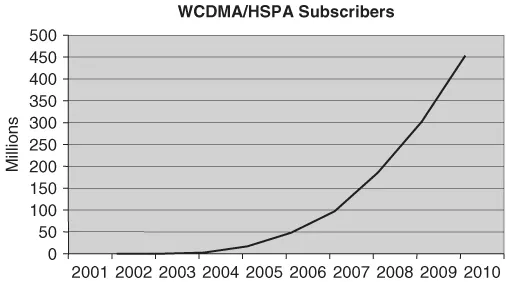
WCDMA/HSPA subscriber growth is shown in Figure 1.1. After the slow take-up, the growth accelerated, starting in 2006 and the total number of subscribers was 450 million by the end of 2009, that is seven years (2002–2009) after the launch of the first 3GPP compliant network.
1.2 HSPA Introduction and Data Growth
The early WCDMA deployments turned out to be important in preparing for the introduction of mobile broadband. 3GPP Release 5 included High Speed Downlink Packet Access (HSDPA) that changed the mobile broadband world. HSDPA brought a few major changes to the radio networks: the architecture became flatter with packet scheduling and retransmissions moving from RNC to the base station, the peak bit rates increased from 0.384 Mbps initially to 1.8–3.6 Mbps and later to 7.2–14.4 Mbps, the spectral efficiency and network efficiency increased considerably and the latency decreased from 200 ms to below 100 ms. The commercial HSDPA networks started at the end of 2005 and more launches took place during 2006. Suddenly, wide area networks were able to offer data rates similar to low end ADSL (Asymmetric Digital Subscriber Line) and were also able to push the cost per bit down so that offering hundreds of megabytes, or even gigabytes of data per month became feasible. The high efficiency also allowed changes to the pricing model, either to be flat rate or gapped flat rate. The HSDPA upgrade to the existing WCDMA network was a software upgrade in the best case without any site visits. The corresponding uplink enhancement, the High Speed Uplink Packet Access (HSUPA), was introduced in 3GPP Release 6. The combination of HSDPA and HSUPA is referred to as HSPA.
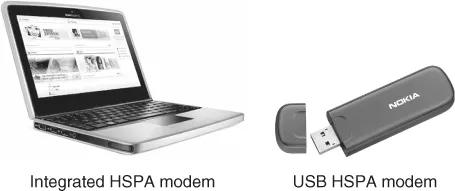
HSPA mobile broadband emerged as a highly successful service. The first use cases were PCMCIA (Personal Computer Memory Card International Association) and USB (Universal Serial Bus) modem connected to a laptop and using HSPA as the high data rate bit pipe similar to ADSL. Later also integrated HSPA modems were available in laptops. The typical modems are shown in Figure 1.2. The penetration of HSPA subscriptions exceeded 10% of the population in advanced markets in less than two years from the service launch which made HSPA connectivity one of the fastest growing mobile services.
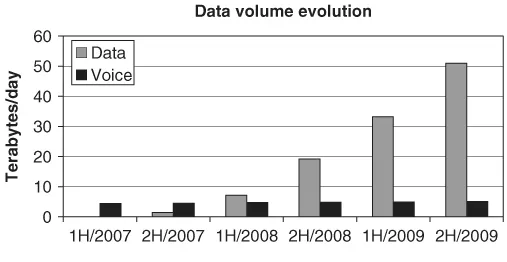
The flat rate pricing together with high data rates allowed users to consume large data volumes. The average usage per subscriber is typically more than 1 gigabyte per month and it keeps increasing. The combination of more subscribers each using more data caused the total data volume to explode in HSPA networks. An example case from a West European country is shown in Figure 1.3. The growth of the total data volume is compared to the total voice traffic. The voice traffic has been converted to data volume by assuming 16 kbps data rate: 10 minutes of voice converts into 1.2 megabytes of data. The data volumes include both downlink and uplink transmission. Total voice traffic has been growing slowly from 2007 to 2009 from 4.4 terabytes per day to 5.0 terabytes per day. At the same time the data has grown from practically zero to 50 terabytes per day. In other words, 90% of the bits in the radio network are related to the data connections and only 10% to the voice connection in 2009. The wide area networks shifted from being voice-dominated to being data-dominated in just two years. Note that the data is primarily carried by HSPA networks and the voice traffic by both GSM and WCDMA/HSPA networks. Therefore, if we only look at WCDMA/HSPA networks, the share of data traffic is even larger.
Fast data growth brings the challenge of cost efficiency. More voice traffic brings more revenue with minute-based charging while more data traffic brings no extra revenue due to flat rate pricing—more data just creates more expenses. The HSPA network efficiency has improved considerably especially with Ethernet-based Iub transport and compact new base stations with simple installation, low power consumption and fast capacity expansion. HSPA evolution also includes a number of features that can enhance the spectral efficiency. Quality of Service (QoS) differentiation is utilized to control excessive network usage to keep users happy also during the busy hours.
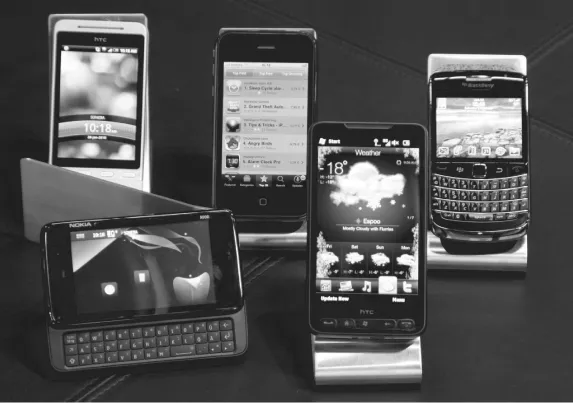
It is not only USB modems but also the increasingly popular smart phones that have created more traffic in HSPA networks. Example smart phones are shown in Figure 1.4. The smart phones enable a number of new applications including community access, push mail, navigation and widgets in addition to browsing and streaming applications. Those applications create relatively low data volumes but fairly frequent flow of small packets which created a few new challenges for end-to-end performance and for the system capacity. The first challenge was terminal power consumption. The frequent transmission of small packets keeps terminal RF parts running and increases the power consumption. Another challenge is the high signaling load in the networks caused by the frequent packet transmissions. HSPA evolution includes features that cut down the power consumption considerably and also improve the efficiency of small packet transmission in the HSPA radio networks.
1.3 HSPA Deployments Globally
Globally, there are 341 HSPA networks running in 143 countries with a total of over 380 commitments for HSPA launches in May 2010 [1]. HSPA has been launched in all European countries, in practice, in all countries in the Americas, in most Asian countries and in many African countries. The largest HSPA network is run by China Unicom with the first year deployment during 2009 of approximately 150,000 base stations. Another large market—India—is also moving towards large-scale HSPA network rollouts during 2010 when the spectrum auctions are completed. The total number of HSPA base stations globally is expected to exceed 1 million during 2010.
Many governments have recognized that broadband access can boost the economy. If there is insufficient wireline infrastructure, the wireless solution may be the only practical broadband solution. HSPA has developed into a truly global area mobile broadband solution serving as the first broadband access for end users in many new growth markets.
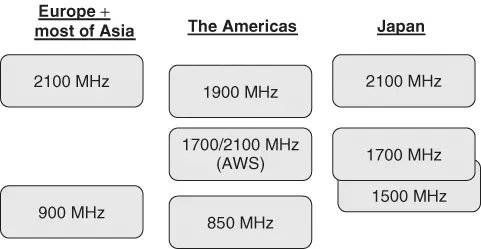
The WCDMA networks started at 2100 MHz band in Asia and in Europe and at 1900 MHz in USA. The high frequency makes the cell size small which limits the coverage area. Therefore, the WCDMA/HSPA networks have recently been deployed increasingly at low frequencies of 850 and at 900 MHz. The lower frequency gives approximately three times larger coverage area than 1900 or 2100 MHz. The first commercial UMTS900 network was opened in 2007 and widespread UMTS900 rollouts started in 2009 when the European Union (EU) changed the regulation to allow UMTS technology in the 900 MHz band. UMTS850 and UMTS900 have clearly boosted the availability of HSPA networks in less densely populated areas.
The bands 850, 900 and 1900 previously were used mainly for GSM. WCDMA/HSPA specifications have been designed for co-existence with GSM on the same band. The commercial networks have shown that WCDMA/HSPA can be operated together with GSM on the same frequency band while sharing even the same base station. The minimum spectrum requirement for WCDMA is 4.2 MHz.
In addition to these four bands, also the AWS (Advanced Wireless Services) band (1700/2100) is used for HSPA in the USA, in Canada and in some Latin American countries, starting in Chile. Japanese networks additionally use two further frequency variants: 1700 by Docomo and 1500 by Softbank. The frequency variants are summarized in Figure 1.5.
The typical HSPA terminals support two or three frequency variants with two upper bands (2100 and 1900) and one lower band (900 or 850). The wide support of 900 and 850 in the terminals makes the low band reframing a feasible option for the operators. Some high end terminals even support five frequency bands 850/900/1700/1900/2100. The number of global frequency variants in HSPA is still small and easier to manage compared to 3GPP LTE where more than 10 different frequency variants are required globally.
1.4 HSPA Evolution
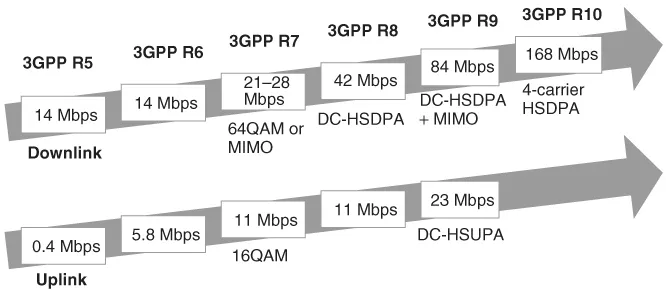
3GPP Releases 5 and 6 defined the baseline for mobile broadband access. HSPA evolution in Releases 7, 8 and 9 has further boosted the HSPA capability. Development continues in Release 10 during 2010. The peak bit rate in Release 6 was 14 Mbps downlink and 5.76 Mbps in uplink. The downlink and uplink data rates improve with dual cell HSPA (DC-HSPA), with 3-carrier and 4-carrier HSPA and with higher-order modulation 64QAM downlink and 16QAM uplink. The multicarrier HSPA permits full benefit of 10–20 MHz bandwidth similar to LTE. The downlink data rate can also be increased by a multi-antenna solution (MIMO, Multiple Input Multiple Output). The peak bit rate in Release 9 is 84 Mbps downlink and 23 Mbps uplink. The downlink data rate is expected to double in Release 10 to 168 Mbps by aggregating four carriers together over 20 MHz bandwidth. The data rate evolution is illustrated in Figure 1.6. We can note that the HSPA peak rates are even higher than the best ADSL peak rates in the fixed copper lines, especially in uplink.
End-to-end latency is another part of optimized end user performance. The commercial HSPA networks show that the average round trip time can be pushed to below 30 milliseconds with HSPA evolution offering faster response times for the applications. The radio latency in many cases is no longer the limiting factor. The latency development has been considerable since the early WCDMA networks had a latency of approximately 200 ms.
The terminal power consumption is reduced considerably with HSPA evolution by using discontinuous transmission and reception (DTX/DRX). The voice talk time can be extended to 10–15 hours. The usage time with data applications and always-on services can be pushed relatively even more by using new common channel structures in addition to DTX/DRX.
Voice service has traditionally been by circuit switched (CS) voice. HSPA evolution allows the traditional CS voice on top of HSPA packet radio to be run. The solution is a CS voice from the core network and from a roaming or charging point of view, but it is similar to Voice over IP (VoIP) in the HSPA radio network. The HSPA radio gives clear benefits also for the voice service: better talk time with discontinuous transmission and reception, higher spectral efficiency with HSPA-related performance enhancements and faster call setup time with less than 2 second mobile-to-mobile call setup time.
In short, the 3G network capability has improved enormously from Release 99 to Release 9. The simple reason is that radio has changed completely from the WCDMA circuit connection type operation to HSPA fully packet-based operation. It is possible to run all the service on top of HSPA in Release 9, including packet services, CS voice service, VoIP, common channels, signaling and paging. There are in practice only a f...