Thermodynamics for the Practicing Engineer
eBook - ePub

Thermodynamics for the Practicing Engineer

  1. English
  2. ePUB (mobile friendly)
  3. Available on iOS & Android
eBook - ePub

Thermodynamics for the Practicing Engineer

About this book

Enables you to easily advance from thermodynamics principles to applications

Thermodynamics for the Practicing Engineer, as the title suggests, is written for all practicing engineers and anyone studying to become one. Its focus therefore is on applications of thermodynamics, addressing both technical and pragmatic problems in the field. Readers are provided a solid base in thermodynamics theory; however, the text is mostly dedicated to demonstrating how theory is applied to solve real-world problems.

This text's four parts enable readers to easily gain a foundation in basic principles and then learn how to apply them in practice:

  • Part One: Introduction. Sets forth the basic principles of thermodynamics, reviewing such topics as units and dimensions, conservation laws, gas laws, and the second law of thermodynamics.
  • Part Two: Enthalpy Effects. Examines sensible, latent, chemical reaction, and mixing enthalpy effects.

  • Part Three: Equilibrium Thermodynamics. Addresses both principles and calculations for phase, vapor-liquid, and chemical reaction equilibrium.

  • Part Four: Other Topics. Reviews such important issues as economics, numerical methods, open-ended problems, environmental concerns, health and safety management, ethics, and exergy.

Throughout the text, detailed illustrative examples demonstrate how all the principles, procedures, and equations are put into practice. Additional practice problems enable readers to solve real-world problems similar to the ones that they will encounter on the job.

Readers will gain a solid working knowledge of thermodynamics principles and applications upon successful completion of this text. Moreover, they will be better prepared when approaching/addressing advanced material and more complex problems.
Frequently asked questions

Yes, you can cancel anytime from the Subscription tab in your account settings on the Perlego website. Your subscription will stay active until the end of your current billing period. Learn how to cancel your subscription.
At the moment all of our mobile-responsive ePub books are available to download via the app. Most of our PDFs are also available to download and we're working on making the final remaining ones downloadable now. Learn more here.
Perlego offers two plans: Essential and Complete
  • Essential is ideal for learners and professionals who enjoy exploring a wide range of subjects. Access the Essential Library with 800,000+ trusted titles and best-sellers across business, personal growth, and the humanities. Includes unlimited reading time and Standard Read Aloud voice.
  • Complete: Perfect for advanced learners and researchers needing full, unrestricted access. Unlock 1.4M+ books across hundreds of subjects, including academic and specialized titles. The Complete Plan also includes advanced features like Premium Read Aloud and Research Assistant.
Both plans are available with monthly, semester, or annual billing cycles.
We are an online textbook subscription service, where you can get access to an entire online library for less than the price of a single book per month. With over 1 million books across 1000+ topics, we’ve got you covered! Learn more here.
Look out for the read-aloud symbol on your next book to see if you can listen to it. The read-aloud tool reads text aloud for you, highlighting the text as it is being read. You can pause it, speed it up and slow it down. Learn more here.
Yes! You can use the Perlego app on both iOS or Android devices to read anytime, anywhere — even offline. Perfect for commutes or when you’re on the go.
Please note we cannot support devices running on iOS 13 and Android 7 or earlier. Learn more about using the app.
Yes, you can access Thermodynamics for the Practicing Engineer by Louis Theodore,Francesco Ricci,Timothy Vanvliet in PDF and/or ePUB format, as well as other popular books in Technology & Engineering & Chemical & Biochemical Engineering. We have over one million books available in our catalogue for you to explore.
Part I
Introduction
Nicolò Machiavelli [1469–1527]
There is nothing more difficult to take in hand, more perilous to conduct, or more uncertain in its success, than to take the lead in the introduction of a new order of things.
The Prince. Chap. 6

Part I serves as the introductory section to this book. It reviews engineering and science fundamentals that are an integral part of the field of thermodynamics. It consists of six chapters, as noted below:
1 Basic Calculations
2 Process Variables
3 Gas Laws
4 Conservation Laws
5 Stoichiometry
6 The Second Law of Thermodynamics
Those individuals with a strong background in the above area(s) may choose to bypass this Part.
Chapter 1
Basic Calculations
Johann Wolfgang Von Goethe [1749–1832]
The sum which two married people owe to one another defies calculation. It is an infinite debt, which can only be discharged through all eternity.
Elective Affinities [1808]. Book I, Chap. 9
INTRODUCTION
This first chapter provides a review of basic calculations and the fundamentals of measurement. Four topics receive treatment:
1 Units and Dimensions
2 Conversion of Units
3 The Gravitational Constant, gc
4 Significant Figures and Scientific Notation
The reader is directed to the literature in the reference section of this chapter if additional information on these four topics is deemed necessary.(1–3)
UNITS AND DIMENSIONS
The units used in this text are consistent with those adopted by the engineering profession in the United States. For engineering work, SI (Système International) and English units are most often employed; in the United States, the English engineering units are generally used, although efforts are still underway to obtain universal adoption of SI units for all engineering and science applications. The SI units have the advantage of being based on the decimal system, which allows for more convenient conversion of units within the system.
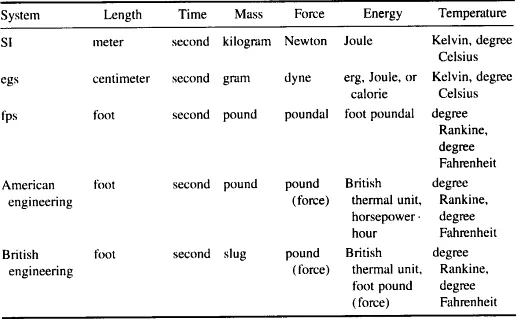
There are other systems of units. Some of the more common of these are shown in Table 1.1; however, English engineering units are primarily used in this text. Tables 1.2 and 1.3 present units for both the English and SI systems, respectively.
Table 1.1 Common Systems of Units
Table 1.2 English Engineering Units
Physical quantity Name of unit Symbol for unit
Length foot ft
Time second s
Mass pound (mass) lb
Temperature degree Rankine °R
Temperature (alternative) degree Fahrenheit °F
Moles pound · mole lbmol
Energy British thermal unit Btu
Energy (alternative) horsepower · hour hp · h
Force pound (force) lbf
Acceleration foot per second square ft/s2
Velocity foot per second ft/s
Volume cubic foot ft3
Area square foot ft2
Frequency cycles per second, hertz cycles/s, Hz
Power horsepower, Btu per second hp, Btu/s
Heat capacity British thermal unit per (pound mass · degree Rankine) Btu/lb · °R
Density pound (mass) per cubic foot lb/ft3
Pressure pound (force) per square inch psi
pound (force...

Table of contents

  1. Cover
  2. Half Title page
  3. Title page
  4. Copyright page
  5. Dedication
  6. Preface
  7. Part I: Introduction
  8. Part II: Enthalpy Effects
  9. Part III: Equilibrium Thermodynamics
  10. Part IV: Other Topics
  11. Appendix
  12. Index