Includes tips and strategies for kids, teens, and adults with dyslexia
Understand what dyslexia is, assess schools and programs, and help your child succeed
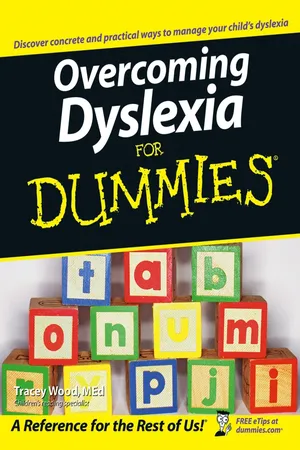
Does your child mix up d's and b's? Does he or she have trouble reading? If so, the cause may be dyslexia. But don't worry -- these days, there are many ways to overcome dyslexia. This hands-on guide leads you step by step through your options -- and explains how anyone with dyslexia can achieve success in school and life.
Discover how to
* Recognize the symptoms of dyslexia
* Understand diagnostic test results
* Set up an Individualized Education Program (IEP)
* Work effectively with teachers
* Improve your child?s reading skills
- English
- ePUB (mobile friendly)
- Available on iOS & Android
eBook - ePub
Overcoming Dyslexia For Dummies
About this book
Information
Edition
1Topic
Personal DevelopmentPart I
Figuring Out What Dyslexia Is All About

In this part . . .
**IN a DROPCAP**
This book contains a tremendous amount of information, so in this part I help you get off on the right foot with some basic but essential facts. First, you find out what dyslexia really means (and what it doesn’t mean). I cover its possible causes and the different forms that it takes. Then, when you’re revving, I show you how dyslexia may be indicated in your child’s behavior, no matter how old he is. Got your water and sensible footwear? Off you go!
Chapter 1
Understanding the Basics of Dyslexia
In This Chapter

Today in a bookstore, I got held up in the magazines section. The problem was that I just couldn’t decide what topic appealed to me the most: “Sixteen foods to make me stronger, happier, sexier, and smarter,” “Ten minutes to a flatter belly,” or “Eat around the clock.” Wouldn’t it be nice if this book offered you a similar approach to dyslexia, with topics such as “Sixteen surefire ways to outsmart dyslexia,” “Ten minutes to perfect reading and spelling,” and “Raising a reader without lifting a finger”?
But in real life, people like to hear the truth. So in this book I give you the plain and simple truth about dyslexia — not the shortcut answers like you might find in those magazines I saw. And it all starts in this chapter with an easy-as-pie outline of what dyslexia really is, a simple sketch of how it shapes your child’s life, and a lightning tour of the programs and treatments you can find in and out of the classroom.
Defining Dyslexia in Plain Terms
Plenty of children struggle with reading. Their parents get extra help for them, and after a few months, they catch up. Sometimes the problem disappears suddenly without any intervention at all.

-plgo-compressed.webp)

Research about dyslexia provides insight into the possible causes of dyslexia. For instance, dyslexics use a different part of the brain when they read than nondyslexics do, and they use more of it. Dyslexia also tends to run in families. And some psychologists break dyslexia down into several types, including phonological dyslexia and visual dyslexia.
In Chapter 2, I give you the full scoop about the definition, causes, and types of dyslexia. I also tell you about different conditions related to (and often mistaken for) dyslexia.
Zeroing In on the Symptoms of Dyslexia
Here’s the thing about dyslexia. One teacher or psychologist may tell you your child lacks “automaticity of language,” or perhaps “auditory perceptual skills,” while another tells you she has “dyslexia.” Some practitioners never use the term “dyslexia,” but psychologists who do diagnose it look for a fairly standard bunch of ...
Table of contents
- Title
- Contents
- Introduction
- Part I : Figuring Out What Dyslexia Is All About
- Chapter 1: Understanding the Basics of Dyslexia
- Chapter 2: Pinpointing What Dyslexia Is (And Isn’t)
- Chapter 3: Being Alert to Symptoms of Dyslexia at Any Age
- Part II : Determining When to Get a Diagnosis
- Chapter 4: Watching Your Child Carefully at a Young Age
- Chapter 5: Acting Quickly with Your School-Age Child
- Chapter 6: Testing Your Child for Dyslexia
- Part III : Exploring Your Options for Schools and Programs
- Chapter 7: Choosing the Best School for Your Child
- Chapter 8: Investigating the Individualized Education Program
- Chapter 9: Securing Help without an Individualized Education Program
- Chapter 10: Working Productively with Your Child’s Teacher
- Part IV : Taking Part in Your Child’s Treatment
- Chapter 11: Putting Memorizing, Visualizing, and Rhyming to Good Use
- Chapter 12: Playing with Phonics
- Chapter 13: Sprinting Ahead with Reading Basics and Practice
- Chapter 14: Taking Advantage of Multisensory Methods
- Chapter 15: Handling Everyday Activities and Difficulties
- Part V : Moving beyond the Childhood Years
- Chapter 16: Assisting Dyslexic Teens
- Chapter 17: Heading Off to College
- Chapter 18: Succeeding with Dyslexia in Adulthood
- Part VI : The Part of Tens
- Chapter 19: Ten Tools for Making a Dyslexic’s Life Easier
- Chapter 20: Ten Well-Known Dyslexia Programs and Treatments
- Part VII : Appendixes
- Appendix A: An Informal Assessment of Phonemic Awareness and Phonics Skills
- Appendix B: Contacts and Resources
Trusted by 375,005 students
Access to over 1.5 million titles for a fair monthly price.
Study more efficiently using our study tools.
Frequently asked questions
Yes, you can cancel anytime from the Subscription tab in your account settings on the Perlego website. Your subscription will stay active until the end of your current billing period. Learn how to cancel your subscription
No, books cannot be downloaded as external files, such as PDFs, for use outside of Perlego. However, you can download books within the Perlego app for offline reading on mobile or tablet. Learn how to download books offline
Perlego offers two plans: Essential and Complete
- Essential is ideal for learners and professionals who enjoy exploring a wide range of subjects. Access the Essential Library with 800,000+ trusted titles and best-sellers across business, personal growth, and the humanities. Includes unlimited reading time and Standard Read Aloud voice.
- Complete: Perfect for advanced learners and researchers needing full, unrestricted access. Unlock 1.5M+ books across hundreds of subjects, including academic and specialized titles. The Complete Plan also includes advanced features like Premium Read Aloud and Research Assistant.
We are an online textbook subscription service, where you can get access to an entire online library for less than the price of a single book per month. With over 1.5 million books across 990+ topics, we’ve got you covered! Learn about our mission
Look out for the read-aloud symbol on your next book to see if you can listen to it. The read-aloud tool reads text aloud for you, highlighting the text as it is being read. You can pause it, speed it up and slow it down. Learn more about Read Aloud
Yes! You can use the Perlego app on both iOS and Android devices to read anytime, anywhere — even offline. Perfect for commutes or when you’re on the go.
Please note we cannot support devices running on iOS 13 and Android 7 or earlier. Learn more about using the app
Please note we cannot support devices running on iOS 13 and Android 7 or earlier. Learn more about using the app
Yes, you can access Overcoming Dyslexia For Dummies by Tracey Wood in PDF and/or ePUB format. We have over 1.5 million books available in our catalogue for you to explore.