- English
- ePUB (mobile friendly)
- Available on iOS & Android
eBook - ePub
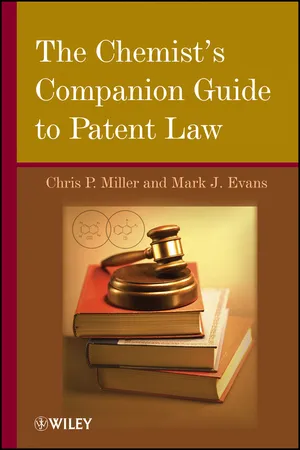
The Chemist's Companion Guide to Patent Law
About this book
Written by an individual with experience as both a chemist and a patent attorney, The Chemist's Companion Guide to Patent Law covers everything the student or working chemist needs to know about patentability, explaining important concepts of patent law (such as novelty, non-obviousness, and freedom-to-operate) in easy-to-understand terms. Through abundant examples from case law as well as real-world situations with which a researcher might be faced, this book provides readers with a better understanding of how to put that knowledge into practice.
CHAPTER 1
Patent Basics
1.1 INTRODUCTION
All too often one of the biggest challenges in any major endeavor is figuring out exactly where to begin. In the endeavor of learning patent law that difficulty is magnified by the fact that patent topics are often highly interwoven so that no matter where one starts, they will inevitably be drawn into other related topics. Because of this, our conceptual framework will not always be assembled in a strictly linear fashion but may come to better resemble a mosaic of interlocking pieces. For some, the sometime frequent diversions from one topic to another may be annoying, but for others (e.g., those with attention deficit disorder) such diversions can be welcome. No matter which camp your flag flies over, the benefit to seeing the same topic introduced multiple times for different purposes adds significant value to the learning experience. Although repetition can magnify boredom, it can also reinforce learning, especially where the repetition occurs in different settings, perhaps resonating somewhat differently each time. Topics will sometimes be presented once or twice as a peripheral component when necessary to help explain the main topic, only to appear yet once again, perhaps this time as the main topic. To the extent such digressions are truly peripheral, they will be explained in footnotes, often with a reference to where in the text that topic is part of the central discussion. I strongly encourage you to read the footnotes because they do much to fill in the mosaic. You’ll notice the tone in the footnotes is typically more relaxed and conversational, allowing an expansiveness in nuance and detail that is not always so readily accommodated in the text.
So where to begin? In this first substantive chapter, we’ll start with some opening thoughts on property, move to patents as property, and end with, a discussion on the fundamental differences between owning a patent and having freedom-to-operate.
1.2 PATENTS AS PROPERTY
Private property began the instant somebody had a mind of his own.
—E. E. Cummings
Most of us have grown up with tangible personal property and are familiar with the concept of ownership of this type of property. In fact, even if we hadn’t grown up with the concept of property ownership, its prerequisites and attractions seem to be almost instinctively shared. If this seems dubious to you, just picture for a moment two children fighting over a toy—each one grasping firmly to an end and shouting: “Mine! Mine!” Fortunately for lawyers, this primal behavior is not limited to children. Society’s attempts to organize and control the basic desire to own property are reflected in the fact that entire areas and many subareas of the law are dedicated to the rights and duties of property owners. Since society places such great emphasis on property, it is perhaps worthwhile to consider just what it actually means to own property in the first place.
Perhaps a good place to start our quest for understanding the nature of property ownership is to understand its limitations, beginning with the maxim, You never can truly own anything. Despite the simplistic nature of this assertion, it provides a valuable first clue into the nature of property ownership because thinking of property ownership in the legal sense means thinking about the legal rights of ownership. In this vein, one would be hard pressed to find an example of an absolute set of legal rights to anything, and the legal rights associated with property ownership are no exception. For example, even though we say a person owns their automobile, he probably does not have the legal right to drive it through his neighbor’s yard; his ownership does not grant unlimited rights with respect to what he owns. Similarly, forgo the property taxes on your house, and you probably will not be living there for too long—ownership often poses affirmative duties to maintain that ownership. The points here are that property ownership is limited and ownership is almost never an all or nothing proposition. Rather than viewing property ownership in a fixed, static, or absolute state, it is more appropriate to think of property as a bundle of sticks in which each stick represents a right or responsibility. Rather than owning a piece of property, one actually holds one or more rights related to that property, often accompanied by one or more obligations as well. The more absolute or complete the ownership of property by one individual or entity, the more rights from the bundle that individual or entity has. For example, real property (e.g., an apartment) may be rented or owned, singly or jointly, by two or more persons at the same time. In the latter case of joint ownership, the bundle of ownership rights might be split right down the middle with each person taking half of the entire bundle. Real property may be commercial, residential, or zoned nonhabitable, but in every case it still has at least one owner—even if that owner is the government. Although the variations in property ownership are almost limitless, the bundle of rights associated with property ownership is probably never enough to be absolute—nobody ever has all of the sticks in the bundle.
1.3 PATENT RIGHTS ARE RIGHTS TO EXCLUDE
In spite of the many shades of ownership interest and the corresponding rights to which that ownership interest represents, there is often one very important right that is common to property owners and that is the right to exclude others from the property, at least up to the extent the owner owns the property. So even though the owner may be limited in her own ability to affirmatively use or enjoy the property, she usually retains the power to exclude others from using or enjoying the property. Thus, although a person with a suspended or revoked driver’s license might not be able to legally drive the car that she owns, she still can decide whether another individual may use the car. Likewise, consider a landowner who owns a piece of land but cannot legally hunt on it because she does not have a hunting license. Despite the fact that she cannot legally hunt on her own land, she still might have the power to decide whether another person who has a hunting license can hunt on her land. In both of these examples, the person owning the property does not have the legal right to enjoy that property in certain ways but she still, as the legal owner, has the power to exclude (or allow) others to use the property for those same purposes. From a commercial standpoint, this power to exclude or allow is significant because one can potentially make tremendous economic benefit of this legal right. A person without a driver’s license might still own hundreds of automobiles that she rents out to others or the landowner who doesn’t have a hunting license might still make significant revenue renting out her land to hunters. This aspect of property ownership is a cornerstone of the economics of commerce and property—if an owner did not have the power to exclude, the power to allow would have little value because nobody would want to pay for something she could otherwise get for free.
So what does all this have to do with patents anyway? The answer is that patent rights are in certain very important ways similar to property rights, and one might think of the claims1 in a patent taking the place of the deed to a piece of real property or the title to an automobile; the claims of the patent define the “metes and bounds” of the property in the same way that a deed to real property or a title to an automobile describes those pieces of property. Instead of a patent owner, we typically refer to that person as the patent assignee, but the effect is the same. In the same way that a person holding legal title to a piece of real property such as land might be able to lease her land to another party, so might a holder of a patent license lease some or all of her stake in the claimed invention. However, we have already seen that holding the deed to the property does not necessarily give one unlimited rights to the property; think back to the car owner who couldn’t drive her own car or the landowner who could not hunt on her own land. The same is true for patents, and this is one of the most conceptually difficult but important concepts in patent law to understand. Owning a patent does not grant one the right to “do” the thing that the claim describes. Owning a patent grants its owner the right to exclude others from practicing the claimed invention.2
1.4 PATENTS DO NOT CONVEY FREEDOM TO OPERATE THE INVENTION
As we just learned, the right to exclude can be a very valuable right; implicit in the right to exclude is the right to not exclude. Where one party has the right to exclude others from making, using, or selling a claimed invention that others covet, then the party holding the right has something of value. Very often, this value can be equated to some cash value by which the party holding the patent rents or sells that intellectual property space to others. Alternatively, the party holding the intellectual property space may want to occupy it himself. However, whether the owner of the patent decides to rent that space to another party or attempts to occupy it himself, neither the other party nor he is guaranteed by the patent right he holds to be allowed to make, use, or sell the invention that he claims since the right of the patent holder is to exclude others from the claimed patent space—the patent holder cannot grant anything or license anything to another party that he does not hold himself. You may find it odd that a person could invent something, be awarded a patent but yet not be able to practice what is described in the patent, but yet still grant the rights under that patent to somebody else who himself may or may not have the right to practice what is claimed in the patent he has taken the rights to from the first person. The primary reason for this dichotomy is that the criteria for obtaining a patent are not the same criteria for determining whether the patent obtained can be used. In other words, the USPTO is not concerned with whether you can legally practice your claimed invention; they are solely concerned with whether your claimed invention meets the requirements of patentability.3 This does not mean that you, the patentee do not have to be worried about whether you can practice the invention claimed in your patent; it all depends what your goals are. Do you wish to practice your invention, license it to another, or simply brag to your friends about it (or even all three)? If you wish to practice the invention described by your granted claims, you will want to be sure that you are not infringing somebody else’s patent(s) in the process. The primary inquiry then is whether you have “freedom to operate” the claimed invention. If practicing your invention infringes another’s patent(s), then you need to consider whether you can find a way to practice your invention that avoids his patent, or consider approaching him to see if you can license his patent(s), or perhaps you are confident that his patent is not valid and that if he tries to assert it, you can get his patent invalidated in a federal court.
In this sense, having freedom to operate is like having a shield that defends one from charges of infringement, whereas a patent acts like a sword, allowing its holder to go on the offense by excluding others from the claimed space of his own patent. In some cases, a chemist may want freedom to operate only as he may simply wish to make, use, or sell a certain composition or process. He does not care to try to exclude others but simply wishes to do something without being bothered by the possibility of an infringement suit by another. In other cases, the chemist may obtain a patent to a composition or process that he is not himself interested in making, using, or selling because he knows the invention would be valuable to others who do not want to be excluded from the claimed invention. Finally, the chemist may wish to make, use, or sell the product of his invention, and he may also wish to own a patent to that invention so that he may prevent others from making, selling, or using his invention so he has the sole or exclusive right to do what he wishes to do. In some cases one needs a shield, in some cases one needs a sword, and in some cases one needs both. Not all three choices are available in all circumstances, but understanding one’s needs is a necessary first step for staging the inquiry that follows.
Knowing whether and to what extent one has freedom to operate in the realm of patents is usually more complicated then understanding one’s rights regarding other types of property. For example, in real property, the rights and restrictions that run with the property usually can be figured out in a relatively straightforward manner by a title search. When a title search is performed, the chain of title is searched back in time to make sure that clear title can in fact be passed by ensuring that each party in the chain of title had conveyed the title in a legally competent manner. In the same manner, that title search should turn up any restrictions that run with the property so that the new owner can be sure he is getting the rights to the land he thinks he is getting. If somebody besides yourself has mineral rights to your land, you might wish to know that before you buy the property lest you be unpleasantly surprised one bright shiny morning when the mining crew shows up in your front yard to begin the excavation. Likewise, before a party wishes to prosecute, license, or even purchase a patent, that party likely will want to know whether the patent he covets is sufficient for him to practice the claimed invention.
In contrast to a piece of real property and its attendant deed, a freedom-to-operate search for intellectual property generally involves a much more multivariate inquiry. The practice of any given technology often requires a large number of steps, any of which may involve processes or materials that may be the subject of different patent claims held by other parties. Holding a patent, unlike the property deed, will not give one notice of whether practicing the claimed invention will infringe another’s patent—such an inquiry must be independently conducted by searching databases that catalog patent claims by various search descriptors (e.g., chemical structure, compound name, keyword).
1.5 CONTRASTING FREEDOM TO OPERATE WITH PATENTABILITY
The freedom-to-operate inquiry is much broader and more complex than the basic consideration of whether clear title to the patent is being offered—even a clean assignment or license to a particular patented invention does not mean that one has freedom to operate by making, using, or selling the claimed invention if that patent results in the infringement of one or more patents held by another party. Furthermore, the freedom-to-operate inquiry is relevant whenever one wishes to practice in an area, so it is entirely separate from the question of whether one has a patent, wishes to get a patent, can get a patent, etc. because the freedom to operate inquiry primarily concerns itself with whether one can practice in a particular area without infringing a patent or patents held by one or more outside interests. It is entirely possible that multiple overlapping patents are held by different parties such that no single party has freedom to operate. Because of this, the freedom-to-operate inquiry is in no way limited to whether the party initiating the inquiry has a patent on the technology or if she doesn’t—it simply asks whether the thing she wishes to do can be done without infringing somebody else’s patent. To solidify these abstract concepts, let’s consider a scenario that involves issues of patentability and freedom to operate to demonstrate one commonly encountered way in which patentability and ...
Table of contents
- Cover
- Half Title Page
- Title Page
- Copyright
- Disclaimer
- Preface
- Chapter 1: Patent Basics
- Chapter 2: The Patent Process
- Chapter 3: Prior art and the Chemical Invention
- Chapter 4: Inventorship
- Chapter 5: Patent Claims
- Chapter 6: Basic Requirements of Patentability: Utility
- Chapter 7: Basic Requirements of Patentability: Novelty
- Chapter 8: Basic Requirements of Patentability: Nonobviousness
- Chapter 9: Basic Requirements of Patentability: Written Description, Enablement, and Best Mode
- Afterword and Sources
- Acknowledgments
- Cases Cited
- Index
Trusted by 375,005 students
Access to over 1.5 million titles for a fair monthly price.
Study more efficiently using our study tools.
Frequently asked questions
Yes, you can cancel anytime from the Subscription tab in your account settings on the Perlego website. Your subscription will stay active until the end of your current billing period. Learn how to cancel your subscription
No, books cannot be downloaded as external files, such as PDFs, for use outside of Perlego. However, you can download books within the Perlego app for offline reading on mobile or tablet. Learn how to download books offline
Perlego offers two plans: Essential and Complete
- Essential is ideal for learners and professionals who enjoy exploring a wide range of subjects. Access the Essential Library with 800,000+ trusted titles and best-sellers across business, personal growth, and the humanities. Includes unlimited reading time and Standard Read Aloud voice.
- Complete: Perfect for advanced learners and researchers needing full, unrestricted access. Unlock 1.5M+ books across hundreds of subjects, including academic and specialized titles. The Complete Plan also includes advanced features like Premium Read Aloud and Research Assistant.
We are an online textbook subscription service, where you can get access to an entire online library for less than the price of a single book per month. With over 1.5 million books across 990+ topics, we’ve got you covered! Learn about our mission
Look out for the read-aloud symbol on your next book to see if you can listen to it. The read-aloud tool reads text aloud for you, highlighting the text as it is being read. You can pause it, speed it up and slow it down. Learn more about Read Aloud
Yes! You can use the Perlego app on both iOS and Android devices to read anytime, anywhere — even offline. Perfect for commutes or when you’re on the go.
Please note we cannot support devices running on iOS 13 and Android 7 or earlier. Learn more about using the app
Please note we cannot support devices running on iOS 13 and Android 7 or earlier. Learn more about using the app
Yes, you can access The Chemist's Companion Guide to Patent Law by Chris P. Miller,Mark J. Evans in PDF and/or ePUB format, as well as other popular books in Physical Sciences & Chemistry. We have over 1.5 million books available in our catalogue for you to explore.