eBook - ePub
Web Analytics 2.0
The Art of Online Accountability and Science of Customer Centricity
- English
- ePUB (mobile friendly)
- Available on iOS & Android
eBook - ePub
Web Analytics 2.0
The Art of Online Accountability and Science of Customer Centricity
About this book
Adeptly address today's business challenges with this powerful new book from web analytics thought leader Avinash Kaushik. Web Analytics 2.0 presents a new framework that will permanently change how you think about analytics. It provides specific recommendations for creating an actionable strategy, applying analytical techniques correctly, solving challenges such as measuring social media and multichannel campaigns, achieving optimal success by leveraging experimentation, and employing tactics for truly listening to your customers. The book will help your organization become more data driven while you become a super analysis ninja!
Information
Chapter 1: The Bold New World of Web Analytics 2.0
For years it has been clear that web analytics holds the promise to truly revolutionize how business is done on the Web. And why not? You can track every click of every person on your site. How can that not be actionable? Unfortunately, the revolution has not quite panned out. The root cause is that analysts and marketers have taken a very limited view of data on the Web and have restricted it just to clickstream data. In this chapter, I make the case for why you need to drastically rethink what it means to use data on the Web. The Web Analytics 2.0 strategy adapts to the evolution of the Web and dramatically expands the types of data available to help you achieve your strategic business objectives.
Chapter Contents
- State of the Analytics Union
- State of the Industry
- Rethinking Web Analytics: Meet Web Analytics 2.0
- Change: Yes We Can!
State of the Analytics Union
Let’s start with a tale about the paradox of data. Professionally speaking, I grew up in the world of data warehousing and business intelligence (BI). I worked with massive amounts of enterprise data; multiterabytes; and sophisticated extract, transform, and load (ETL) middle layers—all fronted by complex business intelligence tools from companies such as MicroStrategy, Business Objects, and SAS. Although the whole operation was quite sophisticated and cool, the data set wasn’t really that complex. Sure, we stored customer names and addresses, products purchased, and calls made, along with company metadata and prices. But not much data was involved. As a result, we made lots of great decisions for the company as we valiantly went to battle for insights.
But the lack of breadth and depth of data meant that often, and I say this only partly in jest, we could blame incompetence on the lack of sufficient types of data. So, we always had a get-out-of-jail-free card, something like, “Gosh darn it. If I knew our customers’ underwear sizes, I could correlate that to their magazine subscriptions, and then we would know how to better sell them lightweight laptops.”
I know, it sounds preposterous. But it really isn’t.
With that context, you’ll appreciate why I was ecstatic about the world of web analytics. Data, glorious data all around! Depth and breadth and length. Consider this: Yahoo! Web Analytics is a 100 percent free tool. It has approximately 110 standard reports, each with anywhere from 3 to 6 metrics each. That number of 110 excludes the ability to create custom reports covering even more metrics than God really intended humanity to have.
But after a few weeks in this world, I was shocked that even with all this data I was no closer to identifying actionable insights about how to improve our website or connect with our customers.
That’s the paradox of data: a lack of it means you cannot make complete decisions, but even with a lot of data, you still get an infinitesimally small number of insights.
For the Web, the paradox of data is a lesson in humility: yes, there is a lot of data, but there are fundamental barriers to making intelligent decisions. The realization felt like such a letdown, especially for someone who had spent the prior seven years on the quest for more data.
But that’s what this book’s about: shedding old mental models and thinking differently about making decisions on the Web, realizing data is not the problem and that people might be, and focusing less on accuracy and more on precision. We will internalize the idea that the Web is an exquisitely unique animal, like nothing else out there at the moment, and it requires its own exquisitely unique approach to decision making. That’s Web Analytics 2.0.
Before we go any further, let’s first reflect on where we are as an industry today.
State of the Industry
As I reflect upon where we are today, I see a lot that has not changed from the very early days of web analytics—all of about 15 years ago. The landscape is dominated by tools that primarily use data collected by web logs or JavaScript tags. Most companies use tools from Google Analytics, Omniture Site Catalyst, Webtrends, Clicktracks, or Xiti to understand what’s happening on their websites.
However, one of the biggest changes in recent years was the introduction of a free robust web analytics tool, Google Analytics. Web analytics had been mostly the purview of the rich (translation: big companies that could afford to pay). Sure, a few free web log–based solutions existed, but they were hard to implement and needed a good deal of IT caring and feeding, presenting a high barrier to entry for most businesses.
Google Analytics’ biggest impact was to create a massive data democracy. Anyone could quickly add a few lines of JavaScript code to the footer file on their website and possess an easy-to-use reporting tool. The number of people focusing on web analytics in the world went from a few thousand to hundreds of thousands very quickly, and it’s still growing.
This process was only accelerated by Yahoo!’s acquisition of IndexTools in mid-2008. Yahoo! took a commercial enterprise web analytics tool, cleverly rebranded it as Yahoo! Web Analytics, and released it into the wild for free (at this time only to Yahoo! customers).
Other free tools also arrived, including small innovators such as Crazy Egg, free open source tools such as Piwik and Open Web Analytics, or niche tools such as MochiBot to track your Flash files. Some very affordable tools also entered the market, such as the very pretty and focused Mint, which costs just $30 and uses your web logs to report data.
A search on Google today for free web analytics tools results in 49 million results, a testament to the popularity of all these types of tools. All these free tools have put the squeeze on the commercial web analytics vendors, pushing them to become better and more differentiated. Some have struggled to keep up, a few have gone under, but those that remain today have become more sophisticated or offer a multitude of associative solutions.
Omniture is a good example of a competitive vendor. SiteCatalyst, its flagship web analytics tool, is now just one of its core offerings. Omniture now also provides Test&Target, which is a multivariate testing and behavior targeting solution, and the company entered the search bid management and optimization business with SearchCenter. It also offers website surveys, and it can now power ecommerce services through its acquisition of Mercado. Pretty soon Omniture will be able to wake you up with a gentle tap and help you into your work clothes! As a result of this competitive strategy, Omniture has done very well for itself and its shareholders thus far.
Beyond web analytics, I am personally gratified to see so many other tools that exploit the Trinity strategy of Experience, Behavior, and Outcomes, which I presented in my first book, Web Analytics: An Hour a Day (Sybex, 2007).
We can now move beyond the limits of measuring Outcomes from web analytics tools, or conversions, to measuring more robust Outcomes, say our social media efforts. Obvious examples of this are using FeedBurner to measure Outcomes from blogs and using the diverse ecosystem of tools for Twitter to measure the success of your happy tweeting existence. We are inching—OK, scraping—closer toward the Holy Grail of integrated online and offline Outcomes measurement.
The Behavior element of the strategy has not been neglected either. Inexpensive online tools allow you to do card sorts (an expensive option offline) to get rapid customer input into redesigns on your websites’ information architecture (IA). A huge number of free survey tools are now available; allow me to selfishly highlight 4Q, which is a free on-exit survey from iPerceptions that was based on one of my blog posts (“The Three Greatest Survey Questions Ever”; http://zqi.me/ak3gsq).
Then there is the adorable world of competitive intelligence. It did not have an official place in the Trinity strategy (though it was covered in Web Analytics: An Hour A Day) because of the limited (and expensive) options in the market at that time. We have had a massive explosion in this area in the past two years with tools that can transform your business, such as Compete, Google’s Ad Planner and Insights for Search, Quantcast...and I am just scratching the surface.
Reflecting on the early days of web analytics, I am very excited about the progress the industry has made since the publication of my last book a couple years ago.
I am confident massive glory awaits the marketer, analyst, site owner, or CEO who can harness the power of these free or commercial tools to understand customer experience and competitive opportunities.
Rethinking Web Analytics: Meet Web Analytics 2.0
Remember the paradox of data? Just a few pages ago? So much data, so few insights. That paradox led me to create the Trinity strategy for web analytics when I was working at Intuit, and it has now led me to introduce Web Analytics 2.0.
Most businesses that focus on web analytics (and sadly there are still not enough of them) think of analytics simply as the art of collecting and analyzing clickstream data, data from Yahoo! Web Analytics, Omniture, or Mint.
This is a good start. But very quickly a realization dawns, as illustrated in Figure 1-1.
The big circle is the amount of data you have. Lots! After a few months, though, you realize the zit at the bottom of the circle is the amount of actionable insight you get from that data. Why?
Figure 1-1: The old paradigm of Web Analytics 1.0
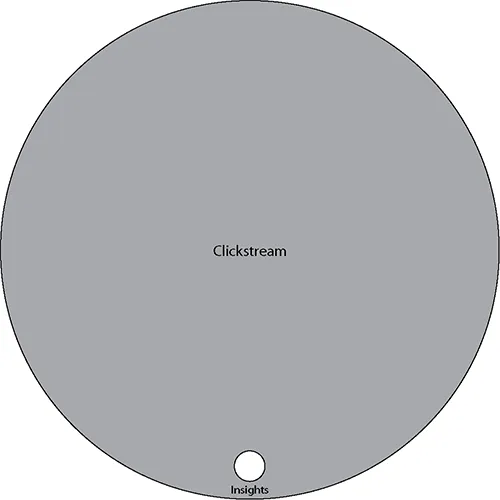
You have so little actionable insight because clickstream data is great at the what, but not at the why. That is one of the limits of clickstream data. We know every click that everyone ever makes and more. We have the what: What pages did people view on our website? What products did people purchase? What was the average time spent? What sources did they come from? What keywords or campaigns produced clicks? What this, and what that, and what not?
All this what data is missing the why. It’s important to know what happened, but it is even more critical to know why people do the things they do on your site. This was the prime motivation behind my redefinition of web analytics. For thorough web analytics, we need to include not just the why but also key questions that can help us make intelligent decisions about our web presence.
Web Analytics 2.0 is:
the analysis of qualitative and quantitative data from your website and the competition,
to drive a continual improvement of the online experience that your customers, and potential customers have,
which translates into your desired outcomes (online and offline).
This definition is specific, it’s modern, and it results in rethinking how to identify actionable insights. Figure 1-2 illustrates Web Analytics 2.0.
Figure 1-2: The updated paradigm of Web Analytics 2.0

With this definition, I wanted to expand the questions that could be answered by redefining what it meant to do web analytics, what sour...
Table of contents
- Cover
- Title Page
- Praise for Web Analytics 2.0
- Copyright
- Publisher's Note
- Dedication
- Acknowledgments
- About the Author
- Introduction
- Chapter 1: The Bold New World of Web Analytics 2.0
- Chapter 2: The Optimal Strategy for Choosing Your Web Analytics Soul Mate
- Chapter 3: The Awesome World of Clickstream Analysis: Metrics
- Chapter 4: The Awesome World of Clickstream Analysis: Practical Solutions
- Chapter 5: The Key to Glory: Measuring Success
- Chapter 6: Solving the “Why” Puzzle—Leveraging Qualitative Data
- Chapter 7: Failing Faster: Unleashing the Power of Testing and Experimentation
- Chapter 8: Competitive Intelligence Analysis
- Chapter 9: Emerging Analytics: Social, Mobile, and Video
- Chapter 10: Optimal Solutions for Hidden Web Analytics Traps
- Chapter 11: Guiding Principles for Becoming an Analysis Ninja
- Chapter 12: Advanced Principles for Becoming an Analysis Ninja
- Chapter 13: The Web Analytics Career
- Chapter 14: HiPPOs, Ninjas, and the Masses: Creating a Data-Driven Culture
- Appendix: About the Companion CD
- Index
- End-User License Agreement
Trusted by 375,005 students
Access to over 1.5 million titles for a fair monthly price.
Study more efficiently using our study tools.
Frequently asked questions
Yes, you can cancel anytime from the Subscription tab in your account settings on the Perlego website. Your subscription will stay active until the end of your current billing period. Learn how to cancel your subscription
No, books cannot be downloaded as external files, such as PDFs, for use outside of Perlego. However, you can download books within the Perlego app for offline reading on mobile or tablet. Learn how to download books offline
Perlego offers two plans: Essential and Complete
- Essential is ideal for learners and professionals who enjoy exploring a wide range of subjects. Access the Essential Library with 800,000+ trusted titles and best-sellers across business, personal growth, and the humanities. Includes unlimited reading time and Standard Read Aloud voice.
- Complete: Perfect for advanced learners and researchers needing full, unrestricted access. Unlock 1.5M+ books across hundreds of subjects, including academic and specialized titles. The Complete Plan also includes advanced features like Premium Read Aloud and Research Assistant.
We are an online textbook subscription service, where you can get access to an entire online library for less than the price of a single book per month. With over 1.5 million books across 990+ topics, we’ve got you covered! Learn about our mission
Look out for the read-aloud symbol on your next book to see if you can listen to it. The read-aloud tool reads text aloud for you, highlighting the text as it is being read. You can pause it, speed it up and slow it down. Learn more about Read Aloud
Yes! You can use the Perlego app on both iOS and Android devices to read anytime, anywhere — even offline. Perfect for commutes or when you’re on the go.
Please note we cannot support devices running on iOS 13 and Android 7 or earlier. Learn more about using the app
Please note we cannot support devices running on iOS 13 and Android 7 or earlier. Learn more about using the app
Yes, you can access Web Analytics 2.0 by Avinash Kaushik in PDF and/or ePUB format, as well as other popular books in Computer Science & Computer Science General. We have over 1.5 million books available in our catalogue for you to explore.