Discover the secrets of written persuasion!
"The principles of hypnosis, when applied to copywriting, add a new spin to selling. Joe Vitale has taken hypnotic words to set the perfect sales environment and then shows us how to use those words to motivate a prospect to take the action you want. This is truly a new and effective approach to copywriting, which I strongly recommend you learn. It's pure genius."
-Joseph Sugarman, author of Triggers
"I've read countless book on persuasion, but none come close to this one in showing you exactly how to put your readers into a buying trance that makes whatever you are offering them irresistible."
-David Garfinkel, author of Advertising Headlines That Make You Rich
"I am a huge fan of Vitale and his books, and Hypnotic Writing (first published more than twenty years ago), is my absolute favorite. Updated with additional text and fresh examples, especially from e-mail writing, Joe's specialty, Hypnotic Writing is the most important book on copywriting (yes, that's really what it is about) to be published in this century. Read it. It will make you a better copywriter, period."
-Bob Bly, copywriter and author of The Copywriter's Handbook
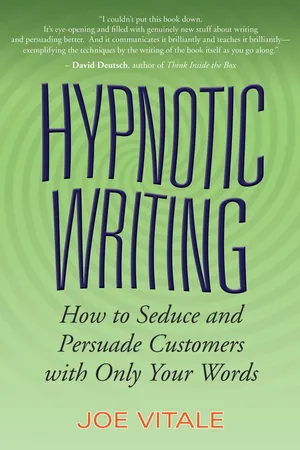
"I couldn't put this book down. It's eye opening and filled with genuinely new stuff about writing and persuading better. And it communicates it brilliantly and teaches it brilliantly-exemplifying the techniques by the writing of the book itself as you go along."
-David Deutsch, author of Think Inside the Box, www.thinkinginside.com
"Hypnotic Writing is packed with so much great information it's hard to know where to start. The insights, strategies, and tactics in the book are easy to apply yet deliver one heck of a punch. And in case there's any question how to apply them, the before-and-after case studies drive the points home like nothing else can. Hypnotic Writing is not just about hypnotic writing. It is hypnotic writing. On the count of three, you're going to love it. Just watch and see."
-Blair Warren, author of The Forbidden Keys to Persuasion
- English
- ePUB (mobile friendly)
- Available on iOS & Android
eBook - ePub
1
IT’S TIME TO AWAKEN
“You are getting sleepier . . . sleepier. . . . As I count backward from 10 to 1, you will feel your eyelids getting heavier . . . and heavier. . . .”
That’s the image you probably get when you think of hypnosis. And you’re right. Hypnosis is about getting you so relaxed that your mind, especially your subconscious, is more receptive to commands. Hypnosis is controversial but effective. It’s been around since 4 B.C., and for good reason. It works. To understand Hypnotic Writing better, let’s begin with a little history.
IN THE BEGINNING WAS THE TRANCE
According to William Edmonston in The Induction of Hypnosis, trance states and the seeds for hypnosis began with the ancient Hindus. Later, ancient Greeks in the fifth century B.C. used “sleep temples” to help cure people. Most of the other ancients, including the Romans, used words to create spells. They also usually placed their hands on or over people to move the “magnetic energy” within them.
In 1765 Franz Anton Mesmer, generally (and inaccurately) considered the father of “mesmerism,” opened salons where patients applied magnets to afflicted parts of their bodies. Later Mesmer moved to Paris where he further developed his theory. He became very popular. He wasn’t using hypnotism per se, but he was using words to create suggestion, probably unknowingly, to influence his patients.
In 1784 Louis XVI set up a commission to investigate Mesmer. It included Benjamin Franklin, M. La Guillotin, and Antoine-Laurent Lavoisier. They concluded that magnetism with imagination had some effect, but Mesmer’s magnetism and magnet healing theories were discredited.
Le Marquis de Puysegur believed magnetic power was produced in his own mind and was transferred to the patient via his fingertips. He found that he could produce a sleep in which the patient would follow his commands.
In 1841 the British doctor James Braid saw a demonstration of mesmerism by a Frenchman named La Fontaine. He was impressed, and started using the mesmerism techniques in his practice. He used a shiny bright lancet case to induce his patients to enter a deep “hypnotic sleep.” In that state his patients would accept his suggestions. He coined the word Neurypnology (literally ‘nervous sleep’), from Hypnos, the Greek god of sleep. This was the first use of the word hypnosis.
Dr. Braid didn’t care for magnetism, believing rather in “fascination” (fixation) and verbal suggestion. He also instituted the use of hypnosis as anesthesia for both minor and major operations.
In 1884 Dr. Ambroise-August Liebeault of France proclaimed that he could cure people in a hypnotic state by suggestion. In 1886 he was joined by Professor Bernheim from Paris, and together they published De La Suggestion, which further rejected the concept of magnetism.
During World War I, between 1914 and 1918, the Germans realized that hypnosis could help treat victims of shell-shock. It allowed soldiers to return to the trenches almost immediately. A formularized version of hypnosis, called Autogenic Training, was devised by Dr. Wilhem Schultz.
After World War II, Milton Erickson—arguably the most famous hypnotist of all time—had a major impact on the practice and understanding of hypnosis and the mind. He theorized that hypnosis is a state of mind that all of us are normally entering spontaneously and frequently. As you’ll soon see, this has enormous implications for your ability to influence people through your written words.
On the heels of Erickson’s work, hypnosis evolved into a well-respected practice, used by doctors, psychologists, business and law enforcement personnel, and even by people in sales and marketing. It’s also used for self help and self improvement. With the development of self-hypnosis, one doesn’t even need to rely on a therapist any longer.
Hypnosis is a tool, not a cure in and of itself. It is used for stress management, stress related disorders, dental and medical anxiety, and anesthesia, even in obstetrics. It is also used for pain management, as an adjunct to psychotherapy, and in the management of a wide range of phobic, anxiety, and other medical and psychological problems.
It’s being used by dentists, doctors, and therapists as well as stage hypnotists. It’s been sanctioned by the American Medical Association since the 1950s. It’s been used to help people with a variety of problems, from psychological to physical ones.
HYPNOTIC WRITING
But none of the above is Hypnotic Writing.
You don’t want your readers to fall asleep and neither do I. By “Hypnotic Writing” I mean writing that is irresistible. Writing that rivets your eyes to the page. Writing that is so clear and concise and effective that you can’t resist reading all of it. And more than that, Hypnotic Writing gets you to remember—and act—on what you’ve read. Hypnotic Writing is spellbinding, unforgettable, and filled with embedded commands.
That’s a lot better than putting your reader to sleep, isn’t it? I believe you’ve come across Hypnotic Writing at one time or another. Think back to the last time you were totally focused on a letter or a book. Did you lose track of time? Did someone call you, but you didn’t hear them yell out? Were you so absorbed in your reading that nothing else mattered?
Face it. You were hypnotized.
Even Shakespeare used Hypnotic Writing, though of course he would never have called it that. According to Peter Brown, in his book, The Hypnotic Brain, Shakespeare’s The Tempest uses hypnotic induction to get readers captivated. The play begins with a shipwreck, causing people to sit up and take notice. That’s a key element in hypnosis: Get attention. Shakespeare did it. The play then moves into a dialogue where the audience is told to sit still and listen. That’s a hypnotic command. Brown adds, “The story is as absorbing and moving today as it was nearly four hundred years ago.”
One of the readers of my books wrote me one day to tell me a book he had read hypnotized him to stop smoking. He said Allen Carr’s book, The Easy Way to Stop Smoking, actually awakens people from their trance of addiction. By the time they finish reading the book, they are nonsmokers. Apparently Carr’s Hypnotic Writing works, as he has now helped millions of people stop smoking. Many people said just reading the book will help you stop smoking.
Friends told me the same thing happened when they read Healing Back Pain by John Sarno. Again, apparently just reading the book helped them awaken from the “pain trance” and actually alleviated and in many cases cured their back pain. I had a similar experience while reading Sarno’s latest book, The Divided Mind. It seemed to take me from one trance—believing in the power of traditional medicine—and to put me in another trance—believing in the power of the unconscious mind. This is the power of Hypnotic Writing. (I explore this trance state in my next book, Buying Trances.)
In fact, in a few pages I prove how one of the greatest mystery writers of all time actually used hypnotic techniques in her books to make her readers buy more of them. In short, she made readers addicted to her novels.
I love Hypnotic Writing. I long to read books that capture my attention and won’t let go. Actually, I don’t see enough writing of that caliber. Do you?
If you want to hold your reader’s attention, then you have to learn how to create Hypnotic Writing. That’s what this book is all about. My intention is to reveal—for the first time anywhere—the principles and strategies that will transform your writings. In an age when radio, television, computer games, videos, and movies are screeching for our attention—and when there is more information than you can possibly read—you must learn to write material your readers can’t avoid. You don’t have any other choice.
With these Hypnotic Writing concepts in mind, you’ll begin to write memos, letters, ads, reports, and yes—even books—that few can resist. You will be able to create mesmerizing writing. You will become a superwriter! You will be equipped to develop writing that outshines the competition and dazzles your readers!
And with your new ability, you’ll be able to get more results and command higher pay for your work. “Hypnotic Writing,” in short, will give you the edge you need to create successful and powerful writing.
Hypnotic Writing isn’t about manipulation; it’s about communication. You won’t put your prospects or buyers into trance states where they do your bidding. People will never do what they don’t have a latent desire to already do. The idea behind Hypnotic Writing is to help you better communicate, and thus better persuade people.
All of this will become clear as you move through this book.
Are you ready?
You cannot teach a man anything; you can only help him find it within himself.
—Galileo
2
STOP! DO THIS FIRST
How do you currently write your sales letters, e-mails, ads, or web site copy?
You already have a strategy for writing. For this book to make the most sense to you, you need to know where you’re at right now. In short, become aware of your current writing method. From there, it will be easier to adapt what you are about to learn.
On the lines following, write a brief explanation of how you currently go about your writing. Explain your process. What do you do just before you write? What do you do as you write? What do you do after you write? Write your answers here:


3
WHAT IS IMPOSSIBLE?
A few minutes ago I read about a woman who has 6 children, 35 grandchildren, 75 great-grandchildren and 10 great, greatgrandchildren—who jumped from an airplane to celebrate her ninety-third birthday. That’s a woman who thinks big.
I believe in the impossible. I think you can have, do, or be anything you can imagine. That’s the subject of one of my earlier books, titled The Attractor Factor. It’s also, for the most part, the way I live my life.
I love to think big. I also love to read about people who set “impossible” goals, and then achieve them. Whether it’s Roger Bannister breaking the four-minute mile, NASA sending a man to the moon, Bruce Barton writing a fundraising letter that pulls a 100% response, or a 93-year-old woman skydiving, all of it proves we have no known limits. None.
What we have, instead, are mind-sets, or mental models. Yoram Wind and Colin Crook, writing in their mind expanding book, The Power of Impossible Thinking, declare, “Mental models shape every aspect of our lives.”
For example, I am currently reading C.K. Prahalad’s book, The Fortune at the Bottom of the Pyramid, and love the true stories of people and companies helping the poor in places like Brazil and India. These people are not thinking small.
For example, Aravind Eye Hospital in India grew from an 11-bed facility to the largest eye care facility in the world. They see over 1.4 million patients and perform over 200,000 sight-restoring surgeries each year. Two-thirds of their patients are served at no cost, and those who pay, pay an average of just $75. The hospital was modeled on the management style of McDonald’s—only it gives fast care for low (or no) money.
Here’...
Table of contents
- Praise
- Title Page
- Copyright Page
- Dedication
- Epigraph
- AUTHOR’S WARNING
- Acknowledgements
- Introduction
- Chapter 1 - IT’S TIME TO AWAKEN
- Chapter 2 - STOP! DO THIS FIRST
- Chapter 3 - WHAT IS IMPOSSIBLE?
- Chapter 4 - A DISCLAIMER
- Chapter 5 - A BEGINNING
- Chapter 6 - AGATHA CHRISTIE PROVES HYPNOTIC WRITING EXISTS
- Chapter 7 - MY SECRET TO HYPNOTIC WRITING
- Chapter 8 - YOU CAN’T EVEN BRIBE ME TO READ A LOUSY LETTER!
- Chapter 9 - WHAT IS HYPNOTIC WRITING?
- Chapter 10 - HYPNOTIC WRITING: A CASE STUDY
- Chapter 11 - THE GREAT INTIMACY SECRET
- Chapter 12 - WHAT’S MORE IMPORTANT THAN COPY?
- Chapter 13 - HYPNOTIC WRITING CONTROLLED STUDY
- Chapter 14 - HOW I LEARNED THE SECRET OF HYPNOTIC WRITING
- Chapter 15 - WHAT IS HYPNOSIS?
- Chapter 16 - TWO WAYS TO CAUSE ACTION
- Chapter 17 - WHAT ABOUT YOUR WEB SITE?
- Chapter 18 - HOW LONG IS TOO LONG?
- Chapter 19 - WHAT EVERY READER WANTS TO KNOW
- Chapter 20 - THE HYPNOTIC POWER OF REPETITION
- Chapter 21 - THE INNER GAME OF HYPNOTIC WRITING
- Chapter 22 - IMITATION SUGAR IS SWEET, TOO!
- Chapter 23 - HOW TO JUMP-START THE MUSE
- Chapter 24 - HOW TO NAIL YOUR READER’S ATTENTION
- Chapter 25 - HOW TO MAKE YOUR WRITING WALK, TALK, AND BREATHE
- Chapter 26 - GIVE ME SOME MEAT!
- Chapter 27 - A WRITING LESSON FROM THE WORLD’S GREATEST HYPNOTIST
- Chapter 28 - ELECTRIFYING TIPS FOR CREATING BREAKTHROUGH WRITING
- Chapter 29 - A CASE AGAINST PERFECTION
- Chapter 30 - HOW TO PERSUADE READERS TO YOUR SIDE
- Chapter 31 - WARP SPEED EDITING SECRETS WORTH KILLING FOR
- Chapter 32 - HOW TO MAKE YOUR WRITING SEXY
- Chapter 33 - HOW PEOPLE THINK
- Chapter 34 - HOW TO CREATE HYPNOTIC STORIES
- Chapter 35 - HOW TO CONTROL THE “COMMAND CENTER” INYOUR PROSPECT’S MIND
- Chapter 36 - THE ONE HYPNOTIC COMMAND THAT ALWAYS WORKS
- Chapter 37 - WHAT I LEARNED FROM THE SEA WOLF
- Chapter 38 - YOUR TURNING POINT MESSAGE
- Chapter 39 - WHAT EVERYONE WILL ALWAYS READ
- Chapter 40 - YOUR CONNOTATION IS SHOWING
- Chapter 41 - WHAT ARE MY SECRETS FOR WRITING HYPNOTIC SELLING STORIES?
- Chapter 42 - HYPNOTIC BLOGGING
- Chapter 43 - REMINDERS AS TRIGGERS
- Chapter 44 - HOW TO CHANGE AVERAGE WRITING INTO HYPNOTIC WRITING
- Chapter 45 - 30 WAYS TO WRITE A HYPNOTIC HEADLINE
- Chapter 46 - HYPNOTIC OPENINGS
- Chapter 47 - HYPNOTIC QUIZ
- Chapter 48 - MY THREE BIGGEST SECRETS
- Chapter 49 - HOW MUCH IS THAT DOGGIE IN THE WINDOW?
- Chapter 50 - HOW TO CHANGE PERCEPTION
- Chapter 51 - AT LAST! THE JOE VITALE HYPNOTIC WRITING FORMULA
- Chapter 52 - A NEW HYPNOTIC COPY CHECKLIST
- Chapter 53 - THE FIVE SECRET LAWS OF HYPNOTIC PERSUASION
- Chapter 54 - THE SEVEN MOST HYPNOTIC BOOKS OF ALL TIME
- Chapter 55 - THE HYPNOTIC WRITING FORMULA
- Chapter 56 - YOUR CHALLENGE
- Appendix - HYPNOTIC E-MAILS
- BIBLIOGRAPHY
- INDEX
- ABOUT DR. JOE VITALE
- HOW CAN YOU EASILY BECOME A MORE POWERFUL HYPNOTIC WRITER?
Trusted by 375,005 students
Access to over 1.5 million titles for a fair monthly price.
Study more efficiently using our study tools.
Frequently asked questions
Yes, you can cancel anytime from the Subscription tab in your account settings on the Perlego website. Your subscription will stay active until the end of your current billing period. Learn how to cancel your subscription
No, books cannot be downloaded as external files, such as PDFs, for use outside of Perlego. However, you can download books within the Perlego app for offline reading on mobile or tablet. Learn how to download books offline
Perlego offers two plans: Essential and Complete
- Essential is ideal for learners and professionals who enjoy exploring a wide range of subjects. Access the Essential Library with 800,000+ trusted titles and best-sellers across business, personal growth, and the humanities. Includes unlimited reading time and Standard Read Aloud voice.
- Complete: Perfect for advanced learners and researchers needing full, unrestricted access. Unlock 1.5M+ books across hundreds of subjects, including academic and specialized titles. The Complete Plan also includes advanced features like Premium Read Aloud and Research Assistant.
We are an online textbook subscription service, where you can get access to an entire online library for less than the price of a single book per month. With over 1.5 million books across 990+ topics, we’ve got you covered! Learn about our mission
Look out for the read-aloud symbol on your next book to see if you can listen to it. The read-aloud tool reads text aloud for you, highlighting the text as it is being read. You can pause it, speed it up and slow it down. Learn more about Read Aloud
Yes! You can use the Perlego app on both iOS and Android devices to read anytime, anywhere — even offline. Perfect for commutes or when you’re on the go.
Please note we cannot support devices running on iOS 13 and Android 7 or earlier. Learn more about using the app
Please note we cannot support devices running on iOS 13 and Android 7 or earlier. Learn more about using the app
Yes, you can access Hypnotic Writing by Joe Vitale in PDF and/or ePUB format, as well as other popular books in Business & Business Communication. We have over 1.5 million books available in our catalogue for you to explore.