![]()
Chapter 1
Microporous Carbon Membranes
Miki Yoshimune and Kenji Haraya
Research Institute for Innovation in Sustainable Chemistry, National Institute of Advanced Industrial Science and Technology (AIST), Tsukuba, Japan
1.1 Introduction
There is growing interest in the development of microporous inorganic membranes made of zeolites, silica, carbon, or similar materials, whose separation mechanisms are controlled mainly by the molecular sieving effect. Such inorganic membranes are capable of achieving excellent separation efficiencies and, unlike conventional polymeric membranes, can function at high temperatures or in harsh environments. Carbon membranes have the greatest potential among these inorganic membranes because of the relative ease with which they can be produced and their resulting low cost.
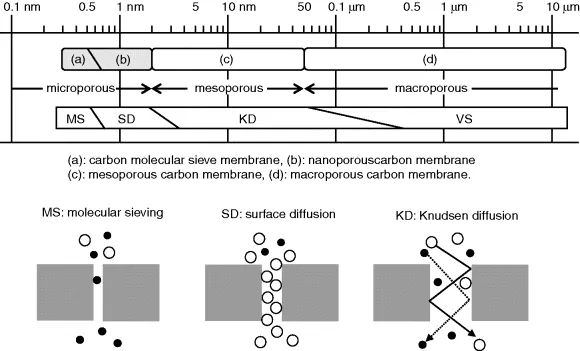
Figure 1.1 shows the general types of carbon membranes together with a classification of their gas transport mechanisms into various categories, such as molecular sieving, surface diffusion, Knudsen diffusion, and viscous flow (VS), together with the ranges of pore sizes that correspond to each particular mechanism. Microporous carbon membranes can be categorised into two types: (i) carbon molecular sieve (CMS) membranes (Figure 1.1a) and (ii) nanoporous carbon membranes (Figure 1.1b). CMS membranes, first prepared by Koresh and Soffer [1], have micropores with diameters of approximately 0.3–0.5 nm, and they are characterised by high selectivities in gas separations as a result of the selective permeation of smaller gas molecules. Nanoporous carbon membranes were designed by Rao and Sircar [2–4] as selective surface flow (SSF) membranes, and have larger micropores (0.5–0.7 nm) than CMS membranes.
Because separations using microporous carbon membranes have attracted consistently high levels of research interest, they are the subject of a number of excellent reviews and books [5–9]. This chapter presents an overview of recent researches on microporous carbon membranes and explores their possible applications in membrane reactors. Section 1.3 reviews and discusses the factors that control the preparation of high-performance microporous carbon membranes. Trends in mixed-matrix carbon membranes prepared from polymeric precursors that incorporate inorganic materials such as metals, metal oxides, or zeolites are discussed in Section 1.3.10. These incorporation methods can also be used to prepare catalytic membranes for use in membrane reactors; such membranes are discussed in Section 1.5.
1.2 Transport Mechanisms in Carbon Membranes
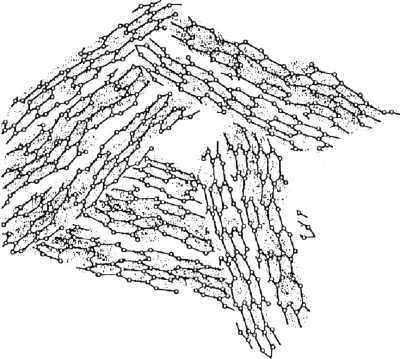
The microporous carbon membranes that are used for gas separation usually have a turbostratic structure [10] in which layer planes of graphite-like microcrystallites are randomly stacked. Figure 1.2 shows that there are lattice vacancies in the microcrystallites and that pores are formed from imperfections in the packing between microcrystalline regions.
The mechanism of gas transport through porous carbon membranes is essentially the same as that in other inorganic porous membranes. When the pore diameter (dp) is greater than the mean free path of the gas molecule (λ), intermolecular collisions predominate and the transport of gas molecules through porous membranes under a pressure or a concentration gradient corresponds to viscous flow and is nonselective.
When
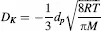
dp is smaller than λ, collisions between the gas molecules and the pore walls predominate so that the transport of gas molecules is controlled by the thermal mean velocity of the gas molecules (
). In the case of a capillary pore with a diameter of
dp, the diffusion of the gas can be described by
Equation (1.1).
Here,
Dk is the Knudsen diffusion coefficient,
R is the universal gas constant,
T is the absolute temperature, and
M is the molecular weight of the penetrant gas. On the basis of Knudsen diffusion, the selectivity (i.e., the ideal separation factor) of a gas pair A–B is given by the expression
.
When the temperature is within the range where adsorption of gas molecules on the pore walls becomes important, transport of the gas molecules along the surface (surface diffusion) occurs in combination with Knudsen flow. The effects of surface diffusion increase with decreasing dp and they produce selectivity in the flow as a result of selective adsorption. Selective surface flow (SSF) membranes, as named by Rao and Sircar [2–4], operate in this regime. SSF membranes can achieve high performances in separations of gas mixtures consisting of a readily adsorbed species and a component that is not readily adsorbed, such as mixtures of hydrocarbons with hydrogen. If penetrants are condensable, such as vapours, the condensates can completely fill the pores resulting in capillary condensation that blocks the permeation of noncondensable components. This mechanism has been observed in other inorganic porous membranes, but has not yet been reported in carbon membranes.
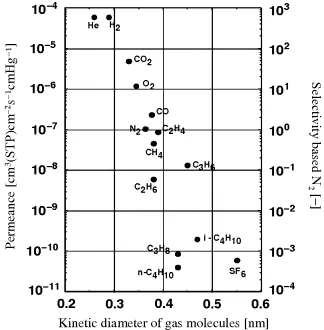
When dp is of a similar size to that of a gas molecule (0.5 nm or less), selective transport as a result of a molecular sieving effect can be observed. Smaller molecules pass readily through the pores, whereas the passage of larger molecules is obstructed or highly restricted. Microporous carbon membranes in this regime are usually known as carbon molecular sieve (CMS) membranes. Typical examples of the permeances of various gases through a CMS membrane are plotted in Figure 1.3 as a function of the size of the gas molecule. This figure shows that the membrane is not only effective in separating mixtures of gases of different molecular sizes, such as H2/CH4, H2/C3H8, He/N2, or N2/SF6, but also in separating gases of similar molecular sizes, such as O2/N2, CO2/CH4, CO2/N2, or C3H6/C3H8.
Because diffusion is an activated process in both CMS and polymeric membranes, the diffusion coefficient (D) can be expressed by an Arrhenius-type relationship:
Here, ED is the energy of activation required for a gas molecule to execute a diffusive jump from one cavity to another, and D0 is the temperature-independent pre-exponential term. The diffusion selectivity of A–B gas molecules can be expressed as follows:
The exponential term is an energetic selectivity. For gas molecules that differ in both size, and shape, complex configurational effects related to factors affecting D0 for the components A and B can occur. These configurational selectivity contributions to the DA/DB ratio are often referred to as the entropic selectivity [11]. The excellent selectivity observed in CMS membranes is the result of a favourable contribution from this factor, which is generally lacking in conventional polymeric membranes.
1.3 Methods for the Preparation of Microporous Carbon Membranes
1.3.1 General Preparation and Characterisation
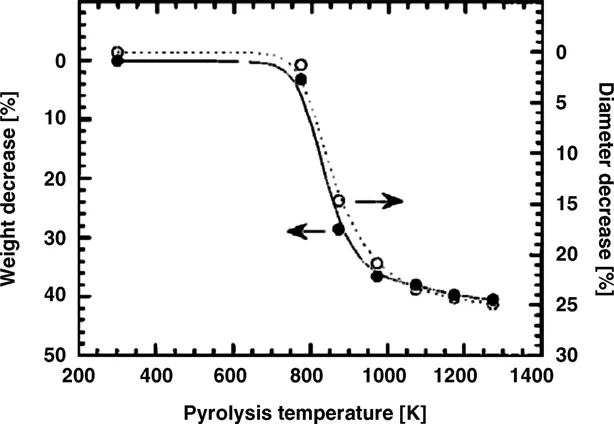
Microporous carbon membranes are generally formed by pyrolysing polymeric precursor membranes. Pyrolysis (or carbonisation) is the process whereby the precursor membrane is heated to a pyrolysis temperature in the range 500–1000 °C under a controlled atmosphere, such as a vacuum or an inert gas (N2, He, or Ar), at a specific heating rate and then held at the pyrolysis temperature for a sufficiently long thermal soak time [8]. Gaseous decomposition products are evolved during the pyrolysis of the polymeric precursor, resulting in formation of micropores in the membrane; this is accompanied by a considerable loss in weight and dimensional shrinkage. Figure 1.4 shows a typical example in which a weight loss of up to 40% and shrinkage by up to 25% were observed during pyrolysis of circular films of a polyimide [12]. The pyrolysed membranes are sometimes post-treated by chemical vapour deposition (CVD) or by activation processes to improve their performance.
The greatest interest in the resulting carbon membranes is in evaluating the possibilities for their use as separation membranes. For this reason, the permeabilities of gases or vapours through the membranes are usually measured by using a permeation test apparatus. In some cases, pervaporation tests are also performed to test the separation performances for organic solutions such as water–ethanol or benzene–cyclohexane [6]. Gas permeability or permeance through flawless carbon membranes depends mainly on the size of the gas molecules, as shown in Figure 1.3, so that the relationship can be considered as an index of the pore size distribution.
The microstructures of carbon membranes are generally investigated by several analytical techniques; these include gas adsorption measurements, wide angle X-ray diffraction (WAXD), high-resol...