Internet of Things: Connecting Objects puts forward the technologies and the networking architectures which make it possible to support the Internet of Things. Amongst these technologies, RFID, sensor and PLC technologies are described and a clear view on how they enable the Internet of Things is given. This book also provides a good overview of the main issues facing the Internet of Things such as the issues of privacy and security, application and usage, and standardization.
- English
- ePUB (mobile friendly)
- Available on iOS & Android
eBook - ePub
About this book
Information
Chapter 1
Introduction to the Internet of Things 1
1.1. Introduction
The Internet of Things (IoT) is somehow a leading path to a smart world with ubiquitous computing and networking. It aims to make different tasks easier for users and provide other tasks, such as easy monitoring of different phenomena surrounding us. With ubiquitous computing, computing will be embedded everywhere and programmed to act automatically with no manual triggering; it will be omnipresent.
In the IoT, environmental and daily life items, also named “things”, “objects”, or “machines” are enhanced with computing and communication technology and join the communication framework. In this framework, wireless and wired technologies already provide the communication capabilities and interactions, meeting a variety of services based on person-to-person, person-to-machine, machine-to-person, machine-to-machine interactions and so on. These connected machines or objects/things will be new Internet or network users and will generate data traffic in the current or emerging Internet.
Connecting objects might be wireless, as with the radio frequency identification (RFID), or sensor radio technologies that offers, respectively, identification of items and sensing of the environment. Connection may be wired, as with power line communication (PLC). PLC offers data transport over electrical media and has pioneered the in-home networking connectivity of electronic consumer devices that we also name “objects” such as smart fridges, smart TVs, smart heaters, etc.
IoT-based services will provide more automation of various tasks around people and connected objects in order to build a smart world not only in manufacturing industries but also in the office, at home and everywhere. Most of these services will also rely on the easy location and tracking of connected objects. Other services — object-to-object-oriented services — will emerge for instance in the context of the green planet goal. This is where specific applications will monitor the environment and automatically react, for example, to minimize energy wastage or avoid natural disasters.
In the IoT, identifying, sensing and automatically deciding and actuating will be the main new functionalities that will enable ubiquitous computing and networking. Therefore, sensor and RFID, among other technologies, will be increasingly deployed and will thus allow integration of the real world environment in the networked services. In fact, billions of RFID tags and sensors are expected to connect billions of items/objects/things to the network in the coming years. Scalable identification, naming and addressing space and structure, scalable name resolution, scalable and secure data transfer are all of major concern. Other enabling technologies for this real-world networked service include nanotechnology, automatic processing and robotics, and probably newly-emerging technologies enabling the envisioned smart world to become real.
IoT will connect heterogenous devices and will be very dense, connecting billions of objects. An Internet-, IP- (Internet protocol) or TCP/IP (transport control protocol/Internet protocol) -based model stands at the centre of the IoT. It is one possible INTERNETworking solution to hide the ever-increasing heterogenity of networking technologies and communication systems in the ubiquitous environment envisioned. IP might not, however, support the resource limitation and scalability of the network.
IP or the Internet will certainly support the close-to-market IoT applications, but IoT research development will hopefully also come with a new INTERNETworking communication model and architecture. These will better support the new requirement of the heterogenity of objects, scalability (of billions of objects expected), limited resources of connecting objects and requirements related to new services and applications to be designed over this connected real world. It falls exactly under the post-IP or future Internet era [EUR 08, GEN 10, FIN 10], where several research projects are building a new communication model and architecture that is more adaptive to the requirements of a given network.
IoT is one network with new requirements related to the introduction of these nodes/objects with new technologies in the network. The existing TCP/IP model might be compatible with the emerging post-IP or future Internet model. While seeking the design of the IoT network and services, a rethinking of the basic concepts will emerge related to addressing, routing, scaling, guaranteeing quality of service, security, mobility, etc. These research projects are currently supported by the all-IP network, where the packet-switching TCP/IP model has taken over the classical telecom circuit-switching model. Thanks to convergent efforts, the Internet is already the generalized model in telecommunications to offer different services.
1.2. History of IoT
IoT was originally introduced by the Auto-ID research center at the MIT (Massachusetts Institute) [AUT] where an important effort was made to uniquely identify products. The result was termed EPC (electronic product code), which was then commercialized by EPCglobal. EPCglobal was created to follow the AutoID objectives in the industry, with the EAN.UCC (European Article Numbering — Uniform Code Council), now called GS1, as a partner to commercialize Auto-ID research, mainly the EPC.
A “thing” or “object” is any possible item in the real world that might join the communication chain. As presented by [HOD 01], the initial main objective of the IoT was to combine the communication capabilities characterized by data transmission. This was viewed as the Internet, also known as the network of bits representing the “digital world”. The process of automation was viewed as connecting the real or physical world, named the “network of atoms” characterized by the smallest component, which is the atom, to the digital world, named the “network of bits”, characterized by the smallest component, which is the bit.
Figure 1.1. Origin of IoT [HOD 01]
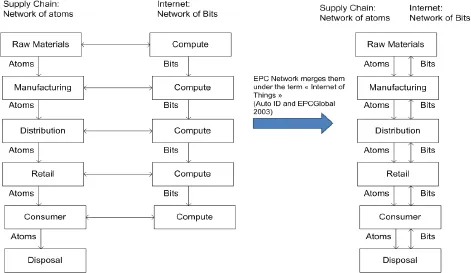
In 2005, the ITU (International Telecommunication Unit) showed interest in new telecommunication business possibilities that could be built into services around the new connectivity of environment objects to the network.
The ITU produced a comprehensive report on the IoT from technical, economical and ethical views [IoT 05]. It introduced a new axis in the ubiquitous networking path to complete the existing “anywhere” and “anytime” connectivity. It is the “anything” connectivity axes where the thing-to-thing or machine-to-machine interaction is added to complete the existing person-to-person and person-to-machine interaction in the possible connectivity framework. This clearly opens new service opportunities.
Figure 1.2 presents the ITU view of ubiquitous networking, adding the “anything connection” to the connectivity anywhere and anytime.
Figure 1.2. ITU any place, any time and any thing vision [IoT 05]
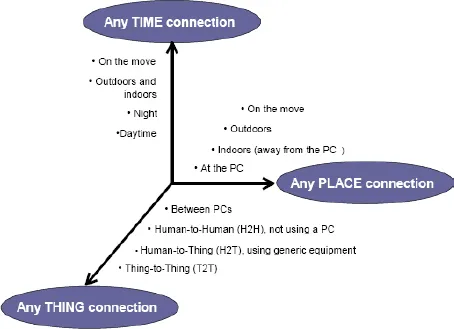
By adding the “any thing” connection axis, new sources of information are introduced in the connected network and this enables new services exploiting the newly-introduced information in the network. These services will be designed to offer the expected ubiquitous networking, where the real-world environment might react and adapt to different situations in order to make human life easier and more comfortable. Connecting these new objects will obviously raise many questions such as:
– the connecting technology of the so-called objects;
– the interoperability between objects;
– the communication model of these connected objects;
– the possible interaction with the existing models, such as the Internet;
– the choice of the transport model;
– the addressing, identifying and naming;
– the security and privacy;
– the economic impact and the telecommunication value chain evolution.
In fact, most of the Internet services were designed to satisfy person-to-person interaction, such as email and phone service. The traffic transported through the Internet is currently generated by people; either voice or data. New services were then developed around person-to-machine and machine-to-person interactions, such as video-on-demand or content distribution services. Finally, in order to provide tasks and process automation, new services will be developed around the machine-to-person, machine-to-machine or thing-to-thing and any other possible interactions in the so-called ubiquitous networking, as shown in Figure 1.3.
Figure 1.3. Ubiquitous networking [IoT 05]
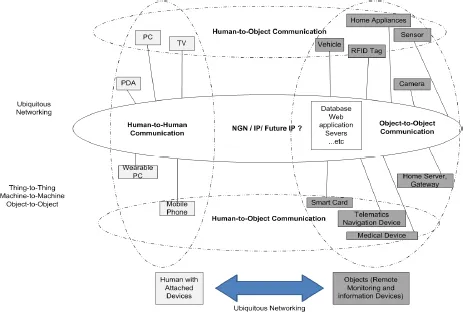
IoT will connect objects to offer new services around people and objects; we can also call it the “Network of Things/Objects”. IoT might suggest that the Internet model will have to be adapted to support the connectivity and traffic transport of new services based upon the connected objects. It is also worth mentioning that “Web of Objects” is another term used to refer to the IoT. As the Web is the main service accessibility to current Internet-connected nodes, similarly IoT is seen as the main service accessibility to the networked and connected objects. Also, in IoT, the naming resolution of identifiers to Web addresses is needed to handle the correspondence of identifiers introduced by RFID technology and ONS (object name service) has been introduced for that — as a similar service to the internet DNS (domain name service). “Web of Objects” has more meaning from the application viewpoint, without indirectly implying the extension of the Internet communication model to these new connected objects, as “IoT” might suggest.
1.3. About objects/things in the IoT
What exactly is a connecting or connected object or a thing? In close-to-market IoT applications, RFID tags and sensors are connecting inanimate objects and are building the actual things enabling the first IoT services.
Following the American Auto ID research center description of the IoT and the European CASAGRAS research project terminology [CAS 08], “things” or “objects” are described as a set of atoms. The atom is the smallest object in the IoT; as could be seen by nanotechnology, which is one of the enabling technologies of the IoT. A network of atoms combined with a network of bits falls into what is named the IoT. It will gather a set of objects connected to the network to help in the execution of new services enabling the smart world. So with the atom, being the smallest possible object, it is possible to classify objects based on their size and complexity, their moveable aspect and whether they are animate or inanimate, as shown in Figure 1.4 [CAS 08].
Figure 1.4. Objects classification [CAS 08]
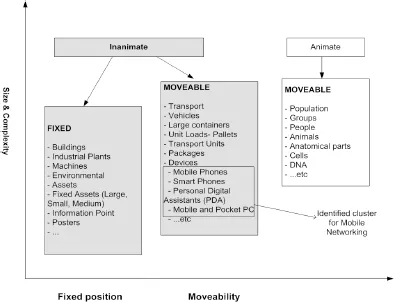
In this terminology, classic devices such as PCs and mobile phones are already connected objects using wired or wireless communication. IoT will extend the connectivity and interworking of these currently existing objects with new objects connected through radio sensing or identifying technologies, such as sensor or RFID networks, allowing the development of new services involving information from the environment. This information could be either a simple ...
Table of contents
- Cover
- Title Page
- Copyright
- Preface
- Chapter 1: Introduction to the Internet of Things
- Chapter 2: Radio Frequency Identification Technology Overview
- Chapter 3: Wireless Sensor Networks: Technology Overview
- Chapter 4: Power Line Communication Technology Overview
- Chapter 5: RFID Applications and Related Research Issues
- Chapter 6: RFID Deployment for Location and Mobility Management on the Internet
- Chapter 7: The Internet of Things — Setting the Standards
- Chapter 8: Governance of the Internet of Things
- Conclusion
- List of Authors
- Index
Trusted by 375,005 students
Access to over 1.5 million titles for a fair monthly price.
Study more efficiently using our study tools.
Frequently asked questions
Yes, you can cancel anytime from the Subscription tab in your account settings on the Perlego website. Your subscription will stay active until the end of your current billing period. Learn how to cancel your subscription
No, books cannot be downloaded as external files, such as PDFs, for use outside of Perlego. However, you can download books within the Perlego app for offline reading on mobile or tablet. Learn how to download books offline
Perlego offers two plans: Essential and Complete
- Essential is ideal for learners and professionals who enjoy exploring a wide range of subjects. Access the Essential Library with 800,000+ trusted titles and best-sellers across business, personal growth, and the humanities. Includes unlimited reading time and Standard Read Aloud voice.
- Complete: Perfect for advanced learners and researchers needing full, unrestricted access. Unlock 1.5M+ books across hundreds of subjects, including academic and specialized titles. The Complete Plan also includes advanced features like Premium Read Aloud and Research Assistant.
We are an online textbook subscription service, where you can get access to an entire online library for less than the price of a single book per month. With over 1.5 million books across 990+ topics, we’ve got you covered! Learn about our mission
Look out for the read-aloud symbol on your next book to see if you can listen to it. The read-aloud tool reads text aloud for you, highlighting the text as it is being read. You can pause it, speed it up and slow it down. Learn more about Read Aloud
Yes! You can use the Perlego app on both iOS and Android devices to read anytime, anywhere — even offline. Perfect for commutes or when you’re on the go.
Please note we cannot support devices running on iOS 13 and Android 7 or earlier. Learn more about using the app
Please note we cannot support devices running on iOS 13 and Android 7 or earlier. Learn more about using the app
Yes, you can access The Internet of Things by Hakima Chaouchi in PDF and/or ePUB format, as well as other popular books in Technology & Engineering & Mobile & Wireless Communications. We have over 1.5 million books available in our catalogue for you to explore.