Covers the hottest topic in investment for multitrillion pension market and institutional investors
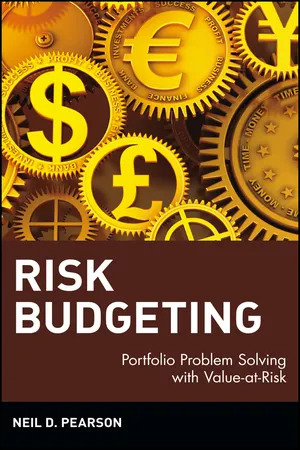
Institutional investors and fund managers understand they must take risks to generate superior investment returns, but the question is how much. Enter the concept of risk budgeting, using quantitative risks measurements, including VaR, to solve the problem. VaR, or value at risk, is a concept first introduced by bank dealers to establish parameters for their market short-term risk exposure. This book introduces VaR, extreme VaR, and stress-testing risk measurement techniques to major institutional investors, and shows them how they can implement formal risk budgeting to more efficiently manage their investment portfolios. Risk Budgeting is the most sophisticated and advanced read on the subject out there in the market.
- English
- ePUB (mobile friendly)
- Available on iOS & Android
eBook - ePub
PART ONE
Introduction
CHAPTER 1
What Are Value-at-Risk and Risk Budgeting?
It is a truism that portfolio management is about risk and return. Although good returns are difficult to achieve and good risk-adjusted returns can be difficult to identify, the concept and importance of return requires no explanation. Larger returns are preferred to smaller ones. This is true at the level of the pension plan, at the level of each asset manager or portfolio used by or within the plan, and at the level of the individual assets. It follows from the fact that the contribution of an asset to the portfolio return is simply the asset’s weight in the portfolio.
Risk is more problematic. Risk is inherently a probabilistic or statistical concept, and there are various (and sometimes conflicting) notions and measures of risk. As a result, it can be difficult to measure the risk of a portfolio and determine how various investments and asset allocations affect that risk. Equally importantly, it can be difficult to express the risk in a way that permits it to be understood and controlled by audiences such as senior managers, boards of directors, pension plan trustees, investors, regulators, and others. It can even be difficult for sophisticated people such as traders and portfolio managers to measure and understand the risks of various instruments and portfolios and to communicate effectively about risk.
For years fund managers and plan sponsors have used a panoply of risk measures: betas and factor loadings for equity portfolios, various duration concepts for fixed income portfolios, historical standard deviations for all portfolios, and percentiles of solvency ratio distributions for long-term asset/liability analysis. Recently the fund management and plan sponsor communities have become interested in value-at-risk (VaR), a new approach that aggregates risks to compute a portfolio- or plan-level measure of risk. A key feature of VaR is that it is “forward-looking,” that is, it provides an estimate of the aggregate risk of the current portfolio over the next measurement period. The existence of a forward-looking aggregate measure of risk allows plan sponsors to decompose the aggregate risk into its various sources: how much of the risk is due to each asset class, each portfolio manager, or even each security? Alternatively, how much of the risk is due to each underlying risk factor? Once the contribution to aggregate risk of the asset classes, managers, and risk factors has been computed, one can then go on to the next step and use these risk measures in the asset allocation process and in monitoring the asset allocations and portfolio managers.
The process of decomposing the aggregate risk of a portfolio into its constituents, using these risk measures to allocate assets, setting limits in terms of these measures, and then using the limits to monitor the asset allocations and portfolio managers is known as risk allocation or risk budgeting. This book is about value-at-risk, its use in measuring and identifying the risks of investment portfolios, and its use in risk budgeting. But to write that the book is about value-at-risk and risk budgeting is not helpful without some knowledge of these tools. This leads to the obvious question: What are value-at-risk and risk budgeting?
VALUE-AT-RISK
Value-at-risk is a simple, summary, statistical measure of possible portfolio losses due to market risk. Once one crosses the hurdle of using a statistical measure, the concept of value-at-risk is straightforward. The notion is that losses greater than the value-at-risk are suffered only with a specified small probability. In particular, associated with each VaR measure are a probability α, or a confidence level 1 − α, and a holding period, or time horizon, h. The 1 − α confidence value-at-risk is simply the loss that will be exceeded with a probability of only α percent over a holding period of length h; equivalently, the loss will be less than the VaR with probability 1 − α. For example, if h is one day, the confidence level is 95% so that α = 0.05 or 5%, and the value-at-risk is one million dollars, then over a one-day holding period the loss on the portfolio will exceed one million dollars with a probability of only 5%. Thus, value-at-risk is a particular way of summarizing and describing the magnitude of the likely losses on a portfolio.
Crucially, value-at-risk is a simple, summary measure. This makes it useful for measuring and comparing the market risks of different portfolios, for comparing the risk of the same portfolio at different times, and for communicating these risks to colleagues, senior managers, directors, trustees, and others. Value-at-risk is a measure of possible portfolio losses, rather than the possible losses on individual instruments, because usually it is portfolio losses that we care most about. Subject to the simplifying assumptions used in its calculation, value-at-risk aggregates the risks in a portfolio into a single number suitable for communicating with plan sponsors, directors and trustees, regulators, and investors. Finally, value-at-risk is a statistical measure due to the nature of risk. Any meaningful aggregate risk measure is inherently statistical.
VaR’s simple, summary nature is also its most important limitation—clearly information is lost when an entire portfolio is boiled down to a single number, its value-at-risk. This limitation has led to the development of methodologies for decomposing value-at-risk to determine the contributions of the various asset classes, portfolios, and securities to the value-at-risk. The ability to decompose value-at-risk into its determinants makes it useful for managing portfolios, rather than simply monitoring them.
The concept of value-at-risk and the methodologies for computing it were developed by the large derivatives dealers (mostly commercial and investment banks) during the late 1980s, and VaR is currently used by virtually all commercial and investment banks. The phrase value-at-risk first came into wide usage following its appearance in the Group of Thirty report released in July 1993 (Group of Thirty 1993) and the release of the first version of RiskMetrics in October 1994 (Morgan Guaranty Trust Company 1994). Since 1993, the numbers of users of and uses for value-at-risk have increased dramatically, and the technique has gone through significant refinement.
The derivatives dealers who developed value-at-risk faced the problem that their derivatives portfolios and other trading “books” had grown to the point that the market risks inherent in them were of significant concern. How could these risks be measured, described, and reported to senior management and the board of directors? The positions were so numerous that they could not easily be listed and described. Even if this could be done, it would be helpful only if senior management and the board understood all of the positions and instruments, and the risks of each. This is not a realistic expectation, as some derivative instruments are complex. Of course, the risks could be measured by the portfolio’s sensitivities, that is, how much the value of the portfolio changes when various underlying market rates or prices change, and the option deltas and gammas, but a detailed discussion of these would likely only bore the senior managers and directors. Even if these concepts could be explained in English, exposures to different types of market risk (for example, equity, interest rate, and exchange rate risk) cannot meaningfully be aggregated without a statistical framework. Value-at-risk offered a way to do this, and therefore helped to overcome the problems in measuring and communicating risk information.
WHY USE VALUE-AT-RISK IN PORTFOLIO MANAGEMENT?
Similar issues of measuring and describing risk pervade the investment management industry. It is common for portfolios to include large numbers of securities and other financial instruments. This alone creates demand for tools to summarize and aggregate their risks. In addition, while most investment managers avoid complex derivative instruments with risks that are difficult to measure, some investment managers do use them, and some use complicated trading strategies. As a result, for many portfolios the risks may not be transparent even to the portfolio manager, let alone to the people to whom the manager reports.
Moreover, pension plans and other financial institutions often use multiple outside portfolio managers. To understand the risks of the total portfolio, the management, trustees, or board of directors ultimately responsible for an investment portfolio must fir...
Table of contents
- Cover
- Contents
- Title
- Copyright
- Dedication
- Preface
- Part One: Introduction
- Part Two: Techniques of Value-at-Risk and Stress Testing
- Part Three: Risk Decomposition and Risk Budgeting
- Part Four: Refinements of the Basic Methods
- Part Five: Limitations of Value-at-Risk
- Part Six: Conclusion
- References
- Index
Trusted by 375,005 students
Access to over 1.5 million titles for a fair monthly price.
Study more efficiently using our study tools.
Frequently asked questions
Yes, you can cancel anytime from the Subscription tab in your account settings on the Perlego website. Your subscription will stay active until the end of your current billing period. Learn how to cancel your subscription
No, books cannot be downloaded as external files, such as PDFs, for use outside of Perlego. However, you can download books within the Perlego app for offline reading on mobile or tablet. Learn how to download books offline
Perlego offers two plans: Essential and Complete
- Essential is ideal for learners and professionals who enjoy exploring a wide range of subjects. Access the Essential Library with 800,000+ trusted titles and best-sellers across business, personal growth, and the humanities. Includes unlimited reading time and Standard Read Aloud voice.
- Complete: Perfect for advanced learners and researchers needing full, unrestricted access. Unlock 1.5M+ books across hundreds of subjects, including academic and specialized titles. The Complete Plan also includes advanced features like Premium Read Aloud and Research Assistant.
We are an online textbook subscription service, where you can get access to an entire online library for less than the price of a single book per month. With over 1.5 million books across 990+ topics, we’ve got you covered! Learn about our mission
Look out for the read-aloud symbol on your next book to see if you can listen to it. The read-aloud tool reads text aloud for you, highlighting the text as it is being read. You can pause it, speed it up and slow it down. Learn more about Read Aloud
Yes! You can use the Perlego app on both iOS and Android devices to read anytime, anywhere — even offline. Perfect for commutes or when you’re on the go.
Please note we cannot support devices running on iOS 13 and Android 7 or earlier. Learn more about using the app
Please note we cannot support devices running on iOS 13 and Android 7 or earlier. Learn more about using the app
Yes, you can access Risk Budgeting by Neil D. Pearson in PDF and/or ePUB format, as well as other popular books in Business & Finance. We have over 1.5 million books available in our catalogue for you to explore.