Fundamental elementary facts and theoretical tools for the interpretation and model development of solid-gas interactions are first presented in this work. Chemical, physical and electrochemical aspects are presented from a phenomenological, thermodynamic and kinetic point of view. The theoretical aspects of electrical properties on the surface of a solid are also covered to provide greater accessibility for those with a physico-chemical background. The second part is devoted to the development of devices for gas detection in a system approach. Methods for experimental investigations concerning solid-gas interactions are first described. Results are then presented in order to support the contribution made by large metallic elements to the electronic processes associated with solid-gas interactions.
eBook - ePub
Physico-Chemistry of Solid-Gas Interfaces
Concepts and Methodology for Gas Sensor Development
- English
- ePUB (mobile friendly)
- Available on iOS & Android
eBook - ePub
Physico-Chemistry of Solid-Gas Interfaces
Concepts and Methodology for Gas Sensor Development
About this book
Information
Chapter 1
Adsorption Phenomena1
1.1. The surface of solids: general points
The concept of form, which can be associated with that of surface, is characteristic of a solid.
On a crystallographic level, every solid can be identified by its atomic or molecular arrangement. This arrangement, which is specific to each solid, constitutes a solid phase.
Generally, the identification of such a structure (atomic positions, cohesive energy) is defined in the hypothesis of an infinite crystal, which implies a similar environment for all atoms. Near the surface, this is no longer true and it is important to imagine a new local structure of atoms or electrically charged species.
In the particular case of ionic species, to submit to the local electroneutrality, it will often be necessary to take the solid’s environment into account. The material and the different phases in contact with it will thus reach equilibrium.
Thus appears the concept of interface: a privileged area of the solid, from which all interactions likely to occur between a solid and different surrounding compounds upon its contact will start and develop.
Depending on the nature of these compounds, there will be talk of solid-solid, solid-liquid or gas-solid reactions.
To conceptualize the solid-gas reactions on which we will concentrate, it is essential to start by simply picturing a molecule of gas bonding with a solid. The bonded molecule could remain independent from its support or react with it.
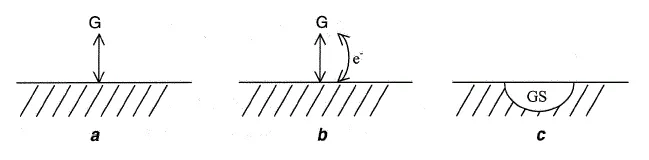
In the first hypothesis, the reversible process at work is one of adsorption, which then constitutes the overall reaction. It is called the adsorption-desorption phenomenon (see Figure 1.1a).
In the second hypothesis, adsorption will be the first step of a more complex process. It has, in this case, a non-reversible character due to which a new compound, GS for instance, will form.
The nature of the observed phenomenon will depend on the thermodynamic conditions (pressure, temperature) as well as on the chemical affinity of the present species.
It is also possible in adsorption phenomena to distinguish between physical and chemical adsorption. Chemical adsorption or chemisorption is characterized by a simple electron transfer between the gas in physisorbed state and the solid. This transfer results in the forming of a reversible chemical bond between the two compounds (see Figure 1.1b). Once again, the appearance of the chemisorption process is directly related to the environment’s thermodynamic conditions.
Figure 1.1. The different interaction modes between a gas and a solid: a) physical adsorption, b) chemisorption, c) non-reversible reaction
1.2. Illustration of adsorption
Volumetric and gravimetric methods are the most explicit and common methods used to display and quantify adsorption.
1.2.1. The volumetric method or manometry
In a closed system, the bonding of a gas molecule with a solid contributes to lowering the partial pressure of the gas and measuring the variation of th...
Table of contents
- Cover
- Title Page
- Copyright
- Preface
- Chapter 1: Adsorption Phenomena
- Chapter 2: Structure of Solids: Physico-chemical Aspects
- Chapter 3: Gas-Solid Interactions: Electronic Aspects
- Chapter 4: Interfacial Thermodynamic Equilibrium Studies
- Chapter 5: Model Development for Interfacial Phenomena
- Chapter 6: Apparatus for Experimental Studies: Examples of Applications
- Chapter 7: Material Elaboration
- Chapter 8: Influence of the Metallic Components on the Electrical Response of the Sensors
- Chapter 9: Development and Use of Different Gas Sensors
- Chapter 10: Models and Interpretation of Experimental Results
- Index
Trusted by 375,005 students
Access to over 1.5 million titles for a fair monthly price.
Study more efficiently using our study tools.
Frequently asked questions
Yes, you can cancel anytime from the Subscription tab in your account settings on the Perlego website. Your subscription will stay active until the end of your current billing period. Learn how to cancel your subscription
No, books cannot be downloaded as external files, such as PDFs, for use outside of Perlego. However, you can download books within the Perlego app for offline reading on mobile or tablet. Learn how to download books offline
Perlego offers two plans: Essential and Complete
- Essential is ideal for learners and professionals who enjoy exploring a wide range of subjects. Access the Essential Library with 800,000+ trusted titles and best-sellers across business, personal growth, and the humanities. Includes unlimited reading time and Standard Read Aloud voice.
- Complete: Perfect for advanced learners and researchers needing full, unrestricted access. Unlock 1.5M+ books across hundreds of subjects, including academic and specialized titles. The Complete Plan also includes advanced features like Premium Read Aloud and Research Assistant.
We are an online textbook subscription service, where you can get access to an entire online library for less than the price of a single book per month. With over 1.5 million books across 990+ topics, we’ve got you covered! Learn about our mission
Look out for the read-aloud symbol on your next book to see if you can listen to it. The read-aloud tool reads text aloud for you, highlighting the text as it is being read. You can pause it, speed it up and slow it down. Learn more about Read Aloud
Yes! You can use the Perlego app on both iOS and Android devices to read anytime, anywhere — even offline. Perfect for commutes or when you’re on the go.
Please note we cannot support devices running on iOS 13 and Android 7 or earlier. Learn more about using the app
Please note we cannot support devices running on iOS 13 and Android 7 or earlier. Learn more about using the app
Yes, you can access Physico-Chemistry of Solid-Gas Interfaces by Rene Lalauze in PDF and/or ePUB format, as well as other popular books in Physical Sciences & Physical & Theoretical Chemistry. We have over 1.5 million books available in our catalogue for you to explore.