Discovering how arthritis affects your body
Becoming aware of the various types of arthritis
Recognising the signs and symptoms of arthritis
Identifying the major causes of arthritis
Discovering who is most likely to get the various forms of the disease
Considering the treatment options
The good news is that you can manage your arthritis, if not cure it, with a combination of medical care, simple lifestyle changes, and good, old common sense. Sitting at home in an armchair, gritting your teeth from pain, or hobbling around the garden with a walking stick aren’t obligatory. Although you may not run a marathon or do back-flips like you did at the age of 13, if you follow the programme outlined in this book, you can usually manage to do things you really want to do – such as take a brisk walk in the park, carry a sleeping child upstairs to bed, or swing a golf club with the best of them. Arthritis may affect a lot of people, but thanks to intensive research over the past several years, medical professionals now know a lot more about how to handle it.
Understanding How Arthritis Affects Your Joints
So what exactly is arthritis, this disease that brings you so much misery and pain? Unfortunately, that question has no easy answer because arthritis involves a group of diseases – each with its own causes, set of symptoms, and treatments. However, these diseases do have the following symptoms in common:
They affect some part of the joint.
They cause pain and (possibly) loss of movement.
They often bring about some kind of inflammation (heat).
As for the causes of these different kinds of arthritis, they run the gamut from inheriting an unlucky gene to physical trauma to getting bitten by the wrong mosquito.
The word arthritis, which literally means joint inflammation, is derived from the Greek words arthros (joint) and itis (inflammation), and the condition’s major symptom is joint pain. Although the same group of ailments is sometimes called rheumatism, they’re usually referred to as arthritis, so that’s the term in use throughout this book. The word arthralgia, a term that’s used much less frequently, refers to joint pain alone.
According to Arthritis Care, arthritis affects some 9 million people in the UK (almost one out of every six people) – that’s a big chunk of the population.
Saying hello to your joints
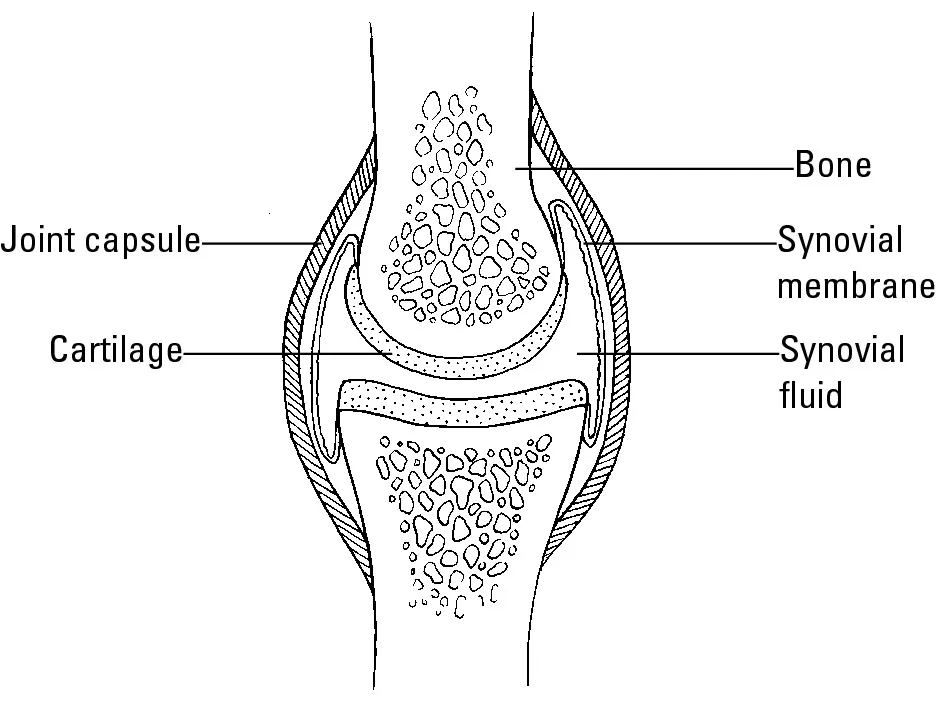
Before you can understand what’s wrong with your joints, you need to understand what a joint is and how it works. Any place in the body where two bones meet is called a joint. Sometimes those bones actually fuse; your skull is an example of an area with fused bones. But in the joints that can develop arthritis, the bones don’t actually touch. As shown in Figure 1-1, a small space exists between the two bone ends. The space between the ends of the bones keeps them from grinding against each other and wearing each other down.
Other structures surrounding your joints, such as muscles, tendons, and bursae – small sacs that cushion your tendons – support your joints and provide the power that makes your bones move. The joint capsule wraps itself around the joint, and its special lining, the synovial membrane or synovium, makes a slick, slippery liquid called the synovial fluid. This liquid fills that little space between the bone ends. Finally, the bone ends are capped by cartilage – a slick, tough, rubbery material that is eight times more slippery than ice and a better shock absorber than the tyres and springs on your car! Together, these parts make up the joint, one of the most fascinating bits of machinery found in your body.
| Figure 1-1: Anatomy of a healthy synovial joint. | |
Bones are living tissue – hard, porous structures with a blood supply and nerves – that constantly rebuild themselves. Bones protect your vital organs and provide the supporting framework for your body. Without bones, you would consist of nothing more than blobs of tissue – like a tent without any supporting poles!
But bones are more than broomsticks that prop you up and, fortunately, they don’t leave you rigid and awkward. The 200-plus bones found in your body are connected together by some 150 joints, giving you a remarkable flexibility and range of motion. You only have to watch a gymnast, ballet dancer, or figure skater execute a handspring, arabesque, o...