Since the 1980s, and especially since the Rio Earth Summit in 1992, there has been a substantial extension in the adoption and use of Environmental Assessment (EA) procedures in developing countries and countries in transition (low and middle income countries). However, few existing texts in environmental assessment or development studies have reflected this trend sufficiently, until this publication.
Divided into two main parts:
* EA Principles, Processes and Practice.
* Country and Institutional Studies of EA Procedures and Practice.
This book explains the essentials of environmental impact association in the context of developing countries and assesses its importance to both developed and developing countries.
eBook - ePub
Environmental Assessment in Developing and Transitional Countries
Principles, Methods and Practice
- English
- ePUB (mobile friendly)
- Available on iOS & Android
eBook - ePub
Environmental Assessment in Developing and Transitional Countries
Principles, Methods and Practice
About this book
Information
1
Introduction
1.1 Environmental Assessment, Developing Countries and Countries in Transition
Environmental assessment (EA) is a widely used policy tool for reducing the negative environmental consequences of development activities and for promoting sustainable development. It covers both the assessment of individual development projects, often known as environmental impact assessment (EIA), and the appraisal of development policies, plans and programmes, which is generally referred to as strategic environmental assessment (SEA). In both cases, the purposes of the assessment are:
a) To identify any potentially adverse environmental consequences of a development action, so that they may be avoided, reduced or otherwise taken into account during planning and design
b) To ensure that any such consequences are taken into account, both whilst planning and designing an action and when it is authorized
c) To influence how it is subsequently managed during its implementation.
EA is potentially applicable to any type of development action, which may result in significant environmental impacts, in any part of the world. Its underlying principles are general but the circumstances in which it is applied and, therefore, the particular forms it takes, vary considerably between different parts of the world.
The main focus of this book is upon developing countries (or less developed countries, LDCs) in Africa, Asia, the Middle East and Latin America and countries in transition (CITs) in Central and Eastern Europe and Central Asia. The individual countries to be covered have been identified according to the level of their per capita national income, using official estimates of Gross National Product (GNP) in 1995 converted to US$ according to official exchange rates.
The World Bank (1997a) classifies 133 countries into four income categories as follows:
1. Low income economies with annual income per capita of less than 766 US$. This category includes 49 countries and their per capita incomes range between 80 (Mozambique) and 730 US$ (Armenia).
2. Lower middle income economies with annual income per capita between 766 and 3160 US$. This category includes 41 countries and their per capita incomes range between 766 (Lesotho) and 3020 US$ (Venezuela).
3. Upper middle income economies with annual per capita incomes between 3160 and 9386 US$. This category includes 17 countries and their average income levels range between 3160 (South Africa) and 8210 US$ (Greece).
4. High income economies with annual per capita incomes of 9386 US$ and above. This category includes 26 countries and their average incomes range between 9700 (Republic of Korea) and 40 630 US$ (Switzerland).
This study relates to the low and middle income countries in the first three categories. Taken together, they occupy 76% of the world’s land area and contain 93% of its total population, but only account for 19% of the total GNP of the 133 countries covered.
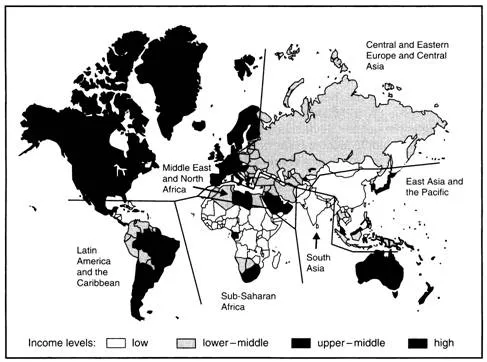
The geographic distribution of countries, according to income group, is shown in Map 1.1. This shows that:
- Low income countries are mainly located in sub-Saharan Africa, South and East Asia (including China and India) and some parts of Central Asia
- Lower middle income countries are located in parts of the former USSR and some adjoining European countries, the Middle East and North Africa, and Central/South America
- Upper middle income countries are located in parts of Central Europe, the Middle East, South East Asia, South Africa and Central/South America
- High income countries are mainly located in North America, North and Western Europe, parts of South East Asia, Japan, Australia and New Zealand.
The developmental, environmental and regulatory characteristics of low and middle income countries are examined, in their regional context, in Chapter 2. This demonstrates the great variations in many of the characteristics which may influence EA regulation and practice, both between low and middle income countries and high income countries, and among low and middle income countries themselves. The variability in EA regulations and practice between countries, which often reflects more fundamental differences in their economic, social, political and environmental circumstances, is a recurring theme in this book. In this connection, it is important to emphasise the dangers of indiscriminately transposing conceptions of good EA practice formulated in high income countries to the quite different situations which prevail in many LDCs and CITs.
Map 1.1 Countries Classified by Income Category (1995)
1.2 The Origins of Environmental Assessment
EA, as a mandatory regulatory procedure, originated in the early 1970s, with the implementation of the National Environmental Policy Act (NEPA) 1969 in the USA. Much of the initial phase of its subsequent development was in a small number of high income countries, such as Canada and Australia, but some developing countries also adopted it at a relatively early stage. Colombia introduced EIA procedures in 1974, and the Philippines established it by presidential decree in 1978 (Smith and van der Wansem 1995).
The major period of expansion of project-level EA has taken place since the mid-1980s. Virtually all high income countries now possess their own mandatory EIA procedures (Lee 1995), as do a large and rapidly increasing number of low and middle income countries. Additionally, most international and bilateral aid agencies and development banks have adopted their own EIA procedures, which they apply when providing development assistance (OECD 1996).
Certain of the earliest regulations (such as NEPA in the USA) covered policy and programming initiatives as well as projects (but they were much less frequently applied to these in practice). In general, SEA regulations and practices have developed at a much slower pace than EIA requirements. However, during the 1990s, both mandatory and less formalized requirements for SEA have been expanding more rapidly not only in high income, but also among lower and middle income countries (Lee 1995; Sadler and Verheem 1996; Therivel and Partidario 1996). This has been mirrored in some strengthening of SEA procedures and practices within aid agencies and development banks. The World Bank, for example, has introduced guidance for both sectoral and regional EA, covering the assessment of plans or programmes which the Bank funds for a specific sector of the economy or geographical region (World Bank 1997b).
A comparative review of current EIA and SEA regulatory provisions and practice in low and middle income countries is presented in Chapter 3, where a number of these features are examined in more detail.
1.3 The Environmental Assessment Process: Scope and Stages
Scope of EA
The types of impacts which are addressed by environmental assessment cover all aspects of the human environment, as well as the ecological and physical environment. A typical assessment might include impacts on:
- Human beings
- Flora and fauna
- Land (including natural resources), water, air and climate
- Cultural heritage assets (including buildings and other structures)
- Landscape and townscape
- Noise and vibration levels
- Eco-systems and other interactions between different components of the environment
This breadth of coverage of the environment in environmental assessment entails overlaps with other forms of impact assessment, including social impact assessment, health impact assessment, risk assessment and cost-benefit analysis. The relationships between environmental assessment and other forms of assessment are explored more fully in Chapters 5–7 and 10.
The projects, to which EIA is applied, may be new developments or major modifications to existing facilities and can occur in a wide range of economic sectors. These include: agriculture, forestry and fishing; mining and other extractive industries; all parts of the energy sector, including fossil-fuelled electricity generation, hydropower, nuclear power and wind power; all major industries within the manufacturing and process industry sector; transport; tourism and leisure developments; water supply; waste treatment and waste disposal facilities; and other infrastructure and urban development projects.
The policies, plans and programmes (PPPs) to which SEA is applied are also wide-ranging and may relate to:
- The overall development of key sectors in the economy (e.g. transport, energy, mining, water supply, forestry and tourism)
- Associated infrastructure development plans, including waste water and solid waste treatment and disposal plans
- Land use and territorial development plans
- National, multi-sectoral PPPs (e.g. privatization programmes and fiscal reform policy measures)
- International and multi-national policy and programme initiatives (e.g. international trade agreements, internationally financed structural adjustment programmes and overseas aid programmes)
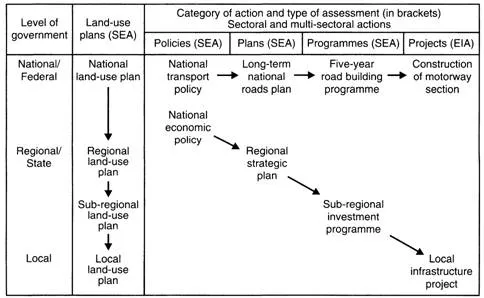
Some SEAs may benefit from being co-ordinated with each other and with certain project-level EIAs, within a tiered system of environmental assessment, as illustrated in Figure 1.1. In such a system, a more strategic form of environmental assessment is first applied to selected policies, plans and programmes during the early stages of the development planning cycle. Then, as shown in Figure 1.1, account is taken of these higher level assessments at each subsequent level in the planning structure. In this way, SEA and EIA are intended to be complementary to each other; each performs tasks most appropriate to the phase of the development planning process at which it is to be used. In practice, as discussed in subsequent chapters, tiering arrangements are still in their infancy in many countries.
Figure 1.1 Sequence of Actions and Assessments Within a Tiered Planning and Assessment System. Source: Lee and Walsh (1992)
Stages in the EA Process
SEA and EIA processes, although applied during different phases of the planning and project cycle, contain similar kinds of assessment activities. These may include:
- Screening: deciding whether the nature of the proposed action and its likely impacts are such that it should be submitted to environmental assessment
- Consideration of alternatives: a review of alternatives to the proposed action (policy, plan, programme or project)
- Description of the action: describing the action in a suitable form to enable its effects to be predicted
- Description of the environmental baseline: describing the current state of the environment likely to be affected, and its expected future state in the absence of the proposed action
- Impact identification and scoping: determining which environmental impacts should be investigated in the assessment
- Prediction of impact magnitude and significance: determining how large the impacts are likely to be, and assessing their importance
- Identification of mitigation measures: defining what steps can be taken to eliminate or reduce any significant impacts or to compensate for them
- Preparing the documentation of the assessment: documenting the findings of the assessment (for example, in an environmental impact statement) in a manner that is clearly understandable to those involved in consultations and decision making
- Review: evaluating the documentation to determine its adequacy for consultation and decision-making purposes
- Consultation and public participation: enabling the environmental authorities and the public to comment upon the proposed action and its environmental impacts, based upon the documentation of the assessment (N.B. consultation and public participation may also take place at other stages of the process, notably in scoping)
- Decision-making: using the assessment documentation and consultation findings to reach a decision on the authorization of the proposed action, with or without conditions attached
- Monitoring implementation: checking whether the action is implemented in accordance with any environmental conditions of the decision and whether its environmental performance is consistent with the assessment’s predictions
These stages and activities in the EA process, and the assessment methods used within them, are reviewed more fully in Chapters 4–11.
1.4 Environmental Assessment and Sustainable Development
The overall purpose of EIA and SEA is to assist in shaping the development process, not to prevent development from taking place. More precisely, their role is to ensure that the environmental consequences of development proposals are systematically assessed and taken into account, in conjunction with their likely economic, social and other consequences, when determining development strategies and, later, when approving individual development projects.
Other forms of appraisal, such as cost–benefit analysis (CBA) and social impact assessment (SIA), may be used to assess the economic and social consequences of developments, so that they can be taken into consideration alongside the findings of the environmental assessment (Vanclay and Bronstein 1995; Kirkpatrick and Lee 1997). However, as discussed in Chapter 10, the integration of these different forms of appraisal, and their combined use for decision-making purposes, can be quite complex from both a procedural and a methodological standpoint. Yet, the pressure for integrated appraisal (sometimes called sustainability appraisal) grows as political commitments to sustainable development increase.
The 1992 United Nations Conference on Environment and Development (UNCED) gave considerable impetus to the adoption, by international organizations and national governments, of sustainable development objectives. It also recognized the role of environmental assessment in their attainment (see Box 1.1). This has two important consequences for EA procedure and practice:
- It reinforces existing tendencies to improve procedures and methodologies for more integrated forms of appraisal and decision-making in the development process
- It highlights the need to develop methods for assessing the significance of environmental, economic and social impacts according to sustainable development criteria
These consequences require that the term ‘sustainable development’ be given sufficient operational meaning. This was explicitly recognized at UNCED, in Agenda 21’s proposals for the development of national and global indicators of sustainable development.
Box 1.1 Extracts from the Rio Declaration on Environment and Development and Agenda 21
Principle 17 of the Rio Declaration
Environmental impact assessment*, as a national instrument, shall be undertaken for proposed activities that are likely to have significant adverse impact on the environment and are subject to a decisio...
Table of contents
- Cover
- Contents
- Title Page
- Copyright
- Preface
- List of Contributors
- Abbreviations
- List of Boxes, Figures, Maps and Tables
- 1 Introduction
- PART ONE: EA Principles, Processes and Practice
- PART TWO: Country and Institutional Studies of EA Procedures and Practice
- Index
Trusted by 375,005 students
Access to over 1.5 million titles for a fair monthly price.
Study more efficiently using our study tools.
Frequently asked questions
Yes, you can cancel anytime from the Subscription tab in your account settings on the Perlego website. Your subscription will stay active until the end of your current billing period. Learn how to cancel your subscription
No, books cannot be downloaded as external files, such as PDFs, for use outside of Perlego. However, you can download books within the Perlego app for offline reading on mobile or tablet. Learn how to download books offline
Perlego offers two plans: Essential and Complete
- Essential is ideal for learners and professionals who enjoy exploring a wide range of subjects. Access the Essential Library with 800,000+ trusted titles and best-sellers across business, personal growth, and the humanities. Includes unlimited reading time and Standard Read Aloud voice.
- Complete: Perfect for advanced learners and researchers needing full, unrestricted access. Unlock 1.5M+ books across hundreds of subjects, including academic and specialized titles. The Complete Plan also includes advanced features like Premium Read Aloud and Research Assistant.
We are an online textbook subscription service, where you can get access to an entire online library for less than the price of a single book per month. With over 1.5 million books across 990+ topics, we’ve got you covered! Learn about our mission
Look out for the read-aloud symbol on your next book to see if you can listen to it. The read-aloud tool reads text aloud for you, highlighting the text as it is being read. You can pause it, speed it up and slow it down. Learn more about Read Aloud
Yes! You can use the Perlego app on both iOS and Android devices to read anytime, anywhere — even offline. Perfect for commutes or when you’re on the go.
Please note we cannot support devices running on iOS 13 and Android 7 or earlier. Learn more about using the app
Please note we cannot support devices running on iOS 13 and Android 7 or earlier. Learn more about using the app
Yes, you can access Environmental Assessment in Developing and Transitional Countries by Norman Lee, Clive George, Norman Lee,Clive George in PDF and/or ePUB format, as well as other popular books in Technology & Engineering & Environmental Management. We have over 1.5 million books available in our catalogue for you to explore.