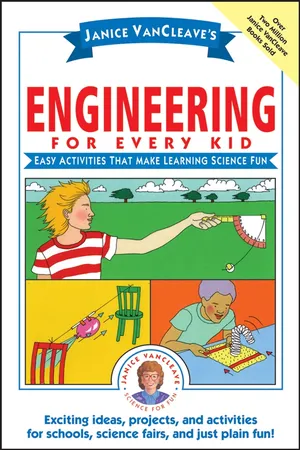
Each of the activities is broken down into its purpose, a list of easy-to-find materials, step-by-step instructions, expected results, and a simple scientific explanation. Plus, the book's 25 projects can easily be used in the classroom, as the basis of a science fair project, or at home just for fun!
eBook - ePub
Janice VanCleave's Engineering for Every Kid
Easy Activities That Make Learning Science Fun
- English
- ePUB (mobile friendly)
- Available on iOS & Android
eBook - ePub
Janice VanCleave's Engineering for Every Kid
Easy Activities That Make Learning Science Fun
About this book
Now you can discover the answers to these and many other fascinating questions about engineering for yourself with this fun-filled resource. Janice VanCleave's Engineering for Every Kid presents entertaining, challenging experiments and activities to help you understand the different types of engineering there are—including structural, solar, electrical, and chemical—and how each is applied to real world everyday situations.
1
Push and Pull
Structural Engineering
What You Need to Know
Structural engineering is the branch of engineering concerned with the design and construction of all types of structures such as bridges, buildings, dams, tunnels, power plants, offshore drilling platforms, and space satellites. Structural engineers research the forces that will affect the structure, then develop a design that allows it to withstand these forces.
A force is a push or a pull on an object. The two basic forces on a structure are lateral forces (forces directed at the side of a structure) and vertical forces (forces directed up or down on a structure). Lateral forces on a structure might include wind (moving air).
The main vertical force on a structure is gravity (force pulling an object downward, which is toward the center of Earth). Weight is the measure of the force of gravity on an object. The weight of an object depends on mass, which is the amount of substance in the object. The greater the mass, the greater the weight; thus, the greater the force of gravity.
Engineers refer to the gravity force acting on a structure as the sum of its dead and live forces. Dead forces are the weight of the permanent parts making up the structure. In a building, dead forces include the weight of the walls, floors, and roof. Live forces are the weight of temporary objects in or on a structure. In a building, live forces include the weight of people, furniture, and snow on the roof. In the figure, live forces include the weight of the wagon, the child, and the boy; dead forces include all the parts making up the bridge. The total gravity force acting on the bridge is shown by the arrow directed downward.
Since shapes of materials affect their strength, structural engineers must consider what shapes to use in designing structures that will stand up to both lateral and vertical forces.

Exercises
1. In a building, which choice represents a live force?
a. floors
b. windows
c. desk
2. Which force in the figure, A, B, or C, is the lateral force?

Activity: SHAPELY
Purpose To determine how the shape of a material can make it stronger.
Materials
2 books of equal thickness ruler
1 sheet of copy paper
15 or more pencils
1 sheet of copy paper
15 or more pencils
Procedure
1. Lay the books on a table so that they are 6 inches (15 cm) apart.

2. Use the sheet of paper to make a bridge between the two books. Make sure that an equal amount of the paper lies on each book.
3. Test the strength of the paper bridge by gently placing one pencil at a time in the center of the paper (between the books) until the paper falls.
4. Remove the paper from the books and fold it in half by placing the short ends together. Fold the paper again in the same direction.
5. Unfold the paper, then bend it accordion style to form an M shape.
6. Use the folded paper to form a bridge between the books as shown. Again, make sure that an equal amount of the paper is on each book.

7. Test the strength of the paper bridge by gently placing one pencil at a time across the top of the folded paper. If the pencil(s) tends to roll, use your finger to stop it. Count the pencils that the paper will support before falling.
8. Remove the M-shaped bridge and press its sides together. Then fold the paper in half, placing the long sides together.
9. Unfold the paper and bend it accordion style as before. The paper now has a double-M shape.
10. Place the paper bridge across the books.

11. Repeat step 7 with the double-M bridge.
Results The unfolded paper will not support even one pencil. Depending on the weight of the pencils, the M-shaped bridge may hold 4 to 6 pencils. The double-M bridge will hold more than twice as many pencils as the single-M bridge.
Why? A flat piece of paper is not very strong, but when it is folded in an accordion shape, it becomes stronger and can support more weight. This is because all of the object’s weight pushes down on one part of the flat paper. But on the folded paper, the object’s weight is spread out and smaller forces push down on different parts of the paper. The more folds, the more spread out the weight. For example, corrugated cardboard, which has a layer of grooves and ridges, is much stronger than flat cardboard.
Solutions to Exercises
1. Think!
• Floors are part of a structure, so they are permanent forces (dead forces).
• Windows are part of a structure, so they are permanent forces (dead forces).
• A desk is not part of a structure, since it can be removed easily, so it is a temporary force—that is, a live force.
Choice C is a live force.
2. Think!
• A lateral force pushes or pulls on the side of a structure.
• Force A shows snow on the roof. Snow adds weight to the house, so it is a gravitational force.
• Force B shows a window in the house. Windows add weight to the house, so force B is a gravitational force.
• Force C shows wind hitting against the side of the house.
Force C represents a lateral force.
2
Blast Off
Aerospace Engineering
What You Need to Know
Aerospace engineering is the branch of engineering concerned with the design, manufacture, and operation of launch vehicles, satellites, spacecraft, and ground-support facilities for the exploration of outer space. One type of spacecraft is a rocket, which is powered by gases that are forced out of one end. Rocket-like devices were demonstrated about 360 B.C. by the Greek mathematician and scientist Archytas (428-350 B.C.). So while some form of a rocket has been in existence for many years, the science of how a rocket wo...
Table of contents
- Other Titles by Janice VanCleave
- Title Page
- Copyright Page
- Dedication
- Introduction
- Chapter 1 - Push and Pull
- Chapter 2 - Blast Off
- Chapter 3 - Up and Away
- Chapter 4 - Up and Down
- Chapter 5 - Coming Through
- Chapter 6 - Easy Listening
- Chapter 7 - Stop and Go
- Chapter 8 - Directors
- Chapter 9 - Recover
- Chapter 10 - Break Out
- Chapter 11 - New Stuff
- Chapter 12 - Hot Stuff
- Chapter 13 - Brighter
- Chapter 14 - Primary
- Chapter 15 - Shiny
- Chapter 16 - The Limit
- Chapter 17 - Weakened
- Chapter 18 - Discarded
- Chapter 19 - Less Is More
- Chapter 20 - Flowing Through
- Chapter 21 - Shake Up
- Chapter 22 - Changes
- Chapter 23 - Around and Around
- Chapter 24 - Neighbors
- Chapter 25 - Stringy
- Glossary
- Index
Trusted by 375,005 students
Access to over 1.5 million titles for a fair monthly price.
Study more efficiently using our study tools.
Frequently asked questions
Yes, you can cancel anytime from the Subscription tab in your account settings on the Perlego website. Your subscription will stay active until the end of your current billing period. Learn how to cancel your subscription
No, books cannot be downloaded as external files, such as PDFs, for use outside of Perlego. However, you can download books within the Perlego app for offline reading on mobile or tablet. Learn how to download books offline
Perlego offers two plans: Essential and Complete
- Essential is ideal for learners and professionals who enjoy exploring a wide range of subjects. Access the Essential Library with 800,000+ trusted titles and best-sellers across business, personal growth, and the humanities. Includes unlimited reading time and Standard Read Aloud voice.
- Complete: Perfect for advanced learners and researchers needing full, unrestricted access. Unlock 1.5M+ books across hundreds of subjects, including academic and specialized titles. The Complete Plan also includes advanced features like Premium Read Aloud and Research Assistant.
We are an online textbook subscription service, where you can get access to an entire online library for less than the price of a single book per month. With over 1.5 million books across 990+ topics, we’ve got you covered! Learn about our mission
Look out for the read-aloud symbol on your next book to see if you can listen to it. The read-aloud tool reads text aloud for you, highlighting the text as it is being read. You can pause it, speed it up and slow it down. Learn more about Read Aloud
Yes! You can use the Perlego app on both iOS and Android devices to read anytime, anywhere — even offline. Perfect for commutes or when you’re on the go.
Please note we cannot support devices running on iOS 13 and Android 7 or earlier. Learn more about using the app
Please note we cannot support devices running on iOS 13 and Android 7 or earlier. Learn more about using the app
Yes, you can access Janice VanCleave's Engineering for Every Kid by Janice VanCleave in PDF and/or ePUB format. We have over 1.5 million books available in our catalogue for you to explore.