- English
- ePUB (mobile friendly)
- Available on iOS & Android
eBook - ePub
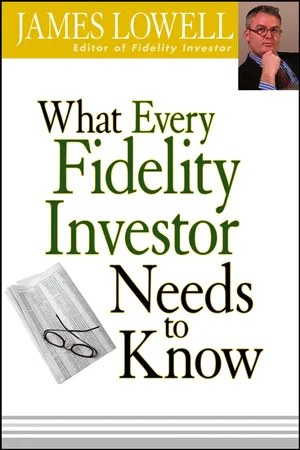
What Every Fidelity Investor Needs to Know
About this book
Fidelity offers investors some of the most innovative financial tools, products, and platforms currently available, and with What Every Fidelity Investor Needs to Know, James Lowell—one of the most trusted names in the investment business and a self-described Fidelity fanatic—will help you get the best out of what Fidelity has to offer; whether it be through taxable accounts, IRAs, or 401(k)s.
PART ONE
Fidelity: Past, Present, and Future
CHAPTER ONE
Fidelity
Past, Present, and Future
Fidelity is the world’s largest mutual fund company, bar none.
With more than $1.1 trillion in mutual fund assets and more than 19 million shareholders, Fidelity Investments has long ruled the mutual fund industry.
In fact, you could say that Fidelity was and still is in no small measure responsible for the growth of the mutual fund industry itself.
It is a Goliath, even in the land of Goliaths.
From its headquarters on Devonshire Street in Boston’s financial district, 60-year-old Fidelity employs nearly 40,000 people; offers over 300 actively managed, index-focused, and ETF-based funds; and casts its investment shadow across the globe.
The sun never sets on Fidelity.
While Fidelity is known as a leading provider of financial services, its empire is vastly greater than its mutual fund company and offerings. Its services extend far beyond mutual funds to include discount brokerage services, retirement services, estate planning, securities execution and clearance, life insurance, real estate, publishing, venture capital, outsourcing, and even a national executive limousine service (aptly named Boston Coach which, by the way, I recommend highly).
Although it has occasionally stumbled, Fidelity has a long and illustrious history of success as a business—as a business that has been able to reinvent itself to not only compete with changing times and changing leadership in the financial services landscape, but to lead and dominate that landscape time and again.
That success can be traced to traits not typically associated with Boston’s Puritan roots: guts and gusto. But ingenuity, hard work, and an eye for global trade has always been part of the Hub’s heritage (“the Hub” being the nickname given to Boston precisely because of its intense historical focus on global commerce). In Fidelity’s founder, one Boston trust lawyer named Edward C. Johnson II, the twain met.
Johnson hailed from a distinguished and wealthy Brahman family. Smart and ambitious, he earned a degree in business from Harvard College and went on to graduate from Harvard Law School.
But Johnson didn’t rest on his social standing—or even on his intellect. Graced with an independent spirit and a voracious appetite for adventure, Johnson soon found himself seduced by Wall Street, a place he once described as one “in which it was every man for himself, no favors asked or given.”
In 1943, at the age of 45, Johnson assumed the reigns of the 13-year-old Fidelity fund. Even by the standards of the financial markets six decades ago, the fund’s $3 million in assets represented a modest sum. Three years later, Johnson established Fidelity Management and Research Company to act as an investment adviser to Fidelity Fund, which by then had grown to $13 million. That 400 percent gain in three years would be a harbinger of growth to come.
Johnson was an imperious leader, one who likened playing the market to being England’s Sir Francis Drake in the midst of a sea battle. By setting high standards, and by rewarding individuals who met those standards, Johnson cultivated a highly competitive money management culture that continues to distinguish Fidelity from most of its peers today. Under Johnson, Fidelity became known as a place where employees were almost fanatical—if not downright, cutthroat—in their quest to meet exacting standards set by Johnson himself.
In fact, Johnson’s steadfast pursuit of individual excellence led him to reject the popular notion that mutual funds were best managed by investment committee. To his way of thinking, funds were best run by individuals—individuals who were smart, decisive, and empowered to make investment decisions. The focus on the manager, not the fund, has been imprinted on each and every Fidelity manager, past and present.
In 1947, Johnson launched a second fund, the Fidelity Puritan Fund. The income-oriented balanced fund was positioned as a less-aggressive offering than the Fidelity Fund. The principle of diversification both in terms of investment choices and as the basis for investment decisions remains a core component of Fidelity’s money management business and investment discipline to this day.
Although money flowed into Fidelity at a healthy clip—by 1956, the firm had $256 million in assets under management—Johnson was in no rush to grow his young money management firm. In fact, it wasn’t until 1958, long after Americans had begun to develop an appetite for risk in the financial markets, that he launched two funds aimed at what we now consider to be aggressive growth investors.
One of the new funds, Fidelity Capital, was created at the behest of Fidelity stock analyst Gerald Tsai Jr., whose no-holds-barred style of investing would transform into a Wall Street star in the go-go days of the 1960s.
Two years later, the other new growth fund, Fidelity Trend, would become the first management assignment held by Johnson’s son Edward C. “Ned” Johnson III, who joined Fidelity as a research analyst in 1957. The younger Mr. Johnson shared his father’s passion for investing and quickly distinguished himself as a stock picker par excellence.
Eventually, Ned would replace his father at Fidelity’s helm—a move that would mark a dramatic turning point in Fidelity’s history.
The 1960s were heady years for Fidelity—and for all of Wall Street, for that matter. Tsai, a native of Shanghai, became the first “star” manager to rise from Fidelity’s ranks. But Tsai’s bold and adventurous investing style, which involved taking big positions in a stock and then bailing out just before its short-term run-up was about to end, soon became the poster child of Wall Street’s appetite for risk in those days.
Fidelity, it seemed, had become Wall Street’s “it” money management firm. Assets, for example, reached $4.3 billion in 1969, up dramatically from $500 million at the beginning of the decade.
But, neither the run of economic prosperity nor the breakneck growth that Fidelity experienced because of it would go unchallenged. Thanks to inflation and a deteriorating U.S. economy, the Dow Jones Industrial Average, which had reached a peak in 1968, began a tortuous series of drops that culminated with a 40 percent decline in one year—1973–1974—preceded by tough years. (Fortunately for Fidelity, Tsai had struck out on his own in 1965, before the market turned so decisively against his hyperag-gressive investing style.) Still, as a result of the broader market’s decline, mutual fund shareholders across America began to yank money from their investment accounts, killing off dozens of fund companies and brokerage houses in the process.
Fidelity, of course, survived. But it did more than merely survive; it learned a lesson about its own need to diversify its business, which it took to heart and put into practice. And, even though the best example of learning from such past experience to better maneuver through difficult times took 28 years to materialize, when the market crash of 2000–2002 took place, erasing nearly 47 percent of the value of the S&P 500, and competitors like Charles Schwab were forced to lay off more than half their workforce, Fidelity not only hired more workers, but gained share in the brokerage marketplace.
But let’s get back to earlier times. Fidelity’s assets under management dropped to $2.4 billion by the end of 1974; nearly a 50 percent drop.
A Family Affair
In the midst of that tumult, Edward C. Johnson II turned to one person for help: his son.
Even though he was only 42 years old when he was appointed president of Fidelity in 1972, Edward C. “Ned” Johnson III, had earned the respect and admiration of Fidelity’s stock-picking team. In fact, the returns he posted while managing Fidelity’s famed Magellan in the 1960s would prove even better than when the much larger fund was in the hands of über-investor Peter Lynch (see Figure 1.1).
FIGURE 1.1 Manager changes at Fidelity Aggressive Growth
Source: www.fidelityinvestor.com

Ned Johnson was more than a good stock picker, however. He was a visionary—a visionary with a knack for product development as well as an early appreciation for the essential business and philosophical role technology would play in Fidelity’s continued success.
With the sky-high-oil-priced economy still in the tank, stocks, and mutual funds that invested in them, had become persona non grata in the portfolios of many American investors. Recognizing this, the younger Johnson set out to recast Fidelity as a company that would appeal to the more skittish investors of that era.
Innovation: Back to Basics
How did he go about doing that? By using the simplest, most efficient, and what proved to be most profitable instrument available (and one that most money managers treated with disdain): a money market fund that also doubled as a checking account. Faced with high inflation and interests rates, many yield-hungry yet conservative investors were flocking to money market funds. Fidelity did not open the first money market fund, but adding the check-writing feature was Johnson’s idea.
Launched on May 31, 1974, Fidelity Daily Income Trust (FDIT) was not only successful in attracting some $500 million from low-yield (or zero-yield) savings or checking accounts during the first seven months of its existence, it also established the secretive Fidelity mascot. Even to this day, when you walk through the inner sanctums leading to Ned Johnson’s office you’ll find glass cases lined with all manners of frog sculptures, the ticker symbol for Fidelity’s first money market fund, FDIT. Two years later, Fidelity unveiled another major investment innovation, tailor-made for the shell-shocked conservative investors of the 1970s: It was the nation’s first open-end municipal bond fund.
In 1977, the same year Ned Johnson’s succession was completed by his ascension to chairman and chief executive, Fidelity expanded its menu of bond offerings to include its first junk-bond vehicle, the Devon Bond Fund (now Capital & Income).
But Ned Johnson was focused on things other than money market and bond funds. Internally, he had also turned his attention to building Fidelity’s technological prowess. Thanks to Johnson’s commitment to computerization and the skill of operations manager Bob Gould, Fidelity would finish the decade by also distinguishing itself through the automation of its back-office operations as well as through the creation of a sophisticated telephone customer service system.
Initially, the calls pouring in to Fidelity’s toll-free lines were all handled by live operators. By 1979, however, the Fidelity Automated Service Telephone (FAST)—forerunner of the account service systems now standard throughout the industry—was up and running.
The economy finally bottomed out with the 1980–1982 recession. In response to President Ronald Reagan’s massive tax cuts and a lowering of interest rates, the Dow Jones Industrial Average i...
Table of contents
- Cover
- Contents
- Title
- Copyright
- Preface
- Acknowledgments
- Part One: Fidelity: Past, Present, and Future
- Part Two: Fidelity’s 401(k) Focus: Retirement Planning and Platforms
- Part Three: Fidelity’s Famous Funds and Hidden Gems
- Part Four: Securing Your Financial Future Using Fidelity’s Funds
- Appendix A: Fidelity Investor Centers
- Appendix B: Fidelity’s 2006 Fund Manager Map
- Appendix C: Lowell and Lynch
- Glossary of Investment Terms
- Glossary of Fidelity Investors’ Terms for Quick Reference
- About the Author
- Index
Trusted by 375,005 students
Access to over 1.5 million titles for a fair monthly price.
Study more efficiently using our study tools.
Frequently asked questions
Yes, you can cancel anytime from the Subscription tab in your account settings on the Perlego website. Your subscription will stay active until the end of your current billing period. Learn how to cancel your subscription
No, books cannot be downloaded as external files, such as PDFs, for use outside of Perlego. However, you can download books within the Perlego app for offline reading on mobile or tablet. Learn how to download books offline
Perlego offers two plans: Essential and Complete
- Essential is ideal for learners and professionals who enjoy exploring a wide range of subjects. Access the Essential Library with 800,000+ trusted titles and best-sellers across business, personal growth, and the humanities. Includes unlimited reading time and Standard Read Aloud voice.
- Complete: Perfect for advanced learners and researchers needing full, unrestricted access. Unlock 1.5M+ books across hundreds of subjects, including academic and specialized titles. The Complete Plan also includes advanced features like Premium Read Aloud and Research Assistant.
We are an online textbook subscription service, where you can get access to an entire online library for less than the price of a single book per month. With over 1.5 million books across 990+ topics, we’ve got you covered! Learn about our mission
Look out for the read-aloud symbol on your next book to see if you can listen to it. The read-aloud tool reads text aloud for you, highlighting the text as it is being read. You can pause it, speed it up and slow it down. Learn more about Read Aloud
Yes! You can use the Perlego app on both iOS and Android devices to read anytime, anywhere — even offline. Perfect for commutes or when you’re on the go.
Please note we cannot support devices running on iOS 13 and Android 7 or earlier. Learn more about using the app
Please note we cannot support devices running on iOS 13 and Android 7 or earlier. Learn more about using the app
Yes, you can access What Every Fidelity Investor Needs to Know by James Lowell in PDF and/or ePUB format, as well as other popular books in Business & Finance. We have over 1.5 million books available in our catalogue for you to explore.