The first modern approach to relate fundamental research to the applied science of colloids, this series bridges academic research and practical applications, thus providing the information vital to both. Written by the very best scientists in their respective disciplines, this volume describes the role of colloids in paints, highlighting the importance of fundamental research in industrial applications. For surface, polymer and physicochemists, materials scientists, and chemical engineers.
Paints or surface coatings are complex, multi-phase, colloidal systems that are applied as a continuous layer to a surface [1]. A paint usually contains pigmented materials to distinguish it from clear films that are described as lacquers or varnishes. The main purpose of a paint or surface coating is to provide aesthetic appeal and to protect the surface. For example, a motor car paint can enhance the appearance of the car body by providing color and gloss and it also protects the car body from corrosion.
When considering a paint formulation, one must know the specific interaction between the paint components and substrates. This subject is of particular importance when one considers the deposition of the components on the substrate and their adhesion to it. The substrate can be wood, plastic, metal, glass, etc. The interaction forces between the paint components and the substrate must be considered when formulating any paint. In addition, the method of application can vary from one substrate and another.
For many applications, it has been recognized that achieving a required property, such as durability, strong adhesion to the substrate, opacity, color, gloss, mechanical properties, chemical resistance and corrosion protection, requires the application of more than one coat. The first two or three coats (referred to as the primer and undercoat) are applied to seal the substrate and provide strong adhesion to the substrate. The topcoat provides the aesthetic appeal such as gloss, color and smoothness. This clearly explains the complexity of paint systems, which require a fundamental understanding of the processes involved such as particle–surface adhesion, colloidal interaction between the various components and mechanical strength of each coating.
The main objective of the present text is to consider the colloidal phenomena involved in a paint system, its flow characteristics or rheology, its interaction with the substrate and the main criteria that are needed to produce a good paint for a particular application.
To obtain a fundamental understanding of the above basic concepts, one must first consider the paint components. Most paint formulations consist of disperse systems (solid in liquid dispersions). The disperse phase consists of primary pigment particles (organic or inorganic), which provide the opacity, color and other optical effects. These are usually in the submicron range. Other coarse particles (mostly inorganic) are used in the primer and undercoat to seal the substrate and enhance adhesion of the topcoat. The continuous phase consists of a solution of polymer or resin which provides the basis of a continuous film that seals the surface and protects it from the outside environment. Most modern paints contain latexes, which are used as film formers. These latexes (with a glass transition temperature mostly below ambient temperature) coalesce on the surface and form a strong and durable film. Other components may be present in the paint formulation such as corrosion inhibitors, driers and fungicides.
This introductory chapter gives a brief account of the properties of the main components in a paint formulation, namely the disperse particles and the medium in which they are dispersed (the film formers and the solvent).
1.1 The Disperse Particles
The primary pigment particles (normally in the submicron range) are responsible for the opacity, color and anti-corrosive properties. The principal pigment in use is titanium dioxide due to its high refractive index, and is the one that is used to produce white paint. To produce maximum scattering, the particle size distribution of titanium dioxide has to be controlled within a narrow limit. Rutile, with a refractive index of 2.76, is preferred over anatase, which has a lower refractive index of 2.55. Thus, rutile gives the possibility of higher opacity than anatase and it is more resistant to chalking on exterior exposure. To obtain maximum opacity, the particle size of rutile should be within the range 220–140 nm. The surface of rutile is photoactive and it is surface coated with silica and alumina in various proportions to reduce its photoactivity.
Colored pigments may consist of inorganic or organic particles. For a black pigment, one can use carbon black, copper carbonate, manganese dioxide (inorganic) and aniline black (organic). For yellow, can use lead, zinc, chromates, cadmium sulfide, iron oxides (inorganic) and nickel azo yellow (organic). For blue–violet, one can use ultramarine, Prussian blue, cobalt blue (inorganic), phthalocyanine, indanthrone blue and carbazole violet (organic). For red, one can use red iron oxide, cadmium selenide, red lead, chrome red (inorganic), toluidine red and quinacridones (organic).
The color of a pigment is determined by the selective absorption and reflection of the various wavelengths of visible light (400–700 nm) which impinges on it. For example, a blue pigment appears so because it reflects the blue wavelengths in the incident white light and absorbs the other wavelengths. Black pigments absorb all the wavelengths of incident light almost totally, whereas a white pigment reflects all the visible wavelengths.
The primary shape of a pigmented particle is determined by its chemical nature, its crystalline structure (or lack of it) and the way in which the pigment is created in Nature or made synthetically. Pigments as primary particles may be spherical, nodular, needle- or rod-like or plate like (lamellar) as illustrated in Figure 1.1.
Figure 1.1 Schematic representation of particle shape.
The pigments are usually supplied in the form of aggregates (whereby the particles are attached at their faces) or agglomerates (where the particles are attached at their corners). When dispersed in the continuous phase, these aggregates and agglomerates must be dispersed into single units. This requires the use of an effective wetter/dispersant and application of mechanical energy. This process of dispersion is discussed in detail in Chapter 3.
In paint formulations, secondary pigments are also used. These are referred to as extenders, fillers and supplementary pigments. They are relatively cheaper than the primary pigments and they are incorporated in conjunction with the primary pigments for a variety of reasons, such as cost effectiveness, enhancement of adhesion, reduction of water permeability and enhancement of corrosion resistance. For example, in a primer or undercoat (matt latex paint), coarse particle extenders such as calcium carbonate are added in conjunction with TiO2 to achieve whiteness and opacity in a matt or semi-matt product. The particle size of extenders range from submicron to a few tens of microns.
Their refractive index is very close to that of the binder and hence they do not contribute to the opacity from light scattering. Most extenders used in the paint industry are naturally occurring materials such as barytes (barium sulfate), chalk (calcium carbonate), gypsum (calcium sulfate) and silicates (silica, clay, talc or mica). However, more recently synthetic polymeric extenders have been designed to replace some of the TiO2. A good example is spindrift, which is polymer beads that consist of spherical particles (up to 30 μm in diameter) which contain submicron air bubbles and a small proportion of TiO2. The small air bubbles (<0.1 μm) reduce the effective refractive index of the polymer matrix, thus enhancing the light scattering of TiO2.
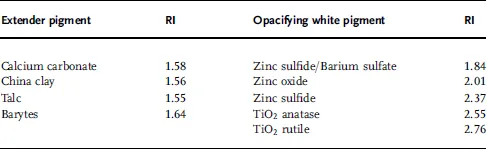
The refractive index of any material (primary or secondary pigment) is a key to its performance. As is well known, the larger the difference in refractive index between the pigment and the medium in which it is dispersed, the greater is the opacity effect. A summary of the refractive indices of various extender and opacifying pigments is given in Table 1.1.
Table 1.1 Refractive indices (RI) of extenders and opacifying pigments.
The refractive index of the medium in which the pigment is dispersed ranges from 1.33 (for water) to 1.4–1.6 (for most film formers). Thus rutile will give the highest opacity, whereas talc and calcium carbonate will be transparent in fully bound surface coatings. Another important fact that affects light scattering is the particle size, and to obtain the maximum opacity from rutile an optimum particle size of 250 nm is required. This explains the importance of good dispersion the powder in the liquid, which can be achieved by a good wetting/dispersing agent and also application of sufficient milling efficiency.
For colored pigments, the refractive index of a pigment in the non-absorbing or highly reflecting part of the spectrum affects its performance as an opacifying material. For example, Pigment Yellow 1 and Arylamide Yellow G give lower opacity than Pigment Yellow 34 Lead Chromate. Most suppliers of colored pigments attempt to increase the opacifying effect by controlling the particle size.
The nature of the pigment surface plays a very important role in its dispersion in the medium and its affinity to the binder. For example, the polarity of the pigment determines its affinity for alkyds, polyesters, acrylic polymers and latexes that are commonly used as film formers (see below). In addition, the nature of the pigment surface determines its wetting characteristics in the medium in which it is dispersed (which can be aqueous or non-aqueous) and also the dispersion of the aggregates and agglomerates into single particles. It also affects the overall stability of the liquid paint. Most pigments are surface treated by the manufacturer to achieve the optimum performance. As mentioned above, the surface of rutile particles is treated with silica and alumina in various proportions to reduce its photoactivity. If the pigment has to be used in a non-aqueous paint, its surface is also treated with fatty acids and amines to make it hydrophobic for incorporation in an organic medium. This surface treatment enhances the dispersibility of the paint, its opacity and tinting strength and its durability (glass retention, resistance to chalking and color retention). It can also protect the binder in the paint formulation.
The dispersion of the pigment powder in the continuous medium requires several processes, namely wetting of the external and internal surface of the aggregates and agglomerates, separation of the particles from these aggregates and agglomerates by application of mechanical energy, displacement of occluded air and coating of the particles with the dispersion resin. It is also necessary to stabilize the particles against flocculation by either electrostatic double-layer repulsion and/or steric repulsion. The process of wetting and dispersion of pigments is described in detail in Chapter 3 and colloid stability (lack of aggregation) is discussed in Chapter 4.
1.2 The Dispersion Medium and Film Formers
The dispersion medium can be aqueous or non-aqueous, depending on the application. It consists of a dispersion of the binder in the liquid (which is sometimes referred to as the diluent). The term solvent is frequently used to include liquids that do not dissolve the polymeric binder. Solvents are used in paints to enable the paint to be made and they allow application of the paint to the surface. In most cases, the solvent is removed after application by simple evaporation, and if the solvent is completely removed from the paint film it should not affect the paint film performance. However, in the early life of the film solvent retention, it can affect hardness, flexibility and other film properties. In water-based paints, the water may act as a true solvent for some of the components, but it should be a non-solvent for the film former. This is particularly the case with emulsion paints.
With the exception of water, all solvents, diluents and thinners used in surface coatings are organic liquids with low molecular weight. Two types can be distinguished, hydrocarbons (both aliphatic and aromatic) and oxygenated compounds such as ethers, ketones, esters and ether alcohols. Solvents, thinners and diluents control the flow of the wet paint on the substrate to achieve a satisfactory smooth, even, thin film, which dries in a predetermined time. In most cases, mixtures of solvents are used to obtain the optimum condition for paint application. The main factors that must be considered when choosing solvent mixtures are their solvency, viscosity, boiling point, evaporation rate, flash point, chemical nature, odor and toxicity.
The solvent power or solvency of a given liquid or mixture of liquids determines the miscibility of the polymer binder or resin. It has also a large effect on the attraction between particles in a paint formulation, as discussed in detail in Chapter 4. A very useful parameter that describes solvency is the Hildebrand solubility parameter, δ [2, 3], which is related to the energy of association of molecules in the liquid phase in terms of ‘cohesive energy density’. The latter is simply the ratio of the energy required to vaporize 1 cm3 of liquid, ΔEv, to its molar volume, Vm. The solubility parameter δ is simply the square root of that ratio,
(1)
Liquids having similar values of δ are miscible, whereas those with a significant difference are immiscible. The solubility parameters of liquids can be determined experimentally by measuring the energy of vaporization. For polymers, one can determine the solubility parameter using an empirical approach by contacting the polymer with liquids with various δ values and observing whether or not dissolution occurs. The solubility parameter of the polymer is taken the average of two δ values for two solvents that appear to dissolve the polymer. A better method is to calculate the solubility parameter from the ‘molar attraction constant’, G, of the constituent parts of the molecule [4]:
(2)
where ρ is the density of the polymer and M is its molecular weight.
Hansen [5] extended Hildebrand’s concept by considering three components for the solubility parameter, a dispersion component δd, a polar component δp and a hydrogen bonding component δh:
(3)
Values of δ and its components are tabulated in the book by Barton [4].
As mentioned above, the dispersion medium consist of a solvent or diluent and the film former. The latter is also sometimes referred to as a ‘binder’, since it functions by binding the particulate components together, and this provides the continuous film-forming portion of the coating. The film former can be a low molecular weight polymer (oleoresinous binder, alkyd, polyurethane, amino resin, epoxide resin, unsaturated polyester), a high molecular weight polymer (nitrocellu...
Table of contents
Cover
Series
Title
Copyright page
Dedication
Preface
1 Colloids in Paints
2 Emulsion, Dispersion and Suspension Polymerization: Preparation of Polymer Colloids and Their Stabilization
3 Pigment Dispersion
4 Colloid Stabilization of Paint Dispersions
5 Particle Deposition and Adhesion
6 Basic Principles of Rheology
7 Rheology of Suspensions, Emulsions and Their Mixtures (Suspoemulsions)
8 Rheology Modifiers, Thickeners and Gels
9 Rheology of Paints
Index
Trusted by 375,005 students
Access to over 1.5 million titles for a fair monthly price.
Study more efficiently using our study tools.
Frequently asked questions
Yes, you can cancel anytime from the Subscription tab in your account settings on the Perlego website. Your subscription will stay active until the end of your current billing period. Learn how to cancel your subscription
No, books cannot be downloaded as external files, such as PDFs, for use outside of Perlego. However, you can download books within the Perlego app for offline reading on mobile or tablet. Learn how to download books offline
Perlego offers two plans: Essential and Complete
Essential is ideal for learners and professionals who enjoy exploring a wide range of subjects. Access the Essential Library with 800,000+ trusted titles and best-sellers across business, personal growth, and the humanities. Includes unlimited reading time and Standard Read Aloud voice.
Complete: Perfect for advanced learners and researchers needing full, unrestricted access. Unlock 1.5M+ books across hundreds of subjects, including academic and specialized titles. The Complete Plan also includes advanced features like Premium Read Aloud and Research Assistant.
Both plans are available with monthly, semester, or annual billing cycles.
We are an online textbook subscription service, where you can get access to an entire online library for less than the price of a single book per month. With over 1.5 million books across 990+ topics, we’ve got you covered! Learn about our mission
Look out for the read-aloud symbol on your next book to see if you can listen to it. The read-aloud tool reads text aloud for you, highlighting the text as it is being read. You can pause it, speed it up and slow it down. Learn more about Read Aloud
Yes! You can use the Perlego app on both iOS and Android devices to read anytime, anywhere — even offline. Perfect for commutes or when you’re on the go. Please note we cannot support devices running on iOS 13 and Android 7 or earlier. Learn more about using the app
Yes, you can access Colloids in Paints by Tharwat F. Tadros in PDF and/or ePUB format, as well as other popular books in Physical Sciences & Industrial & Technical Chemistry. We have over 1.5 million books available in our catalogue for you to explore.