- Many companies have asked suppliers to begin using RFID (radio frequency identification) tags by 2006
- RFID allows pallets and products to be scanned at a greater distance and with less effort than barcode scanning, offering superior supply-chain management efficiencies
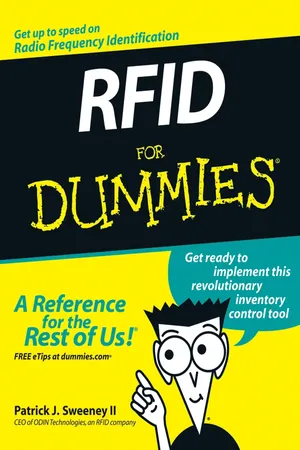
- This unique plain-English resource explains RFID and shows CIOs, warehouse managers, and supply-chain managers how to implement RFID tagging in products and deploy RFID scanning at a warehouse or distribution center
- Covers the business case for RFID, pilot programs, timelines and strategies for site assessments and deployments, testing guidelines, privacy and regulatory issues, and more
- English
- ePUB (mobile friendly)
- Available on iOS & Android
eBook - ePub
RFID For Dummies
About this book
Information
Part I
Now That You Can Spell RFID, Here’s the Rest of the Story

In this part . . .
P art I gets you prowling down the path to RFID adoption. In these three chapters, you become acquainted with the basics of the technology and understand how it compares to other automatic identification (Auto-ID) technologies. I explain why RFID has blossomed into the latest and greatest technology since the electric toaster. You also find out why so many people need to adopt this technology in such a short period of time.
The last chapter of Part I shows you, in simple, easy-to-understand terms, how to compare the different RFID networking and technology systems. This serves as a primer for more detailed discussions later in the book.
Chapter 1
Taking the Mystery out of RFID
In This Chapter

W ith all the recent hype over radio frequency identification (RFID) and the requirements to implement it, you might think that RFID can turn water into wine, transform lead into gold, and cure the world’s diseases. You might also be worried that RFID will enable Big Brother to track your movements to within a foot of your location from a satellite five hundred miles up in space. The truth is, RFID can do none of these things.
In this chapter, you find out the basics of what RFID is, what forces are driving RFID as a replacement for the bar code in the marketplace, and what benefits RFID can offer.
If you are responsible for complying with high-profile mandates from one of your suppliers or customers, this chapter also offers a framework to help you begin setting up a system and making it work within your existing business process. The bad news is that an RFID implementation is a daunting project even at a minimal compliance level, sometimes referred to as slap and ship or, more appropriately, tag and ship. The good news is that the benefits to the business are substantial, particularly if your trading partners are involved. RFID technology is here to stay, so the sooner you understand it, the quicker you can make key strategic decisions for your company.
What Is RFID?
RFID is a very valuable business and technology tool. It holds the promise of replacing existing identification technologies like the bar code. RFID offers strategic advantages for businesses because it can track inventory in the supply chain more efficiently, provide real-time in-transit visibility (ITV), and monitor general enterprise assets. The more RFID is in the news, the more creative people are about its potential applications. For example, I recently heard from someone who wanted to use RFID to track fishing nets in the North Sea.
The origins of RFID in inventory tracking
Wal-Mart has spent millions of dollars since the late 1990s researching the efficacy of RFID systems to replace bar codes (which have been in use since the days of The Brady Bunch and Gilligan’s Island — that’s the early 1970s, for those of you with all your hair left).
In 1999, with the help of scientists at the Massachusetts Institute of Technology (MIT), a consortium of companies formed the Auto-ID Center — a center for continued research into the nature and use of radio frequency identification. The consortium had a new idea about how organizations could identify and track their assets. The vision underlying automatic identification (or Auto-ID) is the creation of an “Internet of Objects.” In such a highly connected network, devices dispersed through an enterprise can talk to each other — providing real-time information about the location, contents, destination, and ambient conditions of assets. This communication allows much-sought-after machine-to-machine communication and decision-making, rendering humans unnecessary and mistakes a thing of the past.
Today, Auto-ID can track not only enterprise assets, but also the movement of products, containers, vehicles, and other assets across vast geographic areas. For more about the Auto-ID Center and the current organizations involved in developing RFID technology, see Chapter 2.
Tracking goods with EPC codes
RFID is actually nothing new. Just as goods today have bar codes, goods in RFID systems have codes that enable systems to share information. Because the mandated RFID systems require businesses to share information with each other, the different systems need to use the same code — the electronic product code (EPC). The EPC is the individual number associated with an RFID tag or chip.
The EPC was developed at MIT’s Auto-ID Center in 2000 and is a modern-day replacement for the Universal Product Code (UPC). A tag’s embedded EPC number is unique to that tag. However, the EPC protocol is universal to all EPC-compliant systems and serves two specific functions:

Wal-Mart, like other large retailers, had more pragmatic issues at hand when they established an RFID requirement for their suppliers. Under Wal-Mart’s mandate, each supplier is required to identify their products not by bar codes and waybills, but through EPCs that are automatically broadcast by RFID tags as new products arrive at the retailer’s warehouse, distribution center, or store. In Chapter 2, I explain how EPC works in more detail.
Sizing Up the Benefits of RFID
Capturing inventory as it arrives from the supplier is the first step in a company-wide tracking system that “knows” where every item is through- out its lifetime in the store. This tracking offers retailers tremendous insight into their inventory, which enables those retailers to control costs and reduce investment on inventory, which means lower prices and better competition for consumers.
Having better information about inventory offers retailers all sorts of potential benefits. The retailers know how much inventory is still on pallets in the warehouse, how much is on its way to distribution centers and stores, and how much is currently on the shelves in each of its stores. With this knowledge, retailers have the foundation for measuring product consumption, seeing buying patterns, and controlling inventory more efficiently. Through this process, a retailer ensures that its shelves are stocked and that customers can buy high-volume products (such as razor blades, diapers, and toilet paper) when they need them and in the quantity they need.
Of course, businesses don’t spend money unless they expect to make money off that investment. Major retailers believe that a comprehensive RFID program — tying suppliers to inventories to retail outlet shelf stock — will generate savings of around 10 to 16 percent, based simply on inventory cost reduction in each of their distribution centers (DCs). This translates into billions of dollars in savings each year — a pretty impressive result by any measure. The benefits can extend to other applications beyond retailers: Third-party logistics companies can speed up their billing cycle and create a new revenue stream with RFID; government agencies can reduce loss and increase security; museums can reduce cost to conduct inventory; sports teams can increase sales at games — the applications are limitless.
In an RFID system that uses an electronic product code (EPC) or similar numbering scheme, the following RFID attributes lead to those kinds of savings:
Table of contents
- Title
- Contents
- Introduction
- Part I : Now That You Can Spell RFID, Here’s the Rest of the Story
- Chapter 1: Taking the Mystery out of RFID
- Chapter 2: Auto-ID Technologies: Why RFID Is King of the Hill
- Chapter 3: Making Basic Decisions about Your RFID System
- Part II : Ride the Electromagnetic Wave: The Physics of RFID
- Chapter 4: What Makes Up an RFID Network
- Chapter 5: Understanding How Technology Becomes a Working System
- Chapter 6: Seeing Different RFID Systems at Work
- Part III : Fitting an RFID Application into Your World
- Chapter 7: Seeing the Invisible: The Site Assessment
- Chapter 8: Testing One, Two, Three: Developing Your Own Lab
- Chapter 9: Tag, You’re It: Testing for Best Tag Design and Placement
- Chapter 10: Hooked on Phonics: Reader Testing, Selection, and Installation
- Chapter 11: Middle Where? It’s Not Just about the Readers
- Part IV : Raising the Beams for Your Network
- Chapter 12: From Pilot to Admiral: Deploying RFID Successfully
- Chapter 13: Getting Set to Administer and Maintain Your System
- Chapter 14: Ping-pong, the Tags Are Gone: How to Monitor Your RFID Network
- Part V : How to Speak Bean Counter
- Chapter 15: Making the Business Case
- Chapter 16: Fitting RFID into Strategic Plans
- Chapter 17: What to Look for When Considering Outsourcing
- Part VI : The Part of Tens
- Chapter 18: Ten (Or So) Equipment Vendors
- Chapter 19: Ten Web Sites for Information on RFID
- Chapter 20: Ten Tips from the Experts
- Chapter 21: Ten (Or So) RFID Standards and Protocols
- Appendix: Glossary of Electrical, Magnetic, and Other Scientific Terms
Trusted by 375,005 students
Access to over 1.5 million titles for a fair monthly price.
Study more efficiently using our study tools.
Frequently asked questions
Yes, you can cancel anytime from the Subscription tab in your account settings on the Perlego website. Your subscription will stay active until the end of your current billing period. Learn how to cancel your subscription
No, books cannot be downloaded as external files, such as PDFs, for use outside of Perlego. However, you can download books within the Perlego app for offline reading on mobile or tablet. Learn how to download books offline
Perlego offers two plans: Essential and Complete
- Essential is ideal for learners and professionals who enjoy exploring a wide range of subjects. Access the Essential Library with 800,000+ trusted titles and best-sellers across business, personal growth, and the humanities. Includes unlimited reading time and Standard Read Aloud voice.
- Complete: Perfect for advanced learners and researchers needing full, unrestricted access. Unlock 1.5M+ books across hundreds of subjects, including academic and specialized titles. The Complete Plan also includes advanced features like Premium Read Aloud and Research Assistant.
We are an online textbook subscription service, where you can get access to an entire online library for less than the price of a single book per month. With over 1.5 million books across 990+ topics, we’ve got you covered! Learn about our mission
Look out for the read-aloud symbol on your next book to see if you can listen to it. The read-aloud tool reads text aloud for you, highlighting the text as it is being read. You can pause it, speed it up and slow it down. Learn more about Read Aloud
Yes! You can use the Perlego app on both iOS and Android devices to read anytime, anywhere — even offline. Perfect for commutes or when you’re on the go.
Please note we cannot support devices running on iOS 13 and Android 7 or earlier. Learn more about using the app
Please note we cannot support devices running on iOS 13 and Android 7 or earlier. Learn more about using the app
Yes, you can access RFID For Dummies by Patrick J. Sweeney, II in PDF and/or ePUB format, as well as other popular books in Technology & Engineering & Electrical Engineering & Telecommunications. We have over 1.5 million books available in our catalogue for you to explore.