eBook - ePub
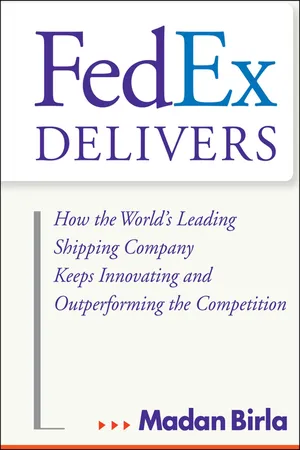
FedEx Delivers
How the World's Leading Shipping Company Keeps Innovating and Outperforming the Competition
- English
- ePUB (mobile friendly)
- Available on iOS & Android
eBook - ePub
FedEx Delivers
How the World's Leading Shipping Company Keeps Innovating and Outperforming the Competition
About this book
An inside look at leadership practices that enabled the world's leading shipping company to outthink and outperform its competition Using firsthand accounts from top leaders at FedEx, FedEx Delivers explains how the company became an international powerhouse and one of the most trusted global brands by using leadership practices that tapped into the creativity and commitment of its employees. Both a compelling business story and a prescription for business success, FedEx Delivers presents a model to show how these practices created and sustained an innovation culture. Readers will learn how to apply this model to their organizations for developing a culture of innovation that evolves with the times and offers fresh solutions to new challenges. Innovative thinking and disciplined execution are what made FedEx a market leader, and they can help any business in any industry do the same. Each chapter covers a different aspect of innovation with real-life stories that highlight its effectiveness, and offers valuable ideas that lead managers through the process of implementing those practices. By breaking innovation down to its three simplest steps-generation, acceptance, and implementation of ideas-and offering proven leadership practices that really work, FedEx Delivers offers unique insight and invaluable advice on building an organization that can adapt to any challenge and meet any goal in today's highly competitive global economy.
Information
Chapter 1
Innovating and Outperforming the Competition
Our vast progress in transportation, past and future, is only a symbol of the progress that is possible by constantly striving toward new horizons in every human activity. Who can say what new horizons lie before us if we can but maintain the initiative and develop the imagination to penetrate them—to the end that greater degrees of well being may be enjoyed by everyone, everywhere.—Alfred P. Sloan Jr.
CREATING A NEW INDUSTRY . . .
On FedEx’s first night of operation, April 17, 1973, a small group of people stood around a makeshift system and sorted 186 packages. They then loaded them onto 14 small planes that promptly took off for 25 cities across the United States. On that night, FedEx became the first transportation company dedicated to overnight express package delivery. Thirty-two years later, FedEx handles over five million packages every day serving 215 countries around the globe.
FedEx’s revenue grew from just $6 million in 1973 to over $24 billion in 2004. In 1983, it was the first company to grow to $1 billion within the first 10 years of its existence, without acquisitions. During the first three years of its operation (1973–1975), FedEx lost over $29 million as it built its infrastructure and established the network that would allow it to start making a profit. For the past three years (2002–2004), its net income has been over $2.3 billion.
Today’s FedEx, which has constantly evolved to meet customer needs, consists of four operating companies connecting the global economy with a full range of transportation, information, and supply chain services. This change and growth did not happen overnight. The factors that contributed to FedEx’s phenomenal success included developing customized business solutions. One example is FedEx’s relationship with Hewlett-Packard. In the fast-changing computer industry with new models coming out every month, HP realized that any computer stored in a warehouse runs the risk of becoming obsolete. FedEx and Hewlett-Packard worked together to develop a supply chain solution that eliminated the warehousing of HP’s industry-leading notebook PCs. The notebooks were shipped directly from the manufacturing facilities in China to homes and businesses throughout North America in just two to three working days.
Over the past five years, FedEx’s stock price has doubled. During the same period, the stock price of its main competitor, United Parcel Service (UPS) increased by only 15 percent, and the Standard & Poor’s 500 fell by 20 percent. FedEx has been recognized as one of the 100 Best Companies to Work for in America (Fortune, 1998–2004) and also as one of America’s Most Admired Companies (2001–2004).
. . . BY TAPPING EMPLOYEES’ CREATIVITY AND COMMITMENT
Before starting FedEx, Fred Smith hired consultants to do a feasibility study and help develop his business idea into a detailed business plan. The consultants estimated the total market potential for air freight to be around $1 billion. Today, FedEx’s share of the express transportation industry is over $17 billion. What allowed FedEx not only to create the express industry and grow the overall market, but to continue to enjoy a dominant market share?
FedEx became an international powerhouse and one of the most trusted global brands by implementing leadership practices that tapped into the discretionary effort, creativity, and commitment of its employees at all levels of the organization—the foundation of a thriving innovation and performance culture. True, Fred Smith had the original business idea, but it was the creativity and commitment of employees that turned it into a successful business. The employees of FedEx have designed and delivered unique customer value propositions (what customers value) that have kept FedEx one step ahead of the competition.
Even though the managers at FedEx did not consciously set out to build and sustain an innovation culture, that is precisely what they accomplished. The open and supportive environment allowed employees at all levels in the organization to be part of the innovation process. The day-to-day leadership practices and behaviors and the company’s organizational support systems have been keys to FedEx’s phenomenal growth.
This book provides a model, or a framework, that explains how these leadership practices and organizational support systems, working together, built and sustained the FedEx’s innovation and performance culture.
There is no company manual entitled The FedEx Way: How to Build and Sustain an Innovation Culture. The book you are reading is based on FedEx managers’ firsthand experiences and interpretation of those experiences in the context of the innovation culture model and the three-step process (generation, acceptance, implementation).
Business leaders also should keep in mind that it is neither feasible nor practical to adopt principles and practices “lock, stock, and barrel” from another organization and try to fit them into their own existing culture because each organization is unique.
Some organizations may already apply some of the leadership practices that promote innovation but do not get the collective benefit—a thriving innovation culture—because some of the pieces may be missing. The goal is to help managers identify and implement the missing piece(s) to actively engage every employee in the innovation process.
The leadership practices and support systems discussed in this book are not unique to FedEx; they have proven to be equally effective in other organizations.
DEFINING CREATIVITY IN THE BUSINESS WORLD
Two key terms are often used interchangeably—creativity and innovation. People normally associate creativity with artistic endeavors—Monet, Picasso, Michelangelo, and Mozart, the artist’s studio, the visual arts, or the performing arts. In the context of the business world, I define creativity as the process of generating ideas that will help the organization become more competitive in the marketplace. Business creativity is generating ideas that will improve the customer experience, increase revenue and market share, or improve efficiency. The thought process uses imagination just as artists do: “What if . . . ?” What if we make this change in our business strategy, product design, manufacturing process, distribution process, billing system, accounting system, and so on?
Walt Disney, after seeing run-down rides and bored adults during a visit to an amusement park with his daughter, thought, “What if there was a place where kids and adults could play together?”
Similarly Sam Walton, CEO of Wal-Mart, asked, “What if we connect the cash register to the inventory planning systems and substantially reduce the cost of doing business?”
After realizing that there was a growing demand for a time-definite express mode of transportation for shipping high-priority, time-sensitive cargo such as computer parts, critical documents, medicines, and electronics, Fred Smith thought, “What if we develop an airline dedicated to providing overnight express service to meet this growing need?” He went one step further and thought, “What if this airline used the hub-and-spoke system?”
Initially, Fred developed and proposed the hub-and-spoke system to the Federal Reserve System for overnight delivery of checks between their 36 locations around the country. At that time, clearing checks used to take anywhere from one to four days. This created a huge float, that is, checks written and presented for deposit but not yet cleared and credited in the recipients’ accounts. The overnight express system would have eliminated the float. The word “Federal” in the company’s original name came from the proposal to carry the Federal Reserve’s checks and “Express” represented the speed with which the new company would carry them.
Creativity in the business world means exploring what ifs—taking time to seek the connection between seemingly unrelated variables, to see other possibilities, and to look at the bigger picture when making decisions. Fred Smith thought out his ideas while he wrote his now-famous Yale term paper. When he was raising venture capital in the early 1970s to start FedEx, a shipper could send a critical package using passenger airlines.
Passenger airlines, for many reasons, did not always guarantee a time-definite and cost-effective service. First, because the primary goal of the passenger airlines was flying passengers, the departure and arrival schedules were built around the needs of the passengers. A flight might not be scheduled to leave at the time a customer wanted to ship a package. Or a flight may not have been scheduled to the destination the package needed to reach, or there might not have been a flight scheduled to arrive at the time the shipment needed to be there. Second, customers had to take packages to the airport because the airlines did not provide pickup service. The only way to avoid that problem was to have a third party pick up the package and transport it to the airport, which added substantially to the shipping cost.
A similar situation existed at the destination end. On arrival, the recipient or a designee had to pick up the package and deliver to the final destination. In general, the handling systems of the passenger airlines were designed to serve the passengers. Processing packages in an expeditious manner was not part of the design.
Fred’s creative idea substantially improved on the then standard express transportation service by making custodial control and “door-to-door” service part of the design of his proposed venture.
THE THREE-STEP INNOVATION PROCESS
Whereas creativity deals solely with the generation of ideas by exploring what if scenarios, innovation starts with creative ideas but takes the process two steps further. As Rosabeth Moss Kanter says in her landmark book, The Change Masters, “innovation is the generation, acceptance, and implementation of new ideas, processes, products or services. It can thus occur in any part of a corporation, and it can involve creative use as well as original invention. Application and implementation are central to this definition; it involves the capacity to change or adapt.” Innovation is the act of introducing something new. Innovation is applied creativity.
The process involves an increasing number of people as it moves through the three steps:
Step One: Individuals freely generate and express creative ideas.Step Two: A small group composed of people in departments and disciplines affected by the idea(s), accept and work collaboratively to develop the raw idea(s) into sound business plans.Step Three: A much larger group—in some cases the whole organization, depending on the scope—adopts the idea(s) and works to develop and implement it.
Walt Disney, Fred Smith, and Sam Walton had original ideas. But it required people from various disciplines to shape those raw ideas into viable business plans. And it required an even greater number (entire organizations) to successfully implement the business plans. Disney, Smith, and Walton understood that humans are inherently creative beings and have...
Table of contents
- Cover
- Table of Contents
- Series
- Title
- Copyright
- Dedication
- Preface
- Acknowledgments
- About the Author
- Introduction
- Chapter 1: Innovating and Outperforming the Competition
- Chapter 2: FedEx’s Innovation Journey
- Chapter 3: Why Organizations Do Not Innovate
- Chapter 4: The Five Dimensions of an Innovation and Performance Culture
- Chapter 5: Engage Employees in the Enterprise
- Chapter 6: Expect and Help Employees to Continually Grow
- Chapter 7: Create a Secure Environment for Expression and Acceptance of Creative Ideas
- Chapter 8: Encourage Collaborative Development of Creative Ideas
- Chapter 9: Tap Employees’ Commitment
- Conclusion: Continuing to Lead the Way
- Bibliography
- Index
- End User License Agreement
Trusted by 375,005 students
Access to over 1.5 million titles for a fair monthly price.
Study more efficiently using our study tools.
Frequently asked questions
Yes, you can cancel anytime from the Subscription tab in your account settings on the Perlego website. Your subscription will stay active until the end of your current billing period. Learn how to cancel your subscription
No, books cannot be downloaded as external files, such as PDFs, for use outside of Perlego. However, you can download books within the Perlego app for offline reading on mobile or tablet. Learn how to download books offline
Perlego offers two plans: Essential and Complete
- Essential is ideal for learners and professionals who enjoy exploring a wide range of subjects. Access the Essential Library with 800,000+ trusted titles and best-sellers across business, personal growth, and the humanities. Includes unlimited reading time and Standard Read Aloud voice.
- Complete: Perfect for advanced learners and researchers needing full, unrestricted access. Unlock 1.5M+ books across hundreds of subjects, including academic and specialized titles. The Complete Plan also includes advanced features like Premium Read Aloud and Research Assistant.
We are an online textbook subscription service, where you can get access to an entire online library for less than the price of a single book per month. With over 1.5 million books across 990+ topics, we’ve got you covered! Learn about our mission
Look out for the read-aloud symbol on your next book to see if you can listen to it. The read-aloud tool reads text aloud for you, highlighting the text as it is being read. You can pause it, speed it up and slow it down. Learn more about Read Aloud
Yes! You can use the Perlego app on both iOS and Android devices to read anytime, anywhere — even offline. Perfect for commutes or when you’re on the go.
Please note we cannot support devices running on iOS 13 and Android 7 or earlier. Learn more about using the app
Please note we cannot support devices running on iOS 13 and Android 7 or earlier. Learn more about using the app
Yes, you can access FedEx Delivers by Madan Birla in PDF and/or ePUB format, as well as other popular books in Business & Management. We have over 1.5 million books available in our catalogue for you to explore.