![]()
1
Prime Directives
Wild animals are mammals, birds, reptiles, amphibians, fish or invertebrates. All these groups sound familiar: they are exactly the same classes of animal seen in veterinary practices. However, there the similarity ends. Wild casualties may be of a similar structure to companion or domestic animals but they demand a completely different strategy in their care and treatment (Stocker, 1995). It is a demanding strategy, especially for veterinary practices that are already overloaded, but to succeed with wildlife casualties it is crucial to set aside time and facilities to cater for their specialised needs.
Of course, wild animals benefit from the first principles of veterinary surgery and they will prosper given the basic disciplines of standard veterinary nursing or animal care procedures, such as:
- A sound regime of hygiene practices both for the animals and the handlers
- The measured clinical use of prescribed drugs and the sterile use of multi-dose bottles, needles, syringes and other medical disposables
- The use of sterile utensils, equipment and clean cages and bedding
- The proper disposal of clinical waste, especially sharps and bodies
- Adherence to health and safety recommendations
- Proper acquaintance with and maintenance of the Control of Substances Hazardous to Health (COSHH) register
- A prohibition of eating, drinking or smoking wherever animals are present
These practices should already be in place. They provide a firm base on which to build the additional practices demanded by wildlife casualties. These additional practices may appear at first onerous and time-consuming, but the wild animals will benefit as, indirectly, will their handlers as more animals recover and become suitable for release into the wild.
All the techniques are part of The Wildlife Hospital Trust’s (St Tiggywinkles) own code of practice and, although not so stringently adhered to in some other centres, we have found them essential for a well-managed hospital and a consistent success rate. Trying not to make them sound like a list of ‘dos and don’ts’, you will find that they marry well with standard procedures and when in place will themselves become standard in the wild animal facility.
Some of the basic principles of wildlife care may seem out of place in a veterinary practice or other animal centre but they are essential for good, humane care for wild creatures. Such care should not even be attempted if you cannot provide the specialities wild animals demand.
The following practices recommended for wildlife complement the whole spectrum of a wild animal’s stay in captivity right through to its release, if that is possible.
(1) NEVER MIX WILD ANIMALS AND DOMESTIC ANIMALS
The author appreciates that this would put an enormous burden on the facilities of many veterinary practices and animal care establishments, but this is the directive most often flouted with disastrous consequences. A wild animal facility joined on to an existing practice does not need to be a state-of-the-art hospital. It could be just a small room or a basement where only wild animals are kept. Many wildlife rescue centres around the world operate from sheds or caravans in a garden. Without them wildlife rehabilitation would not have made the great strides forward that it has.
There are sound reasons for this aversion to mixing wild and domestic animals and the author knows of some wildlife rescue centres that have suffered terribly by innocently allowing companion animals into their facility.
Disease
The major disaster that brought the matter to the fore was when over 30 badgers died after contracting canine parvovirus at a rescue centre that allowed people, with dogs, to visit. It was not recorded if the parvovirus was contracted directly from the dogs or from contamination on the visitors’ footwear, but it made everybody aware of the potential hazards.
Some wild animals are susceptible to many of the common diseases seen in some of our domestic animals, but they do not have the benefit of vaccinations. Most companion animals taken anywhere by anybody should be vaccinated against the familiar diseases. But what if they are not or what if they had been vaccinated with a live-virus vaccine and are shedding the virus? Any contact with infected animal material can lead to fatal disease for wild animals. No one knows if viruses shed by vaccinated companion animals into the environment are affecting wild animals but in the close confines of a practice or rescue facility the likelihood of infection is infinitely greater.
Many diseases affecting domestic animals have been recorded in wildlife. These include:
- Parvovirus in badgers; can also affect foxes
- Canine distemper in foxes
- Infectious canine hepatitis in foxes
- Feline leukaemia in Scottish wildcats
- Paramyxovirus in pigeons
- Viral haemorrhagic disease in rabbits
- The possibility of Aleutian disease in mustelids
Generally it is not advisable to vaccinate wild animals routinely unless there are extenuating circumstances. Wild animals, therefore, have to rely on their own immune systems to fight these diseases. Their immune systems will not previously have been exposed to many of these domestic diseases and consequently any disease will quickly run its course unchallenged, culminating in the death of any wild animal unlucky enough to contract it. By keeping wild and domestic animals separate we are at least taking all the precautions possible to prevent that happening.
Stress
Wild animals are programmed to classify some other animals as extremely dangerous. Top of the list are human beings, so when a wild animal is picked up it will become severely stressed. Then if it is taken to within scenting, hearing or seeing distance of another arch enemy its stress levels can run out of control. Add to this confinement in a cage and the animal will rapidly lose control of its internal homeostatic mechanisms. It panics more and possibly injures itself in its efforts to escape. The animal might well die just from being put into a cage near to a potential enemy. Some of the incidents the author has witnessed, when picking up a casualty, highlight the stress these animals must have been going through:
- A wild deer put into a kennel in a room full of dogs. The deer’s terror must have been absolute as it could scent, hear and see, as it was in this case, similar animals to those that had injured it in the first place.
- A common or garden blackbird injured by a cat and now put into a cattery full of cats. Small birds are renowned for dying instantly from stress.
- A fox, surely the most nervous of all wildlife casualties, also put into a kennel in a room full of dogs.
- To top all these there is the constant to and fro in a busy centre exposing any wild animal kept there to an ever-changing cavalcade of humans – the worst enemy of all.
Stress is said, in humans, to have been the twentieth-century disease. This is also the case in the wild animal population even before they are brought into captivity and subjected to even more.
Noise
Working at any treatment facility you cannot fail to hear all the noisy bangs and clangs going on the whole time. Most of them are unavoidable:
- The stainless steel lids of pots and pans that are impossible to remove quietly
- The buzz and hum of clippers and vacuum cleaners
- The hiss of autoclaves
- The bang of those stainless steel cage doors you try to close quietly
- The incessant ringing of the telephone
Every noise must be like a gunshot to a wild animal that is not used to the closely confined atmosphere of a practice facility.
It is difficult, if not impossible, to counter disease, stress or noise in a close environment, but just a bit of peace and quiet in an annex will give a wild casualty that little bit extra it needs to recover.
Familiarity
Another hazard of keeping wild animals near domestic animals is that they may become familiar with those animals and lose any fear they might have had. When they are released, these wild animals might seek out the company of ‘familiar’ domestic animals and fall foul of an enemy (Plate 1).
Similarly, orphaned wild animals should never be reared by, or be in the company of, companion animals. The same perils will beset these orphans when they are released.
(2) PHOTOPERIOD
Wild animals are very much creatures of habit: if they are diurnal, they are active during the day and if they are nocturnal, they are active at night. However, when we take them into care they move into this glassy world of electric lighting putting yet another stress on an already confused animal.
Yes, operatives need bright lights in order to examine, operate on or even clean animals, but once these necessary procedures are completed the lights should be turned off so that the animal is in daylight or night. Do not close the blinds during the day or even at night. Wild animals need the gradual lighting of dawn or the darkening of dusk. It is something familiar in the strange captive world in which they now find themselves.
Bird fanciers even fit dimmer switches to their lighting so that their birds are not subjected to the sudden switch on or switch off. Even this may help a wild casualty relax that little bit more and help it recover more quickly.
(3) WHITE COATS
There is no reason that white coats have to be white. Surely any coat, if it is laundered properly, will be just as hygienic. Wild animals taken into care only know that this gleaming white apparition is going to approach and catch hold of it. If the animal was not already stressed this white coat is just another stimulus it could well do without.
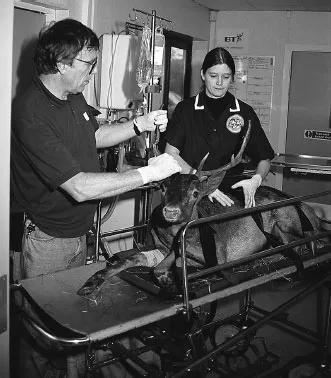
With green or dark blue coats there is not that stark contrast that is so alarming, and more colour conscious coats would still look respectable to onlookers (Fig. 1.1). Birds are easily stressed by coloured images. Green and blue are far more natural than white and are more readily accepted than the danger colours birds respond to: black, red or yellow.
Fig. 1.1 Green or blue coats are much less stark than white coats.
(4) RECORDS
Written records are even more crucial for the wildlife casualty than they are for domestic animals.
The information that is so important to the animal’s treatment can be vital to a medical database and may also produce material useful to biologists and zoologists majoring in British wildlife. Vital information recorded as the animal is admitted can have a direct bearing on its treatment and future. Included on a record card (Fig. 1.2), as well as its medical programme, should be:
- The name, address and telephone number of whoever found the animal. This is important in case any further information is required and if assistance is needed in getting the animal to an appropriate release site. Furthermore, being able to contact the finder could be crucial if ever your possession of a protected bird or other animal is challenged in law.
- The circumstances of rescue can often assist the veterinary surgeon in coming to a diagnosis, e.g. a bird that has flown into a window that shows no apparent injuries could be suffering from head trauma.
- Any treatments given. Sometimes caring people will already have provided their own version of first-aid care and medication. This may include inappropriate substances, detrimental food and, most common of all, a drink of water, brandy, warm milk or herbal remedies that can predispose to inhalation pneumonia.
- It is important to know exactly where the animal was found.
- If it is a territorial or bonding species, like a swan, did it have a mate and were any dependent siblings left behind?
- Lastly, once the animal is admitted, comprehensive records must be maintained of its...