"Customers are the heart of any business. But we can't succeed if we develop only one talk addressed to the 'average customer.' Instead we must know each customer and build our individual engagements with that knowledge. If Customer Relationship Management (CRM) is going to work, it calls for skills in Customer Data Integration (CDI). This is the best book that I have seen on the subject. Jill Dyché is to be complimented for her thoroughness in interviewing executives and presenting CDI."
-Philip Kotler, S. C. Johnson
Distinguished Professor of International Marketing Kellogg School of Management, Northwestern University
"In this world of killer competition, hanging on to existing customers is critical to survival. Jill Dyché's new book makes that job a lot easier than it has been."
-Jack Trout, author, Differentiate or Die
"Jill and Evan have not only written the definitive work on Customer Data Integration, they've made the business case for it. This book offers sound advice to business people in search of innovative ways to bring data together about customers-their most important asset-while at the same time giving IT some practical tips for implementing CDI and MDM the right way."
-Wayne Eckerson, The Data Warehousing Institute author of Performance Dashboards: Measuring, Monitoring, and Managing Your Business
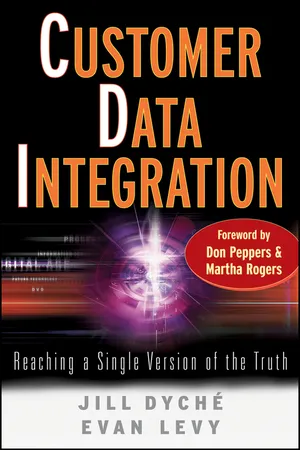
Whatever business you're in, you're ultimately in the customer business. No matter what your product, customers pay the bills. But the strategic importance of customer relationships hasn't brought companies much closer to a single, authoritative view of their customers. Written from both business and technicalperspectives, Customer Data Integration shows companies how to deliver an accurate, holistic, and long-term understanding of their customers through CDI.
- English
- ePUB (mobile friendly)
- Available on iOS & Android
eBook - ePub
CHAPTER 1
Executives Flying Blind
You can’t understand the future without knowing something about the present. Knowing the characteristics of your customers, partners, and suppliers—who they are, where they are, how they interact with your company, and how you support them—can shape every aspect of your company’s strategy and operations, right down to the individuals you target and the products you pitch.
As customer relationship management (CRM) enters the mainstream, companies continue to struggle with finding, gathering, and integrating information about their customers. Unlike other business challenges that require automation, integrating customer data isn’t an obvious call for brute force programming—it’s clearly a problem for management.
What executives don’t know can not only hurt them, it could send them to jail. In the “information age,” there are fewer excuses for ignorance, especially when it comes to corporate performance. But there are also significant barriers to knowledge, and these barriers haven’t been toppled by the latest juggernaut of packaged software solutions like CRM. In this chapter, we examine what’s holding companies back from understanding their customers at a holistic level. Customer information isn’t destiny, but it’s close.
SLOUCHING TOWARD CUSTOMER FOCUS
Nothing has as much impact on a company’s operations as an executive who declares a new strategic direction. Such declarations were common in the early 2000s, when many CEOs proclaimed that their companies would henceforward become “customer focused.”
Of course, major strategy shifts invited analysis of how the company did business prior to its becoming customer focused. Many companies paid large consulting firms big bucks to help them migrate from a state of “customer aware” to the nirvana of being “customer intimate.” While the distinction itself was up for debate, what was clear was that executives had to reexamine how their firms were building products, managing business operations, and interacting with customers.
Mature companies understood that in order to reach customer-centricity, they needed to understand who their customers were. More to the point, they needed to engage in an ongoing dialog with customers and continue to track their interactions and responses. This in turn allowed businesspeople across the company to understand who their good customers were, what made them good customers, and how to motivate other customers to share some of those traits. They needed to understand customers’ various demographics, income levels, existing product mixes, tenure, and the tried-and-true “recency, frequency, and monetary” analysis 1 that could all foretell purchase behaviors. In doing so, managers were finally heard admitting that no two customers were the same.
Companies that had been product-centric since their inception had to endure significant changes to business processes, technologies, job roles, and their very corporate cultures in an effort to become customer-centric. The trouble was that executives expected their organizations to turn on a dime.
Such lofty expectations took the form of new business discussions that informed a new crop of strategic goals. One of those discussions centered on the emerging concept of one-to-one marketing. Made popular by the best-selling book The One-to-One Future by Don Peppers and Martha Rogers, as well as their subsequent writings, one-to-one marketing brought the term mass customization into the popular business lexicon, and set the expectation that every customer was unique and thus should be communicated and sold to accordingly.
Part of one-to-one marketing meant engaging customers on a one-to-one basis, not only “pushing” communications out to them via direct mail and Web messages, but recording their comments via surveys, solicitation of feedback, and even ad-hoc customer conversations. As much as companies needed to start accessing customer information, they also needed to begin recording information about customers in a proactive and sustained way.
Integrated data is increasingly on people’s radar, especially management’s. Of the information technology (IT) professionals surveyed by Baseline Consulting at the end of 2005, over half claimed that their companies lacked a single, authoritative customer system of record.2 Ironically, 77 percent of respondents said that their company executives considered having a “single version of the truth about customers” to be an important issue.
Irrespective of the industry, data integration can have a huge impact. The U.S. Transportation Security Administration (TSA), a division of Homeland Security, had struggled to deploy its Secure Flight program. The program, which was issued a budget of $81 million for 2006, was meant to prequalify air passengers for faster security screening. This not only means cross-checking passenger information against the data on terrorist watch lists, but combining up-to-the-minute traveler data with established information about terrorists. Secure Flight was controversial because of the privacy concerns, but the technical challenges of mapping real-time passenger data with historical records ultimately grounded it for good. The TSA shut down the program in order to audit its IT systems.
As customer data continues to be distributed across a variety of internal and external data sources, more people are recognizing the need to bring it together. And it’s usually these same visionaries who confront how hard that is to do. In survey after survey3 across all the challenges IT executives face, integration is routinely cited as one of the biggest. Not surprisingly, the research firm IDC predicts that the market for data integration tools and services will reach $13.6 billion by the year 2008. Simply put, companies’ ability to communicate with and support their customers is only as effective as their access to consistent and accurate customer data.
Simply put, companies’ ability to communicate with and support their customers is only as effective as their access to consistent and accurate customer data.
MANAGEMENT MANDATES CUSTOMER INTIMACY
Customer-focused business trends incite drastic and far-reaching business programs. Executives whose company strategies had previously been entrenched in research and development (R&D) and supply chains were suddenly putting the customer in the middle of every conversation. There were a lot of anecdotes about how far this went. For example, as part of his newfound customer-centricity, the CEO at one of our clients declared a new company-wide policy: if you’re in a meeting and within five minutes a customer isn’t mentioned, you’re free to leave the meeting.
Executives are transcending the tired edicts of the late 1990s (“The Customer is King!”) and advocating more tactical, measurable customer-focused programs in order to drive smarter marketing and higher revenues. The following list of customer-focused business trends represents the core set of initiatives that helped set the stage for many companies’ newfound customer-focused projects. Not coincidentally, they also prompted escalating requests among businesspeople for integrated customer data:
• Personalization. The emergence of one-to-one marketing combined with a new customer awareness in advertising and brand management circles sparked fresh attention around personalization, the tactic of customizing both written and online communications according to the attributes and behaviors of individual customers or customer groups. Personalization transcended the customized letterhead salutation, relying on customer information like past purchases, sales rep name, or number of customers in a household. These details would then be mentioned in conversations—both by phone and via live Web chat—or in marketing materials and even tailored sales collateral. The desired outcome was for personalized interactions to result in higher response rates.4
• Competitive analysis. With their newfound goal of customer-centricity, companies slowly came to terms with the fact that they were competing with other companies—not for superior products or more pervasive branding—but for customers. This meant a new pressure to understand what competitors were doing and which customers they might be targeting. One Baby Bell we worked with in the late 1990s invested millions of dollars in several campaigns to entice new residential customers. Meanwhile, a competing national carrier was laying fiber-optic cable directly underneath the city streets of the Baby Bell’s headquarters. The national carrier’s cover was blown by the local press, but the Baby Bell ignored the news. The national carrier subsequently launched a campaign to lure away corporate customers, with huge consequences for the Baby Bell.
• Customer segmentation. The one-to-one movement made customer segmentation—traditionally based on simplistic attributes like geography—a dirty word. The premise was that the more specific a company’s characterization of customers, the better its chances for communicating with smaller groups of customers. Marketing vice presidents saw one-to-one marketing as a way to narrow their customer segments by behaviors and preferences, so that the “households in the Midwest” segment became “empty-nesters in suburban Chicago whose next sequential purchase will be a home equity line of credit.” The more detail the company had about its customers, the more precise the segments could be. With the growing volumes of granular information and advanced data mining technologies, companies are treating their highest-value customers as so-called segments of one.
• Cross-selling and up-selling. Cross-selling—that is, selling a different product or service to an existing customer—got traction from various research studies that declared that it was more cost effective to sell products and services to existing customers than to cast the net for new ones.5 Hence, executives in sales, marketing, and customer support, and even chief strategy officers, put cross-selling in their strategic crosshairs. The problem was that in order to cross-sell a new product, or to up-sell a better one, companies had to understand the products the targeted customer had already. This meant, at the very least, integrating customer information with product purchase and payment history. In more mature environments, it meant companies running sophisticated product profitability algorithms or propensity-to-buy models. Whatever the specific requirement, the company’s success with cross-selling and up-selling was directly proportional to the variety of detailed data it kept about its customers.
• Return on marketing investment. The wake-up call of customer focus meant that large, infrequent mass marketing campaigns were to be replaced with more targeted and more frequent campaigns to smaller customer groups. In some companies, this temporarily raised the cost of marketing, and executives began demanding return-oninvestment figures from their marketing staff. Return on marketing investment (ROMI) offers a structured way to quantify the cost and return of individual marketing campaigns in order to pinpoint unsuccessful promotions, leverage the characteristics of successful ones, and refine campaigns to be more successful—and more cost effective—over time.6 ROMI also allowed companies to evaluate different marketing ideas based on their anticipated financial returns.
• Employee productivity. In the early part of the twenty-first century, executives turned their heads toward cost savings as a means of satisfying surly shareholders. Creating a business case for all new IT initiatives went from desirable to mandatory at most large companies.
CASE STUDY: ROYAL BANK OF CANADA
Back when Ted Brewer and his team were planning their first CDI (customer data integration) project, the acronym hadn’t been invented. There were few if any CDI vendor solutions available. Brewer, vice president of customer information management, had seen the bank’s organizational infrastructure change since he joined Royal Bank of Canada (RBC) in 1978, but the business focus around the customer has grown more and more refined with time.
“In 1999 we were well on our way toward relationship management,” Brewer recalls. “In fact, we were already thinking about developing client strategies beyond clients’ relationship with the bank. We wanted to formulate programs around their total relationship with the organization. So we decided to build a utility to help us corroborate and reconcile all those relationships.”
Brewer’s customer information management group is a center of excellence that reports into a key business area: Canadian Personal and Business (CPB), which encompasses multiple RBC companies. In addition to retail banking, CPB spans Action Direct, RBC’s discount brokerage firm; Dominion Securities, its full-service brokerage firm; and RBC’s insurance organization. The utility, called Enterprise Customer Registry (ECR), reads daily data off the operational systems of these organizations and links customer records using their individual customer information source data.
ECR reads the individual customer information files and reconciles their customer identifiers using a unique matching key. “Once that unique ECR number is available, we can load that data onto our data warehouse and p...
Table of contents
- Title Page
- Copyright Page
- Dedication
- Foreword
- Introduction
- Acknowledgments
- CHAPTER 1 - Executives Flying Blind
- CHAPTER 2 - Master Data Management and Customer Data Integration Defined
- CHAPTER 3 - Challenges of Data Integration
- CHAPTER 4 - “Our Data Sucks!”: The (Not So Little) Secret about Bad Data
- CHAPTER 5 - Customer Data Integration Is Different: A CDI Development Framework
- CHAPTER 6 - Who Owns the Data Anyway?: Data Governance, Data Management, and ...
- CHAPTER 7 - Making Customer Data Integration Work
- CHAPTER 8 - Making the Case for Customer Data Integration
- CHAPTER 9 - Bootstrapping Your Customer Data Integration Initiative
- Glossary
- Index
Trusted by 375,005 students
Access to over 1.5 million titles for a fair monthly price.
Study more efficiently using our study tools.
Frequently asked questions
Yes, you can cancel anytime from the Subscription tab in your account settings on the Perlego website. Your subscription will stay active until the end of your current billing period. Learn how to cancel your subscription
No, books cannot be downloaded as external files, such as PDFs, for use outside of Perlego. However, you can download books within the Perlego app for offline reading on mobile or tablet. Learn how to download books offline
Perlego offers two plans: Essential and Complete
- Essential is ideal for learners and professionals who enjoy exploring a wide range of subjects. Access the Essential Library with 800,000+ trusted titles and best-sellers across business, personal growth, and the humanities. Includes unlimited reading time and Standard Read Aloud voice.
- Complete: Perfect for advanced learners and researchers needing full, unrestricted access. Unlock 1.5M+ books across hundreds of subjects, including academic and specialized titles. The Complete Plan also includes advanced features like Premium Read Aloud and Research Assistant.
We are an online textbook subscription service, where you can get access to an entire online library for less than the price of a single book per month. With over 1.5 million books across 990+ topics, we’ve got you covered! Learn about our mission
Look out for the read-aloud symbol on your next book to see if you can listen to it. The read-aloud tool reads text aloud for you, highlighting the text as it is being read. You can pause it, speed it up and slow it down. Learn more about Read Aloud
Yes! You can use the Perlego app on both iOS and Android devices to read anytime, anywhere — even offline. Perfect for commutes or when you’re on the go.
Please note we cannot support devices running on iOS 13 and Android 7 or earlier. Learn more about using the app
Please note we cannot support devices running on iOS 13 and Android 7 or earlier. Learn more about using the app
Yes, you can access Customer Data Integration by Jill Dyché,Evan Levy in PDF and/or ePUB format, as well as other popular books in Business & Business Strategy. We have over 1.5 million books available in our catalogue for you to explore.