Throughout history, most households, regardless of income level, had certain quilts used only for special occasions or when honored guests visited. Quilt makers put their greatest efforts into these quilts, using the best quality fabric they could afford and covering them with miles and miles of beautiful quilting stitches. Many of these rarely used “best quilts” survive today as a testament to the history of quilting and the talents of their makers and are highly coveted by quilt collectors.
In this chapter, I explain what a quilt is and document the quilt’s rich role in the texture of human life. I also share some of the newest developments in quilting and talk a bit about how quilting has become a modern form of artistic expression.
Following the Recipe for a Fabric Sandwich
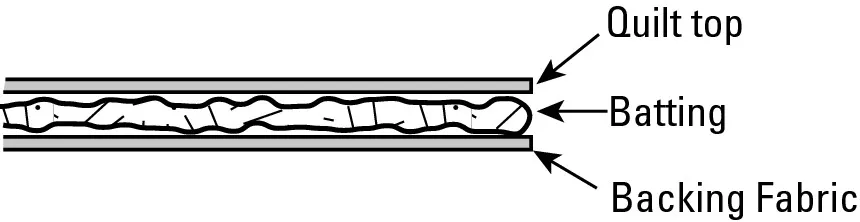
A quilt — that soft, cozy, comforting hunk of fabric and filling — in its simplest sense is a textile sandwich; in fact, that’s how the quilt layers are traditionally described. This simple sandwich is what distinguishes a quilt from any other sewn object.
All quilts — whether intended for use on a bed or as a simple potholder — consist of three layers:
Pieced or appliquéd quilt top
Filling (called
batting or
wadding)
The top, batting, and backing layers are held together, or quilted, using a series of basic running stitches. You can also tie the layers together by stitching yarn, narrow ribbon, or pearl cotton through the layers at regular intervals and tying off the ends. However you do it, your goal is to prevent the layers from shifting during regular use and washing. You can see a cross section of a quilt in Figure 1-1.
| Figure 1-1: The layers are what make a quilt. | |
Some folks call various types of bedcoverings “quilts,” but if it doesn’t consist of three layers (top, filling, and backing), it isn’t really a quilt but rather a coverlet, bedspread, or throw. Also, although the word “quilt” is casually used to refer to a quilted bedcovering, many other objects — such as place mats, vests, wall hangings, and diaper bags — can be quilted.
The quilt top
The topmost layer of the quilt sandwich is the quilt top, which is typically made of fabric blocks that are pieced, appliquéd, or crafted using a mixture of both techniques. Quilt tops can also be devoid of individual blocks, made instead of whole cloth.
Piecing things together
A pieced (also called patchwork) quilt top can be made up of tens to hundreds of small pieces of fabric joined together by hand or machine to create a pattern or repeating design. Modern cutting and stitching techniques make the work of piecing both fun and easy to do. I discuss these techniques in Chapters 8 and 9.
Patchwork is the most recognized form of quilt making and was devised as a way to turn a bunch of fabric odds and ends into one cohesive unit, eliminating waste by using any fabric available. Over the centuries it evolved into the art form we know today. Patchwork uses basic shapes such as squares, triangles, rectangles, and hexagons to form patterns ranging from simple to complex. To create a patchwork top, you piece various patterns together into one block and then piece each block to another to create the overall quilt design. I talk more about patchwork in Chapter 4.
Layering up with appliqué
Appliqué is another method of creating quilt tops. To create an appliquéd top, you stitch various fabric shapes onto a base fabric. In the past, appliqué was used mainly for “best quilts” — the quilts used when company was expected — because of the money and time involved in making them. Stitching a piece of fabric on top of another piece wasn’t a very frugal use of precious fabric, making the quilts more expensive to create than patchwork ones. Appliqué also takes a bit longer to stitch than piecing, but the appliqué method allows you to create interesting patterns that can’t be pieced, such as dainty flowers with gracefully curving stems.
You can do appliqué work either by hand or by machine. Machine appliqué provides a variety of creative possibilities and is easy enough for even the rank beginner to master yet can be done intricately enough to produce a masterpiece worthy of a blue ribbon at the state fair. Chapter 10 covers appliqué in more detail.
Working with the whole top
Whole cloth quilts are one more branch of the quilt tree that bears mentioning. These were the fanciest of quilts, often created by wealthy women for only the most distinguished guests. In whole-cloth quilting, the quilt top consists of one large piece of fabric without seams (wide fabric widths were uncommon and very costly before the invention of modern fabric looms in the 18th century). This single piece is intricately quilted with delicate, closely-spaced stitching designs. One of the unique features of a whole cloth quilt is that it’s reversible, with the front being identical to the back. In France, these types of quilts are known as boutis. Today, whole cloth quilts are often referred to as white work or bridal quilts, and due to their intricacy, they’re still reserved for the best occasions.
The batting
The middle layer, or filling, of a quilt consists of cotton, wool, silk, or polyester batting (also referred to as “wadding” in some parts of the world). Batting is a very important component of a quilt; in fact, it’s the batting that makes a quilt truly a quilt. Without that wonderful, soft inner layer, you have a coverlet rather than a quilt. Batting adds depth and dimension to the quilt in that it buffers the quilt top and bottom, and it gives quilts the loft and coziness that make them so special.
Before the invention of commercial quilt batting, quilt makers used whatever they could find as filler. Wool was usually the filler of choice because it could be fluffed, laid out, and felted by dampening, pounding, and rolling the fibers until they meshed together. Quilt making got a whole lot easier when the first commercial quilt batting was produced from cotton in 1846. Cotton is still one of the favorite choices for quilt batting today.
I talk more about batting options and selection in Chapter 3.
The backing
The bottom layer of the sandwich, the backing, is a large piece of plain or printed cotton that may or may not be pieced together from smaller pieces to create the proper size. I talk more about the backing in Chapter 3.
After you assemble the three layers that make up a quilt, you have a sandwich of sorts: the quilt top and backing fabric enclose a layer of batting. The next step is to quilt the sandwich, meaning that you secure the three layers together by hand or machine stitching them into one cohesive and cozy unit.
“Quilt-thropology:” A Brief History of Quilt Making
Quilt making isn’t just an American pastime; it has roots in Europe, South America, and Asia as well. Quilts were essential articles in households of the past, but they weren’t used only as bedcoverings. You may be surprised to find out that quilts were used as curtains to keep out drafts, draped on supports and used as tents, used to cover doorways when no door was there, and used as petticoats and waistcoats to keep the body warm. Really thick quilts were even used as armor! Need proof? Head out to a Renaissance fair with a battle reenactment and you’ll see something very similar to the quilted armor of our historical past.
Because quilts were so useful, quilting lessons began early in life. As soon as a young girl was able to manipulate a nee...