An Introduction to Modern Cosmology Third Edition is an accessible account of modern cosmological ideas. The Big Bang Cosmology is explored, looking at its observational successes in explaining the expansion of the Universe, the existence and properties of the cosmic microwave background, and the origin of light elements in the universe. Properties of the very early Universe are also covered, including the motivation for a rapid period of expansion known as cosmological inflation. The third edition brings this established undergraduate textbook up-to-date with the rapidly evolving observational situation.
This fully revised edition of a bestseller takes an approach which is grounded in physics with a logical flow of chapters leading the reader from basic ideas of the expansion described by the Friedman equations to some of the more advanced ideas about the early universe. It also incorporates up-to-date results from the Planck mission, which imaged the anisotropies of the Cosmic Microwave Background radiation over the whole sky. The Advanced Topic sections present subjects with more detailed mathematical approaches to give greater depth to discussions. Student problems with hints for solving them and numerical answers are embedded in the chapters to facilitate the reader's understanding and learning.
Cosmology is now part of the core in many degree programs. This current, clear and concise introductory text is relevant to a wide range of astronomy programs worldwide and is essential reading for undergraduates and Masters students, as well as anyone starting research in cosmology.
The cornerstone of modern cosmology is the belief that the place which we occupy in the Universe is in no way special. This is known as the cosmological principle, and it is an idea which is both powerful and simple. It is intriguing, then, that for the bulk of the history of civilization it was believed that we occupy a very special location, usually the centre, in the scheme of things.
The ancient Greeks, in a model further developed by the Alexandrian Ptolemy, believed that the Earth must lie at the centre of the cosmos. It would be circled by the Moon, the Sun and the planets, and then the ‘fixed’ stars would be yet further away. A complex combination of circular motions, Ptolemy’s Epicycles, was devised in order to explain the motions of the planets, especially the phenomenon of retrograde motion where planets appear to temporarily reverse their direction of motion. It was not until the early 1500s that Copernicus stated forcefully the view, initiated nearly two thousand years before by Aristarchus, that one should regard the Earth, and the other planets, as going around the Sun. By ensuring that the planets moved at different speeds, retrograde motion could easily be explained by this theory. However, although Copernicus is credited with removing the anthropocentric view of the Universe, which placed the Earth at its centre, he in fact believed that the Sun was at the centre.
Newton’s theory of gravity put what had been an empirical science (Kepler’s discovery that the planets moved on elliptical orbits) on a solid footing, and it appears that Newton believed that the stars were also suns pretty much like our own, distributed evenly throughout infinite space, in a static configuration. However it seems that Newton was aware that such a static configuration is unstable.
Over the next two hundred years, it became increasingly understood that the nearby stars are not evenly distributed, but rather are located in a disk-shaped assembly which we now know as the Milky Way galaxy. The Herschels were able to identify the disk structure in the late 1700s, but their observations were not perfect and they wrongly concluded that the solar system lay at its centre. Only in the early 1900s was this convincingly overturned, by Shapley, who realized that we are some two-thirds of the radius away from the centre of the galaxy. Even then, he apparently still believed our galaxy to be at the centre of the Universe. Only in 1952 was it finally demonstrated, by Baade, that the Milky Way is a fairly typical galaxy, leading to the modern view, known as the cosmological principle (or sometimes the Copernican principle) that the Universe looks the same whoever and wherever you are.
It is important to stress that the cosmological principle isn’t exact. For example, no one thinks that sitting in a lecture theatre is exactly the same as sitting in a bar, and the interior of the Sun is a very different environment from the interstellar regions. Rather, it is an approximation which we believe holds better and better the larger the length scales we consider. Even on the scale of individual galaxies it is not very good, but once we take very large regions (though still much smaller than the Universe itself), containing say a million galaxies, we expect every such region to look more or less like every other one. The cosmological principle is therefore a property of the global Universe, breaking down if one looks at local phenomena.
The cosmological principle is the basis of the Big Bang Cosmology. The Big Bang is the best description we have of our Universe, and the aim of this book is to explain why. The Big Bang is a picture of our Universe as an evolving entity, which was very different in the past as compared to the present. Originally, it was forced to compete with a rival idea, the Steady State Universe, which holds that the Universe does not evolve but rather has looked the same forever, with new material being created to fill the gaps as the Universe expands. However, the observations I will describe now support the Big Bang so strongly that the Steady State theory is almost never considered.
Chapter 2
Observational Overview
For most of history, astronomers have had to rely on light in the visible part of the spectrum in order to study the Universe. One of the great astronomical achievements of the 20th century was the exploitation of the full electromagnetic spectrum for astronomical measurements. We now have instruments capable of making observations of radio waves, microwaves, infrared light, visible light, ultraviolet light, X-rays and gamma rays, which all correspond to light waves of different (in this case increasing) frequency. We are even entering an epoch where we can go beyond the electromagnetic spectrum and receive information of other types. A remarkable feature of observations of a nearby supernova in 1987 was that it was also seen through detection of neutrinos, an extraordinarily weakly interacting type of particle normally associated with radioactive decay. Very high energy cosmic rays, consisting of highly-relativistic elementary particles, are now routinely detected, though as yet there is no clear understanding of their astronomical origin. And as I write, experiments are starting up with the aim of detecting gravitational waves, ripples in space-time itself, and ultimately of using them to observe astronomical events such as colliding stars.
The advent of large ground-based and satellite-based telescopes operating in all parts of the electromagnetic spectrum has revolutionized our picture of the Universe. While there are probably gaps in our knowledge, some of which may be important for all we know, we do seem to have a consistent picture, based on the cosmological principle, of how material is distributed in the Universe. My discussion here is brief; for a much more detailed discussion of the observed Universe, see Rowan-Robinson’s book ‘Cosmology’ (full reference in the Bibliography). A set of images, including full-colour versions of the figures in this chapter, can be found via the book’s Home Page as given in the Preface.
2.1 In visible light
Historically, our picture of the Universe was built up through ever more careful observations using visible light.
Stars: The main source of visible light in the Universe is nuclear fusion within stars. The Sun is a fairly typical star, with a mass of about 2 × 1030 kilograms. This is known as a solar mass, indicated
, and is a convenient unit for measuring masses. The nearest stars to us are a few light years away, a light year being the distance (about 1016 metres) that light can travel in a year. For historical reasons, an alternative unit, known as the parsec and denoted ‘pc’,1 is more commonly used in cosmology. A parsec equals 3.261 light years. In cosmology, one seldom considers individual stars, instead preferring to adopt as the smallest considered unit the conglomerations of stars known as …
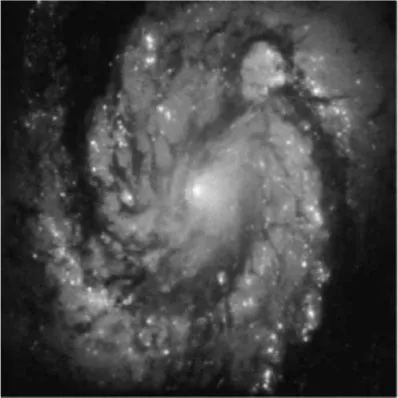
Figure 2.1 If viewed from above the disk, our own Milky Way galaxy would probably resemble the M100 galaxy, imaged here by the Hubble Space telescope. [Figure courtesy NASA]
Galaxies: Our solar system lies some way off-centre in a giant disk structure known as the Milky Way galaxy. It contains a staggering hundred thousand million (1011) or so stars, with masses ranging from about a tenth that of our Sun to tens of times larger. It consists of a central bulge, plus a disk of radius 12.5 kiloparsecs (kpc, equal to 103 pc) and a thickness of only about 0.3 kpc. We are located in the disk about 8 kpc from the centre. The disk rotates slowly (and also differentially, with the outer edges moving more slowly, just as more distant planets in the solar system orbit more slowly). At our radius, the galaxy rotates with a period of 200 million years. Because we are within it, we can’t get an image of our own galaxy, but it probably looks not unlike the M100 galaxy shown in Figure 2.1.
Our galaxy is surrounded by smaller collections of stars, known as globular clusters. These are distributed more or less symmetrically about the bulge, at distances of 5–30 kpc. Typically they contain a million stars, and are thought to be remnants of the formation of the galaxy. As we shall discuss later, it is believed that the entire disk and globular cluster system may be embedded in a larger spherical structure known as the galactic halo.
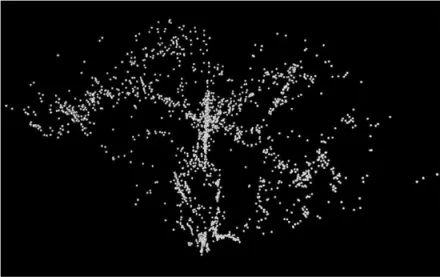
Figure 2.2 A map of galaxy positions in a narrow slice of the Universe, as identified by the CfA (Center for Astrophysics) redshift survey. Our galaxy is located at the apex, and the radius is around 200 Mpc. The galaxy positions were obtained by measurement of the shift of spectral lines, as described in section 2.4. While more modern and extensive galaxy redshift surveys exist, this survey still gives one of the best impressions of structure in the Universe. [Figure courtesy Lars Christensen]
Galaxies are the most visually striking and beautiful astronomical objects in the Universe, exhibiting a wide range of properties. However, in cosmology the detailed structure of a galaxy is usually irrelevant, and galaxies are normally thought of as point-like objects emitting light, often broken into sub-classes according to colours, luminosities and morphologies.
The local group: Our galaxy resides within a small concentrated group of galaxies known as the local group. The nearest galaxy is a small irregular galaxy known as the Large Magellanic Cloud (LMC), which is 50 kpc away from the Sun. The nearest galaxy of similar size to our own is the Andromeda Galaxy, at a distance of 770 kpc. The Milky Way is one of the largest galaxies in the local group. A typical galaxy group occupies a volume of a few cubic megaparsecs. The megaparsec, denoted Mpc and equal to a million parsecs, is the cosmologist’s favourite unit for measuring distances, because it is roughly the separation between neighbouring galaxies. It equals 3.086 × 10²² metres.
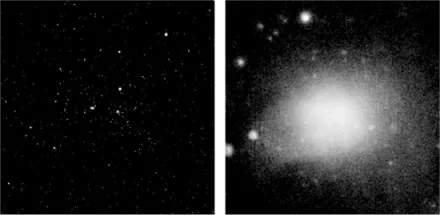
Clusters of galaxies, superclusters and voids: Surveying larger regions of the Universe, say on a scale of 100 Mpc, one sees a variety of large-scale structures, as shown in Figure 2.2. This figure is not a photograph, but rather a carefully constructed map of the nearby region of our Universe, on a scale of about 1:1027! In some places galaxies are clearly grouped into clusters of galaxies; a famous example is the Coma cluster of galaxies. It is about 100 Mpc away from our own galaxy, and appears in Figure 2.2 as the dense region in the centre of the map. The left panel of Figure 2.3 shows an optical telescope image of Coma; although the image resembles a star field, each point is a distinct galaxy. Coma contains perhaps 10 000 galaxies, mostly too faint to show in this image, orbitting in their common gravitational field. However, most galaxies, sometimes called field galaxies, are not part of a cluster. Galaxy clusters are the largest gravitationally-collapsed objects in the Universe, and they themselves are grouped into superclusters, perhaps joined by filaments and walls of galaxies. In between this ‘foamlike’ structure lie large voids, some as large as 50 Mpc across. Structures in the Universe will be further described in Advanced Topic 5.
Figure 2.3 Images of the Coma cluster of galaxies in visible light (left) and in X-rays (right), on the same scale. Colour versions can be found on the book’s WWW site. [Figures courtesy of the Digitized Sky Survey, ROSAT and SkyView ]
Large-scale smoothness: Only once we get to even larger scales, hundreds of megaparsecs or more, does the Universe begin to appear smooth. Recent extremely large galaxy surveys, the 2dF galaxy redshift survey and the Sloan Digital Sky Survey, have surveyed volumes around one hundred times the size of the CfA survey, each containing hundreds of thousands of galaxies. Such surveys do not find any huge structures on scales greater than those seen in the CfA survey; the galaxy superclusters and voids just discussed are likely to be the biggest structures in the present Universe.
The belief that the Universe does indeed become smooth on the largest scales, the cosmological principle, is the underpinning of modern cosmology. It is interesting that while the smoothness of the matter distribution on large scales has been a key assumption of cosmology for decades now, it is only fairly rece...
Table of contents
Cover
Contents
Title Page
Copyright
Preface
Constants, conversion factors and symbols
Chapter 1 A (Very) Brief History of Cosmological Ideas
Chapter 2 Observational Overview
Chapter 3 Newtonian Gravity
Chapter 4 The Geometry of the Universe
Chapter 5 Simple Cosmological Models
Chapter 6 Observational Parameters
Chapter 7 The Cosmological Constant
Chapter 8 The Age of the Universe
Chapter 9 The Density of the Universe and Dark Matter
Chapter 10 The Cosmic Microwave Background
Chapter 11 The Early Universe
Chapter 12 Nucleosynthesis: The Origin of the Light Elements
Chapter 13 The Inflationary Universe
Chapter 14 The Initial Singularity
Chapter 15 Overview: The Standard Cosmological Model
Bibliography
Numerical answers and hints to problems
Index
Trusted by 375,005 students
Access to over 1.5 million titles for a fair monthly price.
Study more efficiently using our study tools.
Frequently asked questions
Yes, you can cancel anytime from the Subscription tab in your account settings on the Perlego website. Your subscription will stay active until the end of your current billing period. Learn how to cancel your subscription
No, books cannot be downloaded as external files, such as PDFs, for use outside of Perlego. However, you can download books within the Perlego app for offline reading on mobile or tablet. Learn how to download books offline
Perlego offers two plans: Essential and Complete
Essential is ideal for learners and professionals who enjoy exploring a wide range of subjects. Access the Essential Library with 800,000+ trusted titles and best-sellers across business, personal growth, and the humanities. Includes unlimited reading time and Standard Read Aloud voice.
Complete: Perfect for advanced learners and researchers needing full, unrestricted access. Unlock 1.5M+ books across hundreds of subjects, including academic and specialized titles. The Complete Plan also includes advanced features like Premium Read Aloud and Research Assistant.
Both plans are available with monthly, semester, or annual billing cycles.
We are an online textbook subscription service, where you can get access to an entire online library for less than the price of a single book per month. With over 1.5 million books across 990+ topics, we’ve got you covered! Learn about our mission
Look out for the read-aloud symbol on your next book to see if you can listen to it. The read-aloud tool reads text aloud for you, highlighting the text as it is being read. You can pause it, speed it up and slow it down. Learn more about Read Aloud
Yes! You can use the Perlego app on both iOS and Android devices to read anytime, anywhere — even offline. Perfect for commutes or when you’re on the go. Please note we cannot support devices running on iOS 13 and Android 7 or earlier. Learn more about using the app
Yes, you can access An Introduction to Modern Cosmology by Andrew Liddle in PDF and/or ePUB format, as well as other popular books in Physical Sciences & Cosmology. We have over 1.5 million books available in our catalogue for you to explore.