- Brings together 25 newly-commissioned essays by some of the top scholars in the field
- Explores Joyce's distinctive cultural place in Irish, British and European modernism and the growing impact of his work elsewhere in the world
- A comprehensive and timely Companion to current debates and possible areas of future development in Joyce studies
- Offers new critical readings of several of Joyce's works, including Dubliners, A Portrait of the Artist as a Young Man, and Ulysses
- English
- ePUB (mobile friendly)
- Available on iOS & Android
eBook - ePub
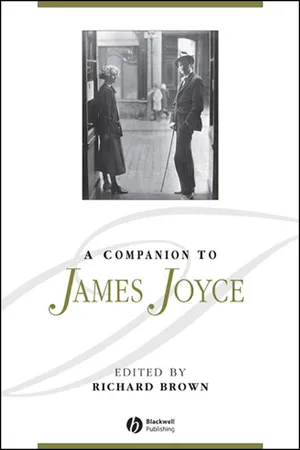
A Companion to James Joyce
About this book
A Companion to James Joyce offers a unique composite overview and analysis of Joyce's writing, his global image, and his growing impact on twentieth- and twenty-first-century literatures.
Information
1
Introduction: Re-readings, Relocations, and Receptions
The contribution of a volume on James Joyce to this series of Companions to Literature and Culture is not hard to justify in itself. Joyce’s work has outstandingly developed the kind of academic interest that would especially repay such treatment, with an intellectually distinguished as well as highly diverse body of criticism having grown up around it, at times exponentially. Joyce’s Dubliners (1914), A Portrait of the Artist as a Young Man (1916), Ulysses (1922), and, in its own way, Finnegans Wake (1939) have established quite unassailable places within the canons of twentieth-century modernistic literature, in Irish literature, more widely in the new, postcolonial, and global literatures in English, and in developments in the study of literary theory and culture, gender and sexuality, and so on. Joyce’s distinctive cultural placement as an iconic founding figure of British, American, and Irish modernism, as well as his unique and emerging significance as a prototypical figure for the discussion of modern multinational and transnational European cultural identity, contribute to the sense of a writer whose importance to a variety of key interests and constituencies is hard to overestimate and continues to grow.
Joyce’s work has been an inspiration to writers of prose fiction, poetry, drama, and film throughout the last century, with his status as a guru of the experimental or avantgarde frequently placing him at the forefront of significant cultural change. Innovations in literary and cultural theory (such as the revolutions in Continental philosophy associated with the post-1968 generation of Francophone intellectuals) as well as modern developments in academic empirical scholarship (such as historical and contextual study, reception study, and textual and genetic study) have frequently defined important stages of their progress in and through productive encounters with Joyce’s work. Joyce’s work remains authorial in a way that sometimes seems more comparable with the authorial status of a Shakespeare than with that of his modern contemporaries, whether you define that iconic position in relation to the newly independent Ireland, to the genre of twentieth-century prose fiction, or to our modernity itself.
Nevertheless aspects of Joyce’s work once provoked scandal and can frequently remain awkward, typically no doubt because of misunderstandings that may arise from the scale and complexity of the work. Significant areas of the work remain less well known, despite such attempts to put them back on the agenda as we can see in approaches to his stage play Exiles (1918) (whose revival in the 1970s by Harold Pinter is discussed here and which was produced on the London stage in a substantial new production in 2006); his critical prose writing, political journalism, and reviews (that became more available when re-edited by Oxford University Press for World’s Classics in 2001); his poetry (more fully collected in the Penguin Twentieth-Century Classics series in 1992); and the prose poem Giacomo Joyce, on which the first full volume of essays appeared last year (Armand and Wallace 2006). These works are all touched upon in this volume, though its emphasis is on the canonical and later work.
Adding an expansive new Companion on Joyce provides the opportunity to mark a moment in this re-approach to Joyce for our new century, presenting distinctively themed, critical readings of canonical texts and places of entry into the wide variety of current approaches within a single volume, and contributing informative pointers to current and possible future movements in the study of Joyce.
That there have already been two Companion volumes published on Joyce tells its own story and is another of the issues which face the editor of this one. The first, edited by Zack Bowen in 1984, contained 16 articles and two appendices written by a variety of academic and some non-academic enthusiasts and it retains much of value – not least in its broad intellectual frame. It offers a critical overview of each of the texts (including the less-well-known texts) with only a single final chapter offered on “The History of Joyce Criticism” (Bowen 1984). Alongside it the more contemporary Companion edited by Derek Attridge in 1990 and updated in 2004 thoroughly responds to the theory revolution of the 1970s and 80s with five chapters on texts, two on geographical and one on historical contexts, and four on the topics of feminism, sexuality, consumer culture, and colonialism/nationalism (Attridge 2004).
The format of this present volume allows for a larger number of more diverse essays and points towards an expansion of these categories, both of the possible contexts and of the themes that might inform our study of Joyce, whilst by no means exhausting the possibilities of such expansion. There is much of value in offering newly themed introductory readings, new contexts and locations for reading Joyce, and new kinds of material that mark the influence of Joyce on later imaginative literatures across the genres in a range of different cultures, as well as discussing how Joyce inspired the visual arts and the theatre, and the increasingly important Joyce of the cinema.
Of course there’s an inevitable and necessary overlapping between categories here. Such overlapping means that some of the work of extending the range of texts receiving critical treatment can be seen in the thematic or contextual essays. For example, the essay by Mark Taylor-Batty, which treats Exiles most fully, appears in the “Approaches and Receptions” section and deals with the profound creative response to Joyce by Britain’s Nobel laureate Harold Pinter – a work of reception that is perhaps distinctive to the medium of drama where a writer may both write and direct the work the others. His essay offers an example of a late twentieth-century English reception of Joyce that is not always recognized in Joycean studies. Derval Tubridy likewise extends the coverage of the volume when she engages the question of Joyce’s poetry, and her chapter likewise invokes geography and contemporary literary reception – discussing Kinsella and the poetry of contemporary Ireland. John McCourt’s essay on Trieste is the one that involves most discussion of Giacomo Joyce. Robert Weninger’s essay on Joyce and German literature and that by Krishna Sen involve some treatment of the genre Joyce may be said to have invented (if not exploited), the short prose sketch or epiphany. There may not be a separate chapter here on Joyce and Paris but Jean-Michel Rabaté’s essay on Joyce and French theory ensures that the developing avant-garde Parisian context for Joyce after the Second World War is not forgotten. Other essays confirm the renewed interest in Joyce’s occasional writings as a lecturer and critic. It is the question of the biographical as well as that of the particular geographical context that emerges in John McCourt’s essay on Joyce’s Trieste in the “Contexts and Locations” section, as it does, perhaps more unexpectedly, in the opening biographical section of David Wright’s. Chapters on Joyce’s early publication in the modernist little magazines by Katherine Mullin, the spectral presence of “The Dead” in the cinema by Luke Gibbons and on the interests of the new technology of radio to his later work by Jane Lewty further diversify this volume’s coverage of both texts and their contexts. Unexpectedness and variety in the juxtapositions of these essays help both to expand and to redefine the ways in which Joyce might be understood.
Re-reading Texts
The shared perception that we return to the reading of Joyce’s major texts and that we all agree that there is no single way of reading them paves the way I think for the section of exemplary textual readings by well-known critics that begins this volume. These essays by no means exhaust or even attempt to summarize mechanically the existing critical debate, but they do each combine a distinctive critical approach with the clarity and accessibility that is necessary for a reader new to the texts, and each offers a full bibliography which places their reading in the context of a debate, providing directions for further reading.
Since a primary goal of this volume is to refresh our approaches to Joyce’s writing it seems especially appropriate that we begin with a chapter from Vicki Mahaffey, who writes on Dubliners, approaching the stories as descriptions of the habitual activities of the characters and also as texts which challenge the habitual assumptions that we might bring to them as readers, assumptions which Joyce’s famously oblique narrative strategies might be shown to subvert. Mahaffey’s underlying intention, as in her recent study Modernist Literature: Challenging Fictions, is to defend Joyce’s apparent difficulty, even in these early works, and to show how the reader’s confrontation with that difficulty can lead to substantial rewards (Mahaffey 2006). She achieves this through a reading of the stories in terms of their metaphors of economy and she explores the new kind of “covenant” between the author and the reader which Joyce’s stories may be said to establish. Developing from a reading of the concept of “grace” in the story of that name, which she wittily exemplifies in the figure of the passing cyclist, she argues that elements in these stories invite a movement from the coercively contractual towards the kind of literary environment in which the reader’s due care and attention can produce special insights. Such openness of the texts, as she argues in her account of “The Dead,” can be compared to the cardinal Homeric virtue of hospitality – explored through its roots in the Greek words xenos and mêtis and in the Latin hospes – a virtue of his own writing which Joyce sees as problematic when absent from the society which his stories depict.
John Paul Riquelme explores A Portrait of the Artist as a Young Man as a text which stands closely beside an important predecessor: Oscar Wilde’s The Picture of Dorian Gray. He considers the title’s invitation to approach the book in terms of the visual arts and places his reading securely within the developing tradition of discussing the book’s treatment of the maturing of Stephen’s sexuality, taken here, in the spirit of recent queer theory, as fundamentally ambiguous in its orientation. Powerful dynamics of entrapment and constraint are seen to govern this and other aspects of Stephen’s psychic and creative life and we are shown this especially in his encounter with the institution of the confession and its constraints which so intrusively govern his embodied sensibility. Riquelme notices the role of some minor characters, like Dante Riordan, Stephen’s schoolfellow Heron, and his teacher Mr Tate, and he identifies imagery of snakes which appears in the discourses that terrorize Stephen’s imagination of sin and guilt as well as appearing in one of the key points of reference for his aesthetic theory (as for that of many philosophic theorists of art of the previous century), the statue of Laocoön in the Vatican.
Maud Ellmann, returning to the vital theme of the body in Ulysses, confirms the enduring significance of that once-marginalized concern. In her essay she reiterates and develops the idea, first voiced by Beckett, that the language of Ulysses is not so much “about” the body as that it “enacts organic process”: that the body and language are both circulatory systems. She builds from this to a reading of Stephen and Bloom in the early episodes in terms of the organs of the body and the cloacal, and of the Bloom in the middle episodes as he is engaged in the economics of wandering and return in the urban and domestic worlds which he inhabits. The final gendered “punch line” of Ulysses emerges here in the suggestion that it is through her body that Molly Bloom achieves the creativity that is so frustrated in Stephen Dedalus.
Finn Fordham offers a thoroughly new introduction to Finnegans Wake in terms of its approximations – or refusals to approximate – to the paradigm of the novel. Not only this but many other kinds of duality are said by Fordham to be characteristic both of the Wake and of the approaches to it that have been adopted over the years. In these approaches he sees a profound debate between those who do and those who do not want to understand it (at least in a conventional sense), between the philologists who accumulate knowledge and the theorists who argue that the very nature of Finnegans Wake is to call such knowledges into question. To approach Finnegans Wake is to enter a discussion concerning the fluid nature of language which Fordham ties to Ezra Pound’s favored sinologist Ernest Fenollosa, who is quoted in Finnegans Wake. He suggests that the discussion of nature and the natural, though it is not often invoked in the criticism of Joyce, can provide a paradigm for understanding this extraordinary text as it plies between opposed tendencies to “irrepressible category-smashing energy” and system-building. Fordham concludes by offering the reader examples of the Wakean transformation of two of the simplest elements of narrative: plot and character, describing what is usually held to be the central family plot or plots in the first sketches which Joyce wrote and what are usually held to be the central overlapping characters, character forms, or so-called “sigla” of the book.
Joycean Geographies: Biographical Contexts and Global Relocations
A second section on some of the places and contexts of Joyce’s residence and reception offers a deliberate expansion of the usual range of places in which Joyce’s work is understood, including nine essays whose keynote is their diversity. These are essays on familiar and unfamiliar geographical contexts for reading Joyce as well as ones which address theoretical problems of location more abstractly.
There is a recurrent debate in Joyce studies between the kind of cosmopolitanism that is implied by his several continental European places of residence and the kind of localism that is implied by his persistent return to the fictional subject-matter of Dublin. Each can be associated with a certain kind of politics. On the one hand the modernity and freedom of his cosmopolitanism is set against a backward-looking or procrustean aspect of the local, whilst on the other hand much recent work has tried to argue that it is his complex placement alongside the politics of an emerging national identity posed against repressive imperial domination that makes Joyce modern. No straight opposition between indigeneity and cosmopolitanism would do justice to the complex reformulation of the opposition between these terms either in Joyce’s work or in the contemporary cultural arena. Questions of where to locate or to relocate James Joyce in a twenty-first-century, global culture are not so easily resolved as by a return to Dublin or even to the succession of Joyce’s residences from Pola to Trieste, to Rome, Trieste, Zurich, Trieste, and Paris which are announced in the topographic by-lines that sign off A Portrait and Ulysses. As most readers will suspect, the “Gazeteer” of Finnegans Wake extends for hundreds of pages with its universalizing project of the overlapping of places through the alignments of their names.
There were different but no less significant cultural environments that informed the production and subsequent response to his work which recurrently radiated, for example, around literary London and which also depended vitally on Chicago and New York. Then there are the patterns of translation and/or literary reception which post-date the texts and make them come to figure in the many diverse narratives of Western European culture and of the cultural emancipation of one after another of the Western democracies and also the cultural modernization of Latin America, the former Eastern European countries, and the former imperial and postcolonial nations of the world. The reviews of three books in the February 2007 issue of the James Joyce Broadsheet bring some of the alternatives to the fore. Mark Sutton considers a book on Finnegans Wake by George Cinclair Gibson which places Joyce’s last work in relation to Irish Gaelic myth and cultural history (Sutton 2007). Fritz Senn reviews the Joycean rediffusion throughout Europe alone, charted in Geert Lernout and Wim van Mierlo’s 2004 volumes The Reception of James Joyce in Europe, which include some 29 articles on various Continental European countries, excluding Britain and Ireland though with an essay on Joyce and Irish-language writers (Senn 2007). This already encyclopedic project cries out for fuller extension around the other continents and language zones of the globe: a need to which this present volume can only gesture. Patrick O’Neill’s Polyglot Joyce is among recent studies that have begun to pay attention to this global “multiplicity” of Joyces: the Joyces of the 65 languages used in the Wake but also the Joyce of the languages into which his works have been translated (O’Neill 2005). This, as Fritz Senn has himself long argued, may constitute one of the richest territories for exploring the phenomenon of Joyce’s Dislocutions, where reading and interpretation may also themselves approximate to the activity of translation (Senn 1984).
Self-modernizing contemporary cosmopolitan Ireland is itself one among the places that has increasingly been led to reshape itself in the wake of the Joycean imagination. Yet if one wanted to locate Joyce as a force of cultural significance and of cultural emancipation for our time it would now appear too prudent even to limit that locationality to the well-developed academic centers of Britain, Europe, and North America, where most of the established academic authorities on Joyce are based. That would be to miss the larger picture of a writer whose liberatory cultural footprint, long planted on the bridges between Ireland, Britain, and Europe and between the larger Europe and North America, is now also poised to step out to the newer worlds of cultural communication that are opened up across the globe, between Europe with its rich inheritance of cultural diversity and Africa with its emerging national and pan-continental forms of cultural consciousness, or between Europe and America and Australasia and Asia that in their different ways have responded to Joyce.
English literary figures have written world histories from Walter Raleigh to H. G. Wells and the theorizing of a cosmopolitan ideal may be traced through Kant back to the Stoics (Nussbaum 1997), but our hotly debated contemporary impetus for global conceptions of culture and for a cultural conception of the global emerges hand-in-hand with rapid increases in the availability of cheap air travel, shared global problems such as climate change, and the everyday reality of instant global communications by means of the Internet. Global or cosmopolitan ideas may seem inevitably either homogenizing or idealistic. It may seem hard to imagine the cosmopolitan except in terms of the expert or even of an elite (Cucullu 2004). Perhaps the distinctive impact of Joyce’s later writing is to imagine a world in which a remarkable variety of places retain their distinctiveness whilst also showing up the comical and surprising aspects of their similarities to each other, where their unexpected fungibilities may reside. At any rate the conception of modernism was always a partly national and a partly international one. For Raymond Williams as for Bradbury and McFarlane the urban spaces which distinguish its emergence as a cultural form and the places it frequently chooses to represent are the modern international or cosmopolitan cities of modernity: London, Paris, Vienna, New York, as well as Joyce’s Dublin (Williams 1989; Bradbury and McFarlane 1970). The geographies of modernism, as a recent volume with that title attests, include a redefinition of nations, empires, locations and locationalities themselves (Brooker and Thacker 2005) and the postmodern cultural environment rapidly accelerates these trends. In late capitalism we see a rise of what Edward Soja has called the “prototopical” in which all places are the same place (Soja 1989) and may be driven all the more to pursue the specificities that Michel Foucault defined as “heterotopia” (Foucault 1986). Cultural productions can be defined as much in terms of the cultural environment, or what Pierre Bourdieu calls the “habitus,” in which they are produced or consumed (Bourdieu 1993), even whilst these habitations themselves can come to seem transmuted through their simulacra (Baudrillard 1983), redefined through the hyperspatial disjunction of the body and its built environment (Jameson 1992), or morph into the intermediate or “non-places” of the airport or shopping mall (Augé 1995). That new nations continue to be born out of old empires and vice versa and that the places of culture are by no means always identical with those of geography or politics may be thought to play into the broad environment for our reading of the many-faceted multi-locatednesses of Joyce and his diasporic texts as much as such traditional terms as exile and displacement.
In the spirit of this situation the essays on Joycean places in this section are arranged into two broad sub-groups, the first dealing with European and the second with non-European locations, though no attempt at coverage of such locations is implied.
Geert Lernout, whose two-volume work on the reception of Joyce’s work in Europe (edited with Wim van Mierlo) maps that field, here writes a more polemical essay....
Table of contents
- Cover
- Contents
- Title Page
- Copyright
- Illustrations
- Acknowledgments
- Notes on Contributors
- Abbreviations and Editions Used
- 1 Introduction: Re-readings, Relocations, and Receptions
- Part I: Re-reading Texts
- Part II: Contexts and Locations
- Part III: Approaches and Receptions
- Index
Trusted by 375,005 students
Access to over 1.5 million titles for a fair monthly price.
Study more efficiently using our study tools.
Frequently asked questions
Yes, you can cancel anytime from the Subscription tab in your account settings on the Perlego website. Your subscription will stay active until the end of your current billing period. Learn how to cancel your subscription
No, books cannot be downloaded as external files, such as PDFs, for use outside of Perlego. However, you can download books within the Perlego app for offline reading on mobile or tablet. Learn how to download books offline
Perlego offers two plans: Essential and Complete
- Essential is ideal for learners and professionals who enjoy exploring a wide range of subjects. Access the Essential Library with 800,000+ trusted titles and best-sellers across business, personal growth, and the humanities. Includes unlimited reading time and Standard Read Aloud voice.
- Complete: Perfect for advanced learners and researchers needing full, unrestricted access. Unlock 1.5M+ books across hundreds of subjects, including academic and specialized titles. The Complete Plan also includes advanced features like Premium Read Aloud and Research Assistant.
We are an online textbook subscription service, where you can get access to an entire online library for less than the price of a single book per month. With over 1.5 million books across 990+ topics, we’ve got you covered! Learn about our mission
Look out for the read-aloud symbol on your next book to see if you can listen to it. The read-aloud tool reads text aloud for you, highlighting the text as it is being read. You can pause it, speed it up and slow it down. Learn more about Read Aloud
Yes! You can use the Perlego app on both iOS and Android devices to read anytime, anywhere — even offline. Perfect for commutes or when you’re on the go.
Please note we cannot support devices running on iOS 13 and Android 7 or earlier. Learn more about using the app
Please note we cannot support devices running on iOS 13 and Android 7 or earlier. Learn more about using the app
Yes, you can access A Companion to James Joyce by Richard Brown in PDF and/or ePUB format, as well as other popular books in Literature & English Literary Criticism. We have over 1.5 million books available in our catalogue for you to explore.