- Includes 22 original essays by an international team of expert scholars
- Examines the social, intellectual, economic, cultural, and political changes that took place throughout Europe in the Cold War and Post Cold War periods
- Discusses a wide range of topics including the Single Market, European-American relations, family life and employment, globalization, consumption, political parties, European decolonization, European identity, security and defence policies, and Europe's fight against international terrorism
- Presents Europe in a broad geographical conception, to give equal weighting to developments in the Eastern and Western European states
- English
- ePUB (mobile friendly)
- Available on iOS & Android
eBook - ePub
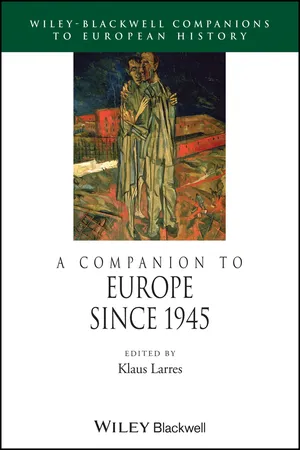
A Companion to Europe Since 1945
About this book
A Companion to Europe Since 1945 provides a stimulating guide to numerous important developments which have influenced the political, economic, social, and cultural character of Europe during and since the Cold War.
Information
PART I
Europe in Transition: From War to Cold War
CHAPTER ONE
From War to Cold War
MARK GILBERT
By late summer 1944, the Red Army had crossed the Soviet Union’s borders into Poland and Romania and would shortly invade and occupy Bulgaria. A million American and British troops had invaded France in June 1944 and, with the assistance of General Charles de Gaulle’s Free French forces, would liberate Paris at the end of August. Athens was occupied by the British in October 1944 and Italy had been liberated as far north as Florence. Despite the tenacious resistance of the German forces, who fought on all three fronts with a determination born of desperation, it was clear that Nazi Germany was doomed. Her casualties in the east were totalled in the millions; in the West and the Mediterranean theaters of war she was unable to match the allies’ massive superiority in tanks, aeroplanes, and artillery.
In Poland, Greece, Italy, Yugoslavia, and France, the German forces were fighting savage wars of repression against the peoples of the occupied territories. As Russian armies neared Warsaw, the Polish Home Army raised a heroic insurrection against the Nazi occupiers in August 1944. The Red Army remained passive, however, for two months as SS troops crushed the uprising and killed over 200,000 Polish civilians. Terrible episodes of repression took place elsewhere in Europe. To give just one example, in September 1944, 1,836 civilians, including many children, were murdered at Marzabotto, near Bologna, as a brigade commanded by SS officer Walter Rader concluded its “march of death” through Emilia-Romagna and Tuscany. By late 1944 and early 1945 the grim machinery of the Final Solution was being wound down. Europe would soon discover the full extent of the human damage done by the Nazis’ ideological madness (although it had been known since the end of 1942 that the Jews were being systematically slaughtered). Almost six million Jews had been killed by the Einsatzgruppen or in the extermination camps located in eastern Poland. Hundreds of thousands of other “undesirables” – the Roma, the mentally and physically handicapped, homosexuals – had also been murdered.
Faced with evil on this scale, the Allies responded by waging the war with a terrible brutality of their own. Dresden, Hamburg, and the cities of the Ruhr were bombed to destruction in British and American “obliteration raids” in 1944 and early 1945: hundreds of thousands of tons of bombs were dropped on by now defenseless Germany in the first quarter of 1945. The advancing Soviet forces treated the enemy with the same ruthlessness that the Nazis themselves had applied in Russia. Captured German soldiers were either shot out of hand or sent eastwards to windswept labor camps far behind the lines. Few ever returned.
The central question facing the Allies in the postwar world was whether they would be able to cooperate together to undo the damage of the war and to revive a morally and physically devastated continent. In the summer of 1944, there was still optimism on this score. The President of the United States, Franklin Delano Roosevelt, believed he had established a good working relationship with Stalin. British premier Winston Churchill was more suspicious of the Soviet leader’s intentions, but certainly believed that Stalin was a leader with whom deals could be made. Over the next three years, this optimism was shattered by events. The continent was divided in two, with the lands east of the Elbe being dominated by Soviet-backed regimes that gradually eliminated all domestic political opposition. The allies that had been united in fighting against Hitlerite Germany found it impossible to agree on a peace settlement. As a result, Germany was partitioned economically and politically as early as 1947, although the formal political separation of East and West Germany only came in the summer of 1949.
The task of this chapter is to reconstruct how and why this process of division occurred. Its argument is that unfolding events confirmed ideological stereotypes, on both sides, and transformed the normal friction of great-power coexistence into a clash of civilizations and values. In an age where, to paraphrase Stalin’s notorious remark to the Yugoslav intellectual Milovan Djilas, every victorious power inevitably imposed its own social system, neither side could make the calculated territorial arrangements that had characterized traditional European diplomacy without fearing that a loss had been made.1 Poland or Hungary could not be “awarded” to the Soviet Union without democrats believing that a vital principle was at stake; Germany could not be rebuilt by the Allies without provoking Russian fears that a capitalist plot was being hatched. Neither side was satisfied with mere territory; both believed that their ideals had to prevail as well.
The High Tide of Cooperation: October 1944–June 1945
Great Britain and the United States went as far as was consistent with ordinary decency to satisfy Stalin’s territorial ambitions and security fears between the autumn of 1944 and the late spring of 1945. Over Poland, in particular, the Western allies, especially the US, followed a highly conciliatory policy towards Stalin, allowing the Soviet leader to dictate the precise boundaries of the new Polish state and to construct a provisional government that was only dubiously in accordance with the USSR’s commitment at the Yalta conference in February 1945 to widen the democratic composition of the Soviet-backed government. Churchill and Roosevelt arguably had little choice – although they had committed themselves in the Atlantic Charter in August 1941 to making no territorial changes that did not accord with the wishes of affected populations. The Red Army dominated the country and the two Western allies needed Stalin’s cooperation: the US because, still unsure whether the atomic bomb would work, it thought it would need Russian military help against Japan and Russian participation in the new international organization, the United Nations, in which Roosevelt placed so many of his hopes for the postwar world; Britain because Churchill’s reactionary policy of backing conservative, preferably monarchist, governments in Greece and Italy would run into difficulties if the Soviet Union gave covert support to the powerful and well-armed communist parties of those countries.
This process of engagement with the ambitions of Stalin began October 9, 1944, when Churchill and his foreign secretary Anthony Eden met the Soviet leader in Moscow. During this meeting, Churchill presented the Soviet leader with a “naughty document” that proposed to share out influence in the Balkans according to the following percentages: in Romania, the USSR would have 90% influence; in Bulgaria 75% (which was amended by the foreign ministers, Molotov and Eden, to 80% in the following days). Hungary and Yugoslavia would be shared 50 : 50, while Britain would have 90% influence in Greece.2 Stalin scrawled a large tick on the document, but for all its notoriety, it should not be thought that the “percentages’ agreement” was decisive for the political future of the Balkans as a whole. Josip Broz Tito, the communist leader in Yugoslavia, would demonstrate over the next three years that he was his own man, not Stalin’s; Britain had no illusions about its ability to influence politics in Bulgaria. On the other hand, in both Greece and Romania, the percentages agreement had a clear and immediate effect on events.
In Greece, Stalin did not so much as raise his voice in December 1944–January 1945 when the British army suppressed a rebellion by the communist-controlled National Liberation Front (EAM) and forced its military wing, the National People’s Liberation Army (ELAS) to disarm. Bowing to reality, Britain renounced its long-standing support for King George II of t...
Table of contents
- Cover
- Table of Contents
- Series page
- Title
- Copyright
- Dedication
- Contributors
- Acknowledgments
- Maps
- Introduction
- PART I: Europe in Transition: From War to Cold War
- PART II: Europe and The Cold War World
- PART III: Europe since 1990: Political and Economic Developments
- PART IV: Europe Since 1990: Social and Cultural Developments
- Index
- End User License Agreement
Trusted by 375,005 students
Access to over 1.5 million titles for a fair monthly price.
Study more efficiently using our study tools.
Frequently asked questions
Yes, you can cancel anytime from the Subscription tab in your account settings on the Perlego website. Your subscription will stay active until the end of your current billing period. Learn how to cancel your subscription
No, books cannot be downloaded as external files, such as PDFs, for use outside of Perlego. However, you can download books within the Perlego app for offline reading on mobile or tablet. Learn how to download books offline
Perlego offers two plans: Essential and Complete
- Essential is ideal for learners and professionals who enjoy exploring a wide range of subjects. Access the Essential Library with 800,000+ trusted titles and best-sellers across business, personal growth, and the humanities. Includes unlimited reading time and Standard Read Aloud voice.
- Complete: Perfect for advanced learners and researchers needing full, unrestricted access. Unlock 1.5M+ books across hundreds of subjects, including academic and specialized titles. The Complete Plan also includes advanced features like Premium Read Aloud and Research Assistant.
We are an online textbook subscription service, where you can get access to an entire online library for less than the price of a single book per month. With over 1.5 million books across 990+ topics, we’ve got you covered! Learn about our mission
Look out for the read-aloud symbol on your next book to see if you can listen to it. The read-aloud tool reads text aloud for you, highlighting the text as it is being read. You can pause it, speed it up and slow it down. Learn more about Read Aloud
Yes! You can use the Perlego app on both iOS and Android devices to read anytime, anywhere — even offline. Perfect for commutes or when you’re on the go.
Please note we cannot support devices running on iOS 13 and Android 7 or earlier. Learn more about using the app
Please note we cannot support devices running on iOS 13 and Android 7 or earlier. Learn more about using the app
Yes, you can access A Companion to Europe Since 1945 by Klaus Larres in PDF and/or ePUB format, as well as other popular books in History & 20th Century History. We have over 1.5 million books available in our catalogue for you to explore.