- Represents the first scholarly work on any of film director John Waters' films
- Incorporates original interview material with the director
- Reveals meanings embedded in the film's narrative treatment of racial and sexual politics
eBook - ePub
Hairspray
About this book
By reconsidering assumptions about mainstream popular culture and its revolutionary possibilities, author Dana Heller reveals that John Waters' popular 1988 film Hairspray is the director's most subversive movie.
Information
Chapter 1
The Roots
The Roots
Baltimore. The story of Hairspray begins here, as does the story of its director. John Samuel Waters, Jr was born in Maryland’s largest municipality on April 22, 1946. He was raised in suburban Lutherville, in an upper-middle-class Catholic home. His parents, Patricia Ann Whitaker and John Samuel Waters, a successful manufacturer of fire-protection equipment, provided him with a happy and conventional childhood despite recognizing early on that their eldest child was “an odd duck” (Waters, 2004b).1 For example, he was obsessed with catastrophic automobile wrecks, fires (an interest he shared with his father), hurricanes, and disasters in general, all of which fed the grisly fantasies of his precocious imagination. He was drawn to stagecraft, costuming, and showmanship, always with an entrepreneurial edge. Neighborhood children paid a nickel for admission to his family’s garage, which Waters transformed into a “horror house.” He staged puppet shows for local birthday parties at US$20 a pop, presenting hyper-violent versions of Cinderella and Punch and Judy. He developed a particular fascination with the stage actor, Cyril Ritchard’s portrayal of Captain Hook, so much that the young Waters attempted to imitate him by scotch-taping his fathers’ neckties to his head to create the appearance of long, pirate locks.
Growing up, Waters loved the movies. He especially enjoyed horror films, films with evil villains, or anything involving a gimmick. In the late 1950s, he became a fan of the director William Castle, the “King of the gimmicks,” who aggressively promoted his low-budget horror films with sensational stunts such as “Emergo” (glow-in-the-dark skeletons attached to wire were floated over the audience during House on Haunted Hill (1959)), “Percepto” (joy-buzzers attached underneath movie-goers’ seats were activated synchronously with the attack of the creature, The Tingler (1958)), and “Illusion-O” (audiences were given cellophane “ghost-viewer” lenses to look through during climactic moments of 13 Ghosts (1960), which enabled them to see spirits or, if they became too frightened, make them disappear). In 1960, Mike Todd, Jr. introduced the short-lived gimmick, “Smell-O-Vision” with the release of the film Scent of Mystery (1960). This technique made it possible for movie audiences to smell what characters in the film smelled by releasing odors through theater seats in sync with the film’s projection. For good or ill, technical and aesthetic limitations plagued “Smell-O-Vision” from its inception, and it met with an abrupt end. However, Waters’ 1981 film, Polyester (starring Divine and Tab Hunter), a satirical homage to the women’s melodramas of Douglas Sirk, paid tribute to the great film gimmicks of the director’s youth through the introduction of “Odorama.” Viewers were provided with numbered scratch-’n’-sniff cards that were used with corresponding numbers on the screen to enliven the olfactory dimensions of the plot.
An aspiring beatnik, Waters rebelled against the rigid moral and aesthetic principles of the post-World War II era. In addition to the popular horror and novelty films of the day, he was irresistibly drawn to forbidden movies that were labeled “dirty” or sinful by the nuns at his Catholic Sunday school. He was fascinated by cultural objects and behaviors that were considered “criminal,” “filthy,” or offensive to middle-class taste. In Junior High School, he became fascinated by the tough girls who were regarded as “skags” or cheap. He studied their risqué manner of dress – their hair, make-up, and cha-cha heels – and marveled at their catfights and brazen disregard for authority. When he entered Catholic High School, Waters was unable to find many kindred spirits so he befriended kids from his own neighborhood who were similarly inclined to challenge social decorum, polite manners, and the law. With buddies such as Mary Vivian Pearce (who would eventually become a “Dreamlander,” one of his regular cast of actors), Waters discovered the delights of shoplifting and alcohol. Drugs – mainly marijuana, LSD, and speed – would come later. He quickly learned that art films, foreign films, and above all Swedish films were simply synonyms for “dirty” films. “I was interested in how the taboos would fall,” he explains, recalling the thrill of discovering the hidden world of cinematic garbage (Waters, 2004b). Waters began reading Variety in his early teens, clipping out the ads for movies that sounded particularly lurid, sneaking outside with a pair of binoculars to watch from a nearby hill the distant drive-in showings of sensational “adult-only” exploitation features. At school, and among his friends’ parents, he established a reputation as a troublemaker. Waters eventually lost interest in academics, preferring instead a program of self-education that included the writings of the Marquis de Sade, William Burroughs, Jean Genet, Theater of the Absurd, and Sigmund Freud’s case studies of abnormal psychology. He began cutting classes in order to attend sleazy downtown movie theaters that showed B films. Later, he would cut entire days of school to hitchhike with friends to New York City’s Greenwich Village, where Waters discovered the burgeoning underground film scene and the iconic directors whose work would eventually inspire his own, directors such as Kenneth Anger, Jack Smith, Andy Warhol, and the Kuchar Brothers. Meanwhile, back home in Baltimore, Waters’ grandmother gave him an 8mm Brownie movie camera for his seventeenth birthday. By then he already knew what he wanted to do with his life: his goal was to create “the trashiest motion pictures in cinema history” (1981, p. 34).
The Nicest Kids in Town
Not all of Waters’ youthful fixations were so scandalous. In fact, among the many obsessions, squalid or otherwise, that would ultimately work their way into his films, perhaps the most innocent was The Buddy Deane Show, the televised dance party that was Baltimore’s own local answer to the nationally-syndicated, American Bandstand, and the principal plot backdrop of Hairspray. The Buddy Deane Show (which Waters renames The Corny Collins Show) began airing in 1957 on WJZ-TV. The show was hosted by Winston “Buddy” Deane, who first established his reputation as a radio disc jockey and dedicated rock-and-roll enthusiast. Deane’s televised dance party also featured local teenagers known as “the committee” (Waters renames them “the counsel”). Billed as “the nicest kids in town,” the young people who were selected to appear as regular “Deaners” were catapulted to instant celebrity as a result of their dancing ability, fashion sense, rumored on/off screen romances, and – above all – their unrelenting penetration into Baltimore’s living rooms. The Buddy Deane Show aired for two and a half hours a day, six days a week (on Saturdays it would run even longer). Indeed, the show became a fixture of Baltimore’s youth culture, and for a brief time, it was the most popular local television show in the nation.
Waters was a self-confessed “groupie” of the show. Passionately, he followed the gossip, studied the dance moves that were introduced every week, and lusted after the clothing and hairstyles, although much to his disappointment his parents forbid him to have a “drape,” or greaser haircut. He also entertained himself by constructing wicked fantasies about the television teens whose names became household words as a result of their celebrity status. Waters playfully imagined them “committing crimes; robberies, burning down schools” (O’Donnell, 1988, p. 12). Above all, he loved the rhythm and blues music that was so frequently featured on the program. This was the music that was considered indecent and corrupting “race music” by White defenders of youth morality (typically code for pro-segregation and anti-miscegenation views), and which was “whitened” by chart-topping teen idols such as Elvis Presley. Baltimore’s African-American community was home to many great R&B musical performers, and the city could boast of some of the best R&B music stations in the country. The music was inseparable from the life of Baltimore itself, and Waters recalls hearing from his bedroom on still summer nights the lilting a cappella voices of Black men walking home alone in the neighborhoods that bordered on his.2 However, Baltimore was a racially turbulent city, and tensions ran very high in the years before and during the Civil Rights Movement. “It burned,” Waters recalls, in describing the late-1950s racial atmosphere and Baltimore’s centrality to Hairspray’s story of integration. “It’s the South here” (2001, 2007).
The Buddy Deane Show featured musical acts that were both Black and White. However, unlike American Bandstand, which allowed Black teenagers to appear on the program so long as they only danced with one another, The Buddy Deane Show prohibited White and Black teens from appearing together on the floor. Instead, the last Thursday afternoon of every month was set aside as “Black Only” day, where Black teens were permitted to dance without the participation of any Whites. The core committee members remained all White, and WJZ fiercely resisted growing pressures to integrate the show. In fact, the station refused to broadcast American Bandstand, substituting Deane’s show instead, precisely because of Bandstand’s policy of allowing Black teens to mix with Whites on the floor. Such staunch opposition to changing times and attitudes would eventually be the show’s downfall. In 1964, WJZ decided to cancel the show rather than yield to mounting calls for integration. In this sense, as we shall discuss subsequently at length, Hairspray revises the past and imagines a just ending to the Buddy Deane saga where actually there was none.
Midnight Madness
By 1964, however, Waters was preparing to leave his teenage years and his hometown behind. Despite his spotty academic record, he was accepted into New York University to study film-making after earning good grades for one year at the University of Baltimore. His NYU experience did not last very long, however, as once again Waters found himself far less interested in the highly formalistic, academic study of film – the endless viewings of the Odessa Steps sequence from Eisenstein’s The Battleship Potemkin – than in the grittier cinematic attractions of the city. He discovered the underground and exploitation theaters, which he bought admission into by stealing textbooks from the college bookstore and then selling them back as used. After three months, he was expelled after complaints that he and others were smoking marijuana in their dormitory.
Returning to Baltimore, Waters reconnected with the core group of friends that would constitute, for most of his career, his cast and crew. This group would come to be known as “The Dreamlanders” after his production company, Dreamland Studios. Over time the group came to include, but was not limited to, David Lochary, Edith Massey, Harris Glenn Milstead (aka Divine), Pat Moran (his casting director), Mary Vivian Pearce, Vincent Peranio (his production designer), Van Smith (his costumer and hairdresser), Maelcum Soul, and Mink Stole. During the ensuing years, Waters moved frequently around the United States, finding temporary work and living arrangements in Baltimore, New York City, Provincetown, New Orleans, and San Francisco. He also began making movies in earnest, a process he had earlier initiated with his first project, Hag in a Black Leather Jacket (1964), a 15-minute film shot with his grandmother’s 8mm camera. In 1966, he followed up with Roman Candles, a 40-minute film inspired by Andy Warhol’s Chelsea Girls. A moving-picture triptych, Roman Candles was composed of three synchronized movies projected by three adjacent 8mm projectors. Billed as a “trash epic,” the film was never commercially released, and is perhaps most memorable for Maelcum Soul’s strung-out performance as a lascivious nun (Waters, 1981, p. 50).
Waters next complete project was Eat Your Makeup (1968), a 16mm film that also starred Maelcum Soul as a maniacal governess who kidnaps fashion models and tortures them by forcing them to model in front of a crazed audience until they drop dead from exhaustion. Not long after the film’s opening Soul died of a drug-overdose at the age of 28, thus opening the way for Waters’ friend and future muse, Divine, to take center stage in the next Dreamland project. That project was Mondo Trasho (1969), Waters’ first feature-length film.3 It was financed by Waters’ father, who loaned his son US$2000 to make it. It starred Divine as a trashy blond-bombshell, a gum-chewing Jayne Mansfield look-alike. Filmed without dialogue or discernible plot, but only a musical soundtrack comprised of unlicensed original tracks, Mondo Trasho was notable for a brief outdoor nude scene that got Waters, along with several of his cast and production crew, arrested for “indecent exposure” and “conspiracy” to commit indecent exposure. The charges were eventually dropped, but the coverage of the scandal in the press turned out to be great publicity for the film, which sold out for its gala world premiere at Emmanuel Church in Baltimore. When it was screened in Los Angeles, Variety’s A.D. Murphy assessed it as: “A very amusing satire on films that exploit sex, violence, and seaminess. Should give pause to some established film makers who think they have their fingers on the pulse of the film-going public” (quoted in Waters, 1981, p. 61). Waters’ reputation was beginning to take shape.
Next was Multiple Maniacs (1970), a work Waters refers to as his “celluloid atrocity” (1981, p. 62). It was his first “talkie,” shot on a budget of US$5000, with another loan from his father. Like many of Waters’ early films, the plot of Multiple Maniacs defies easy description – suffice it to say that its central themes are insanity, murder, betrayal, and Catholicism, and it all ends with the rape of Divine’s character by a 15-foot shellfish named “Lobstora.” Otherwise, it is worth noting that the making of the film was framed by the grisly and sensational 1969 murder of Sharon Tate, the actress and wife of film director, Roman Polanski, by the Charles Manson “family” in Southern California. The Tate-LaBianca murders, which occurred just as production of Multiple Maniacs began, and the arrest of the Manson family members, which took place near the completion of the project, obsessed Waters. That obsession has lasted throughout his career, evidenced by the fact that most of his films contain some reference to the Manson crime. He remains, to this day, a dedicated follower of true crime in general, an expert on the Manson case in particular (he is a longtime friend of former “family” member, Leslie Van Houten), and a frequent attendee at celebrity trials wherever and whenever he can gain admittance.4 More to the point, one of the central preoccupations of Waters’ work – which ultimately informs Hairspray – takes on definition at this stage of his developing creativity: the glamour of notoriety, or the celebrity status that American culture lavishly confers on the (typically female) taboo-breaker.
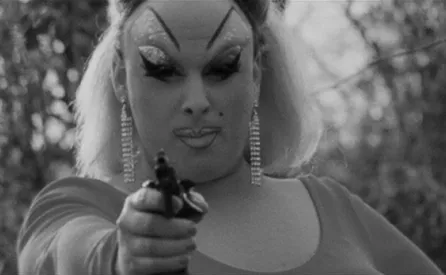
Perhaps nowhere is this theme more extravagantly exploited than in Waters’ next film, Pink Flamingos (1972). If Hairspray is the film that made John Waters famous, Pink Flamingos is the film that made him infamous. A venerable staple of the 1970s midnight movie circuit, described in 1973 by Inter/View’s Fran Lebowitz as “one of the sickest movies ever made. And one of the funniest” (quoted in Hoberman and Rosenbaum, 1983, p. 154), it is also the film that made Divine an international underground drag star and a legend in her own time. This was the result in no small part of the film’s notorious final segment – shot in one continuous take, with no editing, special effects, or cut-away – of Divine eating dog feces. It happens quickly – it’s a small piece of fecal matter from a small poodle – and without great fanfare. After that, the rest was cinematic bad-taste history.
Divine from Pink Flamingos (1972).
On this, Waters has been remarkably articulate: “To me, bad taste is what entertainment is all about,” he explains. “If someone vomits watching one of my films, it’s like getting a standing ovation (1981, p. 2).5 Considering these words, it comes as little surprise that as a film director Waters considers himself a “carny,” or a promoter of the lost art of cinema showmanship, particularly cinema involving the excessively twisted or freakish. Take, if you will, Pink Flamingos. The story involves two families who become locked in deadly competition to win the title “The Filthiest People Alive.” On one side, there is Divine and her cohort, which includes her psychotic, hippie son (Danny Mills) and her deranged 250-pound mother (Edith Massey) who remains in a playpen throughout the film, wearing nothing but a bra and girdle, eating eggs. On the other side, there are the Marbles (David Lochary and Mink Stole), a couple who make their living by kidnapping runaway girls, inseminating them with their man servant’s sperm, and then selling the offspring to lesbian couples. In their unstoppable quest for glamour and fame, the Marbles believe that they have been wrongly denied the title of “The Filthiest People Alive” by Divine. They declare war – a war that they will ultimately lose – by sending Divine a bowel movement in the mail and by setting fire to her trailer.
Pink Flamingos was made on a budget of US$10 000 and filmed over a six-month period on location in Baltimore. Waters took it upon himself to rate the film “X,” not because it contains scenes of any explicit sex but because it contains scenes that are explicitly disgusting. It premiered in late 1972 on the campus of the University of Baltimore and was eventually picked up for distribution by New Line Cinema, which at the time was a fledgling New York City firm with a reputation for supporting unconventional material. The film proved difficult to market, until Waters suggested to New Line that they book it for one night at as a midnight feature at the Elgin Theater, a haven for offbeat film aficionados. Through word of mouth alone, the film began to cultivate an audience. In time, Waters’ “exercise in poor taste” (the film’s tagline) became a hit, one that would acquire an even wider audience following its release on VHS. Although a full critical discussion of Pink Flamingos lies beyond the scope of this book, it needs to be said that this film – more than any other John Waters work – set the standard according to which all of his future films would be received and judged. Understanding this helps set the stage for the great leap that Hairspray will represent – both critically and popularly – in the underground school of American film-making that Waters had now come to uniquely emblematize. Of course, we could say that the subject of class competition between rival families in Pink Flamingos anticipates the Miss Auto Show contest in Hairspray and the class-inflected warfare between the bourgeois Von Tussles and the working class Turnblads. However, Pink Flamingos remains a one-of-a-kind movie, for which no equal or sequel could ever be attempted.6 Why? According to Waters, simply “because it would have to end with Divine t...
Table of contents
- Cover
- Contents
- Halftitle page
- Series page
- Title page
- Copyright
- Dedication
- List of Figures
- Acknowledgements
- Introducing Hairspray
- Chapter 1: The Roots
- Chapter 2: Tangled Genres: The Teenpic Gets a Makeover
- Chapter 3: Hair with Body: Corpulence, Unruliness, and Cultural Subversion
- Chapter 4: Highlighting History: Hairspray’s Uses of Popular Memory
- Chapter 5: More Than 20 Years and Still Holding: The Many Lives of Hairspray
- Notes
- Bibliography
- Index
Trusted by 375,005 students
Access to over 1.5 million titles for a fair monthly price.
Study more efficiently using our study tools.
Frequently asked questions
Yes, you can cancel anytime from the Subscription tab in your account settings on the Perlego website. Your subscription will stay active until the end of your current billing period. Learn how to cancel your subscription
No, books cannot be downloaded as external files, such as PDFs, for use outside of Perlego. However, you can download books within the Perlego app for offline reading on mobile or tablet. Learn how to download books offline
Perlego offers two plans: Essential and Complete
- Essential is ideal for learners and professionals who enjoy exploring a wide range of subjects. Access the Essential Library with 800,000+ trusted titles and best-sellers across business, personal growth, and the humanities. Includes unlimited reading time and Standard Read Aloud voice.
- Complete: Perfect for advanced learners and researchers needing full, unrestricted access. Unlock 1.5M+ books across hundreds of subjects, including academic and specialized titles. The Complete Plan also includes advanced features like Premium Read Aloud and Research Assistant.
We are an online textbook subscription service, where you can get access to an entire online library for less than the price of a single book per month. With over 1.5 million books across 990+ topics, we’ve got you covered! Learn about our mission
Look out for the read-aloud symbol on your next book to see if you can listen to it. The read-aloud tool reads text aloud for you, highlighting the text as it is being read. You can pause it, speed it up and slow it down. Learn more about Read Aloud
Yes! You can use the Perlego app on both iOS and Android devices to read anytime, anywhere — even offline. Perfect for commutes or when you’re on the go.
Please note we cannot support devices running on iOS 13 and Android 7 or earlier. Learn more about using the app
Please note we cannot support devices running on iOS 13 and Android 7 or earlier. Learn more about using the app
Yes, you can access Hairspray by Dana Heller in PDF and/or ePUB format, as well as other popular books in Media & Performing Arts & Film History & Criticism. We have over 1.5 million books available in our catalogue for you to explore.