- Commit to organizational objectives and culture
- Transform behaviors, cultures, and perceptions
- Implement competency or organization effectiveness models
- Exhibit strong top management leadership support and passion
eBook - ePub
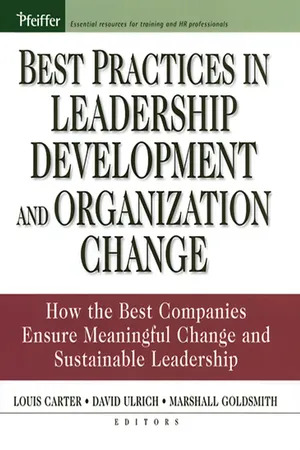
Best Practices in Leadership Development and Organization Change
How the Best Companies Ensure Meaningful Change and Sustainable Leadership
- English
- ePUB (mobile friendly)
- Available on iOS & Android
eBook - ePub
Best Practices in Leadership Development and Organization Change
How the Best Companies Ensure Meaningful Change and Sustainable Leadership
About this book
In this important book, successful organizations—including well-known companies such as Agilent Technologies, Corning, GE Capital, Hewlett Packard, Honeywell Aerospace, Lockheed Martin, MIT, Motorola, and Praxair—share their most effective approaches, tools, and specific methods for leadership development and organizational change. These exemplary organizations serve as models for leadership development and organizational change because they
Chapter One
Agilent Technologies, Inc.
Agilent Technologies’ corporate-wide executive coaching program for high-performing and high-potential senior leaders features a customized 360-degree-feedback leadership profile, an international network of external coaches, and a “pay for results” clause linked to follow-up measurements.
OVERVIEW
BACKGROUND
Early Coaching Efforts
Agilent Global Leadership Profile
DESIGN OF THE APEX PROGRAM
Initial Objectives
Five Coaching Options
Results-Guarantee Clause
Worldwide Coaching Pool
Internal Marketing
ABOUT THE APEX PROCESS
Qualification and Coach Assignment
What Do Coaches and Executives Do in the Program?
Follow-Up with Key Stakeholders
MEASUREMENT: THE MINI-SURVEY PROCESS
RESULTS
Figure 1.1: Aggregate Results for Overall Leadership Effectiveness
Figure 1.2: Aggregate Results for Selected Areas of Development
Figure 1.3: Aggregate Results for Follow-up Versus No Follow-up
KEY INSIGHTS AND LESSONS LEARNED
EXHIBITS
Exhibit 1.1: The Agilent Business Leader Inventory
Exhibit 1.2: The Agilent Global Leadership Profile
Exhibit 1.3: Agilent Sample Mini-Survey
ABOUT THE CONTRIBUTORS
OVERVIEW
As a 47,000-person Silicon Valley “start-up,” Agilent Technologies was presented with an opportunity to begin anew. The senior leadership team set out to pursue the company’s future strategy and new corporate values. A focused leadership development program aligned with the company’s strategic initiatives, including an integrated executive coaching program, quickly became a corporate imperative.
This case study will highlight the development and implementation of Agilent’s APEX (Accelerated Performance for Executives) coaching program. APEX has served over one hundred leaders through a sixty-person, worldwide coaching pool over the past two and one-half years. Based on feedback from raters, over 95 percent of the leaders have demonstrated positive improvement in overall leadership effectiveness while participating in the program.
The lessons learned by Agilent Technologies in the implementation of the APEX program serve as valuable insights for any organization committed to the continuing development of key leaders.
BACKGROUND
In 1999, Hewlett-Packard (HP) announced a strategic realignment to create two companies. One, HP, included all the computing, printing, and imaging businesses. Another, a high-tech “newco,” comprised test and measurement components, chemical analysis, and medical businesses. This second company would be named Agilent Technologies.
Agilent became entirely independent on November 18, 1999, while being afforded the NYSE ticker symbol “A” in the largest initial public offering in Silicon Valley history. New corporate headquarters were constructed on the site of HP’s first owned and operated research and development (R&D) and manufacturing facility in Palo Alto, California.
At the time of its “birth,” Agilent declared three new corporate values to guide its future: speed, focus, and accountability. Agilent also retained the “heritage” HP values: uncompromising integrity, innovation, trust, respect, and teamwork.
With a clear understanding of the need for strong individual leaders to build and sustain the company, an immediate requirement emerged to construct the leadership development strategy. The development of future leaders was and remains one of CEO Ned Barnholt’s critical few priorities.
Early Coaching Efforts
A key piece of the emerging leadership development plan would include executive coaching aimed at further developing key executives who were already recognized as high-potential or high-performing leaders.
Executive coaching had an established track record within HP, but efforts were generally uncoordinated. Coaching hadn’t been strategically integrated within the company’s leadership development initiatives. Multiple vendors and individual practitioners provided different coaching programs at varied prices. Learning from hindsight, Agilent had a desire to accomplish two early objectives: (1) to create an outstanding “corporate recommended” integrated coaching program and (2) to benefit from a preferred discount rate.
One of Agilent’s operating units, the Semiconductor Products Group (SPG), had engaged in a coordinated, “results-guaranteed” coaching program beginning in summer 1999 with Keilty, Goldsmith & Company (later to become Alliance for Strategic Leadership Coaching & Consulting). Over fifty of SPG’s senior leaders would receive one-year leadership effectiveness (behavioral) coaching, which included a unique “results guarantee.” The effort attracted positive attention in the company and would later form the foundation of the APEX program.
In February 2000, Dianne Anderson, Agilent’s global program manager, was charged with designing the corporate coaching solution for the company’s senior managers and executives (about 750 people worldwide). She worked with Brian Underhill of Keilty, Goldsmith & Company to collaborate on the design and delivery of the new APEX program, based on the same successful coaching model used within SPG.
Agilent Global Leadership Profile
At the outset of the APEX program, it was agreed that a critical need centered on the development of a new leadership behavioral profile to clearly and accurately reflect the company’s strategic priorities, core values, and expectations of those in senior leadership roles. Although a leadership inventory had been previously custom-designed to begin the SPG divisional coaching effort, at this time it was largely agreed that an Agilent-wide profile would be needed to position the leadership behaviors throughout the whole organization in a consistent fashion.
This next-generation leadership profile was drafted, based upon key strategic imperatives of top management, Agilent’s new and heritage core values, and SPG’s original profile. After gathering feedback from multiple sources, the Agilent Business Leader Inventory was created in summer 2000. The primary competencies are provided in Exhibit 1.1.
Exhibit 1.1. The Agilent Business Leader Inventory
- Delivers superior market-driven performance Focuses externally on the customerDrives for resultsModels speedModels focusModels innovation
- Practices active leadership Leads peopleActively manages talentModels accountabilityModels trust, respect, and teamworkModels uncompromising integrity
- Builds equity in the Agilent brand Practices strategic portfolio managementPromotes a global brandCreates a boundaryless organization
Later, in spring 2001, Agilent decided to update the Agilent Business Leader Inventory and create a set of profiles that would span all management levels from first-level managers through senior business leaders. A multifunctional team of Agilent and A4SL Coaching & Consulting (A4SL C&C) people set out to create the new profiles.
Through a several-month iterative process of document review, internal inputs, and refinements, a scalable and aligned Global Leadership Profile was developed for use throughout the organization. In the end, the midlevel/first-level manager profile turned out to be 80 percent the same as the executive profile, with only slight differences in some of the specific behavioral descriptions for “Leads Strategy & Change” and “Drives for Results” areas.
Finally, both profiles were reviewed by a senior manager in each of Agilent’s business units and by representatives of non-U.S. geographies. Feedback from these reviews was incorporated into the final product, and hence the Agilent Global Leadership Profile was ready for consistent application across all divisions and has been in use since summer 2001. The primary competencies are outlined in Exhibit 1.2. Assessment Plus of Atlanta, Georgia, served as APEX’s scoring partner throughout the multiple revisions of the profile.
Exhibit 1.2. The Agilent Global Leadership Profile
- Delivers high-growth performance Focuses externally on the customerDrives for resultsModels speedModels focusModels accountability
- Practices active leadership Leads strategy and changeActively develops selfActively manages talentModels uncompromising integrityModels innovation
- Acts globally Creates a global organizationModels trust, respect, and teamwork
DE...
Table of contents
- Cover
- Contents
- Title
- Copyright
- Dedication
- Acknowledgments
- About This Book
- How to Use This Book
- Introduction
- Chapter One: Agilent Technologies, Inc.
- Chapter Two: Corning
- Chapter Three: Delnor Hospital
- Chapter Four: Emmis Communications
- Chapter Five: First Consulting Group
- Chapter Six: GE Capital
- Chapter Seven: Hewlett-Packard
- Chapter Eight: Honeywell Aerospace
- Chapter Nine: Intel
- Chapter Ten: Lockheed Martin
- Chapter Eleven: Mattel
- Chapter Twelve: McDonald’s Corporation
- Chapter Thirteen: MIT
- Chapter Fourteen: Motorola
- Chapter Fifteen: Praxair
- Chapter Sixteen: St. Luke’s Hospital and Health Network
- Chapter Seventeen: StorageTek
- Chapter Eighteen: Windber Medical Center
- Chapter Nineteen: Conclusion
- About the Best Practices Institute
- About the Editors
- Index
Trusted by 375,005 students
Access to over 1.5 million titles for a fair monthly price.
Study more efficiently using our study tools.
Frequently asked questions
Yes, you can cancel anytime from the Subscription tab in your account settings on the Perlego website. Your subscription will stay active until the end of your current billing period. Learn how to cancel your subscription
No, books cannot be downloaded as external files, such as PDFs, for use outside of Perlego. However, you can download books within the Perlego app for offline reading on mobile or tablet. Learn how to download books offline
Perlego offers two plans: Essential and Complete
- Essential is ideal for learners and professionals who enjoy exploring a wide range of subjects. Access the Essential Library with 800,000+ trusted titles and best-sellers across business, personal growth, and the humanities. Includes unlimited reading time and Standard Read Aloud voice.
- Complete: Perfect for advanced learners and researchers needing full, unrestricted access. Unlock 1.5M+ books across hundreds of subjects, including academic and specialized titles. The Complete Plan also includes advanced features like Premium Read Aloud and Research Assistant.
We are an online textbook subscription service, where you can get access to an entire online library for less than the price of a single book per month. With over 1.5 million books across 990+ topics, we’ve got you covered! Learn about our mission
Look out for the read-aloud symbol on your next book to see if you can listen to it. The read-aloud tool reads text aloud for you, highlighting the text as it is being read. You can pause it, speed it up and slow it down. Learn more about Read Aloud
Yes! You can use the Perlego app on both iOS and Android devices to read anytime, anywhere — even offline. Perfect for commutes or when you’re on the go.
Please note we cannot support devices running on iOS 13 and Android 7 or earlier. Learn more about using the app
Please note we cannot support devices running on iOS 13 and Android 7 or earlier. Learn more about using the app
Yes, you can access Best Practices in Leadership Development and Organization Change by Louis Carter, Dave Ulrich, Marshall Goldsmith, Louis Carter,Dave Ulrich,Marshall Goldsmith in PDF and/or ePUB format, as well as other popular books in Business & Leadership. We have over 1.5 million books available in our catalogue for you to explore.