- English
- ePUB (mobile friendly)
- Available on iOS & Android
eBook - ePub
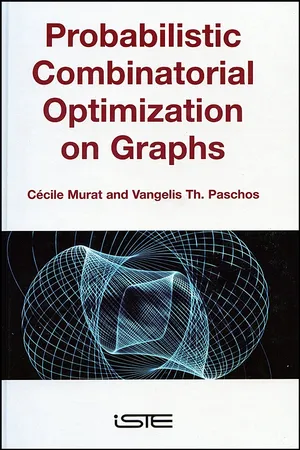
Probabilistic Combinatorial Optimization on Graphs
About this book
This title provides a comprehensive survey over the subject of probabilistic combinatorial optimization, discussing probabilistic versions of some of the most paradigmatic combinatorial problems on graphs, such as the maximum independent set, the minimum vertex covering, the longest path and the minimum coloring.
Those who possess a sound knowledge of the subject mater will find the title of great interest, but those who have only some mathematical familiarity and knowledge about complexity and approximation theory will also find it an accessible and informative read.
Tools to learn more effectively

Saving Books

Keyword Search

Annotating Text

Listen to it instead
Information
Chapter 1
A Short Insight into Probabilistic Combinatorial Optimization
1.1. Motivations and applications
The most common way in which probabilities are associated with combinatorial optimization problems is to consider that the data of the problem are deterministic (always present) and randomness carries over the relation between these data (for example, randomness on the existence of an edge linking two vertices in the framework of a random graph theory problem ([BOL 85]) or randomness on the fact that an element is included to a set or not, when dealing with optimization problems on set-systems or, even, randomness on the execution time of a task in scheduling problems). Then, in order to solve an optimization problem, algorithms (probabilistic or, more frequently, deterministic) are devised, and the mathematical expectation of the obtained solution is measured. A main characteristic of this approach is that probabilities do not intervene in the mathematical formulation of the problems but only in the mathematical analysis performed in order to get results.
More recently, in the late 1980s, another approach to the randomness of combinatorial optimization problems was developed: probabilities are associated with the data describing an optimization problem (for a particular datum, we can see the probability associated with it as a measure of how much this datum is likely to be present in the instance to be finally optimized) and, in this sense, probabilistic elements are explicitly included in the formulations of these problems. Such formulations give rise to what we will call probabilistic combinatorial optimization problems. Here, the objective function is a form of carefully defined mathematical expectation over all possible instances of size less than, or equal to, a given initial size.
The fact that, when dealing with probabilistic combinatorial problems, randomness lies in the presence of the data means that the underlying models are very suitable for the modelling of natural problems, where randomness is the quantification of uncertainty, or fuzzy information, or inability to forecast phenomena, etc.
For instance, in several versions of satellite shot planning problems, the uncertainty concerning meteorological conditions can be quantified by a system of probabilities. The optimization problems derived are, as we will see later in this chapter, clearly of probabilistic nature. If, on the other hand, during a salesman’s tour, some clients need not to be visited, he should omit them from his tour and if the fact that a client has to be visited or not is modelled in terms of probabilities-systems, then a probabilistic traveling salesman problem arises1. For similar or other reasons, starting from a transportation, or computer, or any other kind of network, we encounter problems like probabilistic shortest path problem2 or probabilistic longest path problem3, probabilistic minimum spanning tree problem4, etc. Also, in industrial automation, the systems for foreseeing workshops’ production give rise to probabilistic scheduling, or probabilistic set covering or probabilistic set packing, etc. Finally, in computer science, mainly when dealing with parallelism or distributed computation, probabilistic combinatorial optimization problems very frequently have to be solved. For instance, modeling load-balancing with non-uniform processors and failures possibility becomes a probabilistic graph partitioning problem; also in network reliability theory, many probabilistic routing problems are met ([BER 90b]).
In all, models of probabilistic nature are very suitable and appropriate real-life problems where randomness is a constant source of concern and, on the other hand, the study of the problems derived from these models are very attractive as mathematical abstraction of real systems. Another reason motivating work on probabilistic combinatorial optimization is the study and the analysis of the stability of the optimal solutions of deterministic combinatorial optimization problems when the considered instances are perturbed. For problems defined on graphs, more particularly, these perturbations are simulated by the occurrence, or the absence, of subsets of vertices (see, for example, [PEE 99] where probabilistic combinatorial optimization approaches and concepts are used to yield robust solutions for an on-line traffic-assignment problem).
Informally, given a combinatorial optimization graph5-problem Π, defined on a graph G(V, E), an instance of its probabilistic counterpart, denoted by PΠ, is built by associating a probability pi with any vertex vi in V. This probability is considered as the presence-probability of vi in the subgraph of G on which Π will be finally solved. Problem PΠ expresses the fact that Π will, eventually, have to be solved not on the whole G, but rather on some of its subgraphs that will be specified very shortly before the solution in this subgraph is required.
In order to illustrate the issue outlined...
Table of contents
- Cover
- Title Page
- Copyright
- Preface
- Chapter 1: A Short Insight into Probabilistic Combinatorial Optimization
- FIRST PART: Probabilistic Graph-problems
- SECOND PART: Structural Results
- Appendix A: Mathematical Preliminaries
- Appendix B: Elements of the Complexity and the Approximation Theory
- Bibliography
- Index
Frequently asked questions
Yes, you can cancel anytime from the Subscription tab in your account settings on the Perlego website. Your subscription will stay active until the end of your current billing period. Learn how to cancel your subscription
No, books cannot be downloaded as external files, such as PDFs, for use outside of Perlego. However, you can download books within the Perlego app for offline reading on mobile or tablet. Learn how to download books offline
Perlego offers two plans: Essential and Complete
- Essential is ideal for learners and professionals who enjoy exploring a wide range of subjects. Access the Essential Library with 800,000+ trusted titles and best-sellers across business, personal growth, and the humanities. Includes unlimited reading time and Standard Read Aloud voice.
- Complete: Perfect for advanced learners and researchers needing full, unrestricted access. Unlock 1.4M+ books across hundreds of subjects, including academic and specialized titles. The Complete Plan also includes advanced features like Premium Read Aloud and Research Assistant.
We are an online textbook subscription service, where you can get access to an entire online library for less than the price of a single book per month. With over 1 million books across 990+ topics, we’ve got you covered! Learn about our mission
Look out for the read-aloud symbol on your next book to see if you can listen to it. The read-aloud tool reads text aloud for you, highlighting the text as it is being read. You can pause it, speed it up and slow it down. Learn more about Read Aloud
Yes! You can use the Perlego app on both iOS and Android devices to read anytime, anywhere — even offline. Perfect for commutes or when you’re on the go.
Please note we cannot support devices running on iOS 13 and Android 7 or earlier. Learn more about using the app
Please note we cannot support devices running on iOS 13 and Android 7 or earlier. Learn more about using the app
Yes, you can access Probabilistic Combinatorial Optimization on Graphs by Cécile Murat,Vangelis Th. Paschos in PDF and/or ePUB format, as well as other popular books in Mathematics & Discrete Mathematics. We have over one million books available in our catalogue for you to explore.