- English
- ePUB (mobile friendly)
- Available on iOS & Android
eBook - ePub
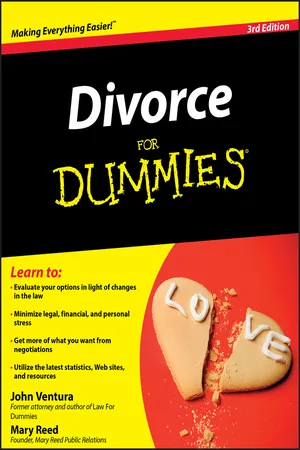
Divorce For Dummies
About this book
Since Divorce For Dummies, 2nd Edition published in 2005, there have been considerable changes in collaborative divorces, common law marriages, same sex marriages, visitation, and even custody laws (from children to pets). Divorce For Dummies, 3rd Edition includes 25 percent new, revised, and refreshed material covering all of the above.
Information
Edition
3Topic
Personal DevelopmentPart I
When Your Marriage Is on the Rocks
In this part . . .
Every marriage isn’t made in heaven. If you and your spouse are not living happily ever after and you think that your marriage may be ending, this part of the book provides you with a quick overview of divorce (and alternatives to it). It introduces you to the legal and financial issues that you and your spouse must resolve before your divorce can be official and the laws that apply to divorce, and it gives you an idea of the likely cost of your divorce. It also provides an overview of what you can expect if your divorce ends up in court.
Chapter 1
Divorce Fundamentals
In This Chapter
Figuring out your financial future
Beginning the divorce process
Knowing the steps in the divorce process
Resolving the basic issues in your divorce
Figuring out the financial costs of divorce
Getting through your emotions
The thought that a divorce is in your future may make your stomach churn and cause you to lie awake at night worrying about what the process will be like, especially if your only knowledge of the legal system comes from watching courtroom dramas on TV. Understandably, the prospect of dealing with lawyers, courts, and legal mumbo jumbo may intimidate you.
Like most people in your situation, you’re probably also concerned about what the divorce will do to your finances. You may worry about how much you’ll have to spend to get divorced and whether after your divorce is final you’ll have to pay every penny you earn on spousal support and/or child support (or whether you’ll receive enough spousal support or child support from your spouse). You may also lose sleep wondering about the kind of postdivorce lifestyle you will be able to afford.
And, if you have young children, you probably have worries about how your divorce will affect them. You’re right to be concerned because studies show that when parents don’t work together to make their children feel safe and to keep their lives as normal as possible during and after their divorce, the children are apt to suffer emotionally. Studies also show that these same children have difficulty establishing healthy relationships as adults.
After you read this book, you should sleep better at night and worry a little less because you’ll be armed with the information and advice you need to help you and your children get through your divorce and prepare for life afterward.
This chapter takes you through predivorce planning, provides a peek at the divorce process, and touches on the emotional aspects of divorce. In addition, we introduce you to some of the professionals you may need to call on to help with your divorce, explain the role that mediation may play in your divorce and discuss a relatively new, non-court process for ending your marriage called a collaborative divorce.
Considering Whether You Have Cause for Concern
If your marriage is going through tough times, you may find yourself wondering whether it’s an example of the “for better or for worse” your marriage vows mentioned or whether your relationship is truly on the rocks. Although no test exists that can tell you whether your problems are typical reactions to the stress and strain that most marriages experience at one time or another or whether they point to more serious issues, troubled marriages do tend to exhibit many of the same characteristics. How many of the following statements apply to your marriage?
In your mind, your spouse just can’t do anything right anymore.
You fight constantly.
You’ve lost the ability or the willingness to resolve your marital problems.
Resentment and contempt have replaced patience and love.
You’ve turned from lovers into roommates.
One or both of you is having an affair.
You go out of your way to avoid being together and, when you are together, you have nothing to talk about.
Your children are reacting to the stress in your marriage by fighting more, having difficulty in school, getting into trouble with the police, abusing drugs or alcohol, or becoming sexually promiscuous.
You have begun having thoughts about divorce.
Don’t panic if you find that your marriage exhibits some of these characteristics; you’re not necessarily headed for divorce court. However, you do have cause for concern; you and your spouse need to assess your options — first separately and then together — and decide what to do next.

Getting Prepared Financially for a Divorce
Predivorce financial planning is essential to minimizing the cost of your divorce and increasing the likelihood that when your divorce is over, you have a settlement agreement that meets your short- and long-term postdivorce financial needs. (We discuss how to prepare yourself emotionally in the “Surviving the Emotional Roller Coaster” section, later in this chapter, as well as in Chapter 7.) The amount and type of planning you need to do depends on how involved you’ve been in managing your family’s financial life, whether you have a good credit history in your own name, and whether you have maintained a career outside your home during your marriage. See Chapter 3 for advice about evaluating your family’s finances.
_fmt-plgo-compressed.webp)
Ideally, before your divorce begins, you will have
Built a good credit history in your own name. In other words, all or most of your credit should not be joint credit — that is, credit that you share with your spouse. Without a solid credit history of your own, you will have a difficult time qualifying for credit that has affordable terms after your divorce. You may even have a difficult time qualifying for certain kinds of jobs or promotions because some employers check your credit history or credit score as part of their decision-making process. You may also have a difficult time renting a nice place to live because some landlords review their potential tenants’ credit histories or scores as part of their screening process. Finally, without good credit, you may not be able to obtain adequate insurance.
Cleaned up your credit history if the one you built in your own name was full of negatives. To improve your credit history, make all future credit payments on time, don’t go over your credit limits, and don’t take on new debt. Within a matter of months, your credit history should begin to improve.
Begun to update your job skills or to develop new ones if you’ve been a stay-at-home parent or a full-time homemaker during your marriage. In today’s economy, having the right job skills is critical to being competitive in the job market. You may have to return to school to get the skills that you need.
Table of contents
- Cover
- Table of Contents
- Title Page
- Introduction
- Part I: When Your Marriage Is on the Rocks
- Part II: Getting Your Divorce Going
- Part III: Deciding the Basic Issues in Your Divorce
- Part IV: Working Out the Details of Your Divorce
- Part V: After You're Officially Divorced: Avoiding Problems and Handling Challenges
- Part VI: The Part of Tens
Trusted by 375,005 students
Access to over 1.5 million titles for a fair monthly price.
Study more efficiently using our study tools.
Frequently asked questions
Yes, you can cancel anytime from the Subscription tab in your account settings on the Perlego website. Your subscription will stay active until the end of your current billing period. Learn how to cancel your subscription
No, books cannot be downloaded as external files, such as PDFs, for use outside of Perlego. However, you can download books within the Perlego app for offline reading on mobile or tablet. Learn how to download books offline
Perlego offers two plans: Essential and Complete
- Essential is ideal for learners and professionals who enjoy exploring a wide range of subjects. Access the Essential Library with 800,000+ trusted titles and best-sellers across business, personal growth, and the humanities. Includes unlimited reading time and Standard Read Aloud voice.
- Complete: Perfect for advanced learners and researchers needing full, unrestricted access. Unlock 1.5M+ books across hundreds of subjects, including academic and specialized titles. The Complete Plan also includes advanced features like Premium Read Aloud and Research Assistant.
We are an online textbook subscription service, where you can get access to an entire online library for less than the price of a single book per month. With over 1.5 million books across 990+ topics, we’ve got you covered! Learn about our mission
Look out for the read-aloud symbol on your next book to see if you can listen to it. The read-aloud tool reads text aloud for you, highlighting the text as it is being read. You can pause it, speed it up and slow it down. Learn more about Read Aloud
Yes! You can use the Perlego app on both iOS and Android devices to read anytime, anywhere — even offline. Perfect for commutes or when you’re on the go.
Please note we cannot support devices running on iOS 13 and Android 7 or earlier. Learn more about using the app
Please note we cannot support devices running on iOS 13 and Android 7 or earlier. Learn more about using the app
Yes, you can access Divorce For Dummies by John Ventura,Mary Reed in PDF and/or ePUB format. We have over 1.5 million books available in our catalogue for you to explore.