- English
- ePUB (mobile friendly)
- Available on iOS & Android
eBook - ePub
About this book
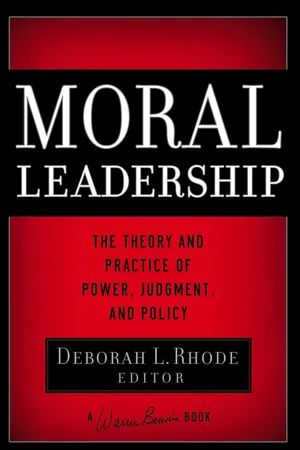
Moral Leadership brings together in one comprehensive volume essays from leading scholars in law, leadership, psychology, political science, and ethics to provide practical, theoretical policy guidance. The authors explore key questions about moral leadership such as: How do leaders form, sustain, and transmit moral commitments? Under what conditions are those processes most effective? What is the impact of ethics officers, codes, training programs, and similar initiatives? How do standards and practices vary across context and culture? What can we do at the individual, organizational, and societal level to foster moral leadership? Throughout the book, the contributors identify what people know, and only think they know, about the role of ethics in key decision-making positions. The essays focus on issues such as the definition and importance of moral leadership and the factors that influence its exercise, along with practical strategies for promoting ethical behavior. Moral Leadership addresses the dynamics of moral leadership, with particular emphasis on major obstacles that stand in its way: impaired judgment, self-interest, and power. Finally, the book explores moral leadership in a variety of contexts?business and the professions, nonprofit organizations, and the international arena.
Information
Part One
ETHICAL JUDGMENT
1
MAKING SENSE OF MORAL MELTDOWNS
David Luban
The wave of corporate scandals that began in 2001 produced a remarkable parade of business executives partaking in what has become an American ritual: the Perp Walk. In the ensuing four years, we have witnessed trials and mistrials and retrials of John and Timothy Rigas (Adelphia), Dennis Kozlowski and Mark Swartz (Tyco), Bernard Ebbers (WorldCom), Richard Scrushy (Health South), and Andrew and Lea Fastow (Enron), and we are approaching trials of Enron’s Kenneth Lay and Jeffrey Skilling. Scrushy was acquitted, and Kozlowski dodged the conviction bullet once, only to be retried and convicted.
The successful defense of Richard Scrushy was that he did not know what his underlings were doing. Kozlowski worked the same defense in his first trial, while Ebbers and the Rigas (father and son) attempted it but failed. Legal observers expect Lay to venture the same defense of ignorance. The defense is in its own way as damning of these executives’ leadership as the charges against them. If the defense fails, they stand convicted of orchestrating crimes and frauds. If it succeeds, they stand acquitted because they did not know what was going on in the companies they led. Acquittal signifies that their leadership was at best utterly inept. At worst, acquittal indicates that they not only fostered an amoral, win-at-all-costs moral climate, they also succeeded in engineering their own deniability. Either they were ostriches, hiding their heads in the sand as their managers committed crimes, or they were foxes who understood the importance of not knowing too much and then managed to persuade juries that their carefully contrived ignorance was exculpatory.1 In all cases, these were disastrous examples of moral leadership. The remarkable fact is that before their businesses crashed, all these people were among the most successful and innovative business leaders in America. Those one tier down—the lawyers, accountants, consultants, and other professionals involved in different aspects of the crooked deals and cooked books—have also gotten into trouble. Arthur Andersen accounting partner David Duncan pleaded guilty to obstruction of justice charges based on Enron document shredding; and, based on the conduct of Andersen’s lawyer, Nancy Temple, the accounting giant was itself convicted. (The U.S. Supreme Court overturned the conviction because it deemed the jury instructions inadequate, but Andersen had already been ruined, and it could still face retrial.)
My aim in this chapter is to explore why executive and professional leadership goes sour. The examination proceeds along four principal dimensions: ethical, cultural, economic, and psychological.
The Ethical Dimension: Adversarial Ethics
At its simplest, what we seem to have witnessed in Enron, World-Com, Global Crossing, Arthur Andersen, Merrill Lynch, and the other high-profile cases of the past few years is an epidemic of dishonesty, self-dealing, cheating, and even outright theft—an incredible failure to honor the most basic rules of Sunday school morality by executives and professionals who people trusted to know better than that and to do better than that. Obviously it was not the first such epidemic: the 1980s were marked by spectacular insider-trading scandals (at least two financial titans, Ivan Boesky and Michael Milken, went to jail), followed by the savings-and-loan catastrophe. It will not be the last either.
What conclusions we should draw from pandemic business scandals is likely to depend on one’s overall outlook on business regulation. Those who think that our economy works best when executives have lots of power and discretion to make innovative, high-risk decisions are likely to favor tough enforcement over new regulation. According to their view, the fraudulent executives are bad apples in a basically sweet barrel. Whatever we do, let us make sure we do not kill the apple tree with a regulatory chainsaw. Others argue that the problem is not a few bad apples but a system that allows gross conflicts of interest and cries out for regulation. Their view is that the rottenness goes a lot deeper into the barrel than the notorious bad apples on top. With a system that makes self-dealing so easy and so profitable, it is no wonder that basic honesty goes out the window.2
I take a different outlook from both of these. My proposition is that most of the people who brought us these scandals have ethical belief systems that are not much different from yours and mine. I suspect that if you asked them whether they think lying and cheating are okay, they would answer with an indignant no, and if you gave them a lie detector test when they said it, the needle would not budge. I do not pretend to see into people’s brains, but I would be willing to bet that virtually none of the architects of these scandals—not the executives, not the accountants, not the lawyers—really thinks he or she did anything wrong. In that case, you might be asking what planet these people come from, but the answer, of course, is that we are standing on it. In their basic moral outlook, most will not turn out to be that much different from anyone else.
The fact is that everyday morality does not have settled principles for hypercompetitive, highly adversarial settings.3 For example, when the other side fights dirty, can you fight dirty too? On this issue, most people’s moral intuitions are conflicted. Even Sunday school sends a double message. On the one hand, we say that two wrongs do not make a right and tell ourselves to turn the other cheek. On the other hand, we say that turnabout is fair play, we say an eye for an eye, we say you have to fight fire with fire.
Consider a legal example that has become all too familiar to litigators: discovery abuse. Both plaintiffs and defendants in highstakes civil litigation are notorious for abusing the system of civil discovery. Plaintiffs’ counsel attempt to bury the other side in interrogatories, aiming self-consciously to make the process so expensive and time-consuming for defendants that they will settle the case favorably. Defendants retaliate in kind by withholding documents on specious legal theories or sometimes by burying the smoking-gun documents in a truckload of paper. While legal scholars disagree about the extent of discovery abuse, everyone agrees that it goes on.4 A question I have often asked lawyers is this: If the other side does it, can you retaliate? The legal answer is no. The federal rule against discovery abuse (Rule 26) does not have a “they started it!” exception. But many lawyers think that if the other side starts playing discovery games, they would be hurting their clients to turn the other cheek. The legal rules may be clear, but the moral rules are anything but. In a classic case, a law firm was sanctioned $325,000 for egregious discovery abuse, but fourteen prominent experts testified that the firm’s behavior was ethical, and in more than a decade, only one other court has followed the precedent that this case set.5
Our society’s moral ambivalence about hardball behavior in highly competitive settings obviously carries over to the business world, because business is as competitive as it gets outside war. Take an example: the 1970 fraud case United States v. Regent Office Supply.6 This case presented the question whether it is fraud for salesmen to lie their way past secretaries so they can make their pitch to a purchasing agent if their goods are high quality and their prices are honest. In Regent Office Supply, the government and the defendant companies stipulated the facts in the mail fraud indictment and in effect asked the court for an advisory opinion on lies told by salesmen to get their foot in the door. The Second Circuit Court of Appeals made no secret that it was annoyed to be asked, as the opinion puts it, “to give approval or disapproval to the myriad of sales pitches used for various purposes in the diversified world of commerce.” It was an awkward, embarrassing question. The court did not want to condone lying, but it also did not want to put the discount stationery industry out of business. It found the Solomonic solution: it held that deceit by itself does not necessarily amount to fraud, but then proceeded to denounce deceit as “repugnant to ‘standards of business morality.’” I suspect the judges on the panel understood very well that the evidence before them showed the opposite: that these lies are an accepted part of business morality.
I am not suggesting that “everyone does it” is a legitimate moral excuse. Rather, I am suggesting that there are very few consensus moral rules for highly adversarial, competitive settings. That implies a lot of moral uncertainty and ambiguity in a culture as addicted to competition as ours is.
The Cultural Dimension: America’s Love Affair with Winners
This takes me to the second point: the cultural obstacles to dealing with Enron-type ethical meltdowns. The fact is that our culture loves the Fastows and Skillings of the world as long as they succeed. The explanation of success worship goes all the way back to Max Weber’s classic study of the Protestant ethic and the spirit of capitalism. According to Weber, capitalism flourished in religious climates that emphasized the idea that business is a secular calling, just as much a part of the divine plan as religious callings. And in these religious traditions, worldly success was a sign of divine approval. It would be a mistake to place too much weight on the Protestant origins of American capitalism: four hundred years and millions of non-Protestant immigrants have largely effaced the theological specifics of the Protestant ethic. But the cultural residue remains, and it is hard to deny that Americans still worship success and love winners. The employees, managers, accountants, and attorneys who work for the winners are no exception.
More than that, I think it is undeniable that American culture has always had a soft spot in its heart for bad boys who break rules to get results, as long as they do it in style. A favorite Hollywood genre is movies whose heroes are a gang of thieves pulling off an intricate heist: The Sting, Ocean’s 11, all the way down to forgettable summer fluff like The Italian Job. True, the thieves usually steal from other bad guys or target the idle rich who have more jewelry than is good for them. But they are still crooks—and we kind of like them. Almost as popular is the Hollywood good guy who breaks rules to get results, from John Wayne in The Man Who Shot Liberty Valance, to Stallone in Rambo, to My Cousin Vinnie. The main thing is that they have to be winners, and they have to do it in style. We are willing to forgive a lot when it comes to flamboyant rascals who also happen to be winners. Jesse Ventura parlayed a bad boy image into a governor’s mansion. And there is no denying that Enron reveled in a kind of high-octane flamboyant aggressiveness, where top performers got million-dollar bonuses and then joined Skilling for Land Cruiser racing in Australia.7
Having a soft spot for bad boy winners seems harmless enough, but the flip side is a little uglier. As a culture, we have little patience with losers. If they did something wrong, we do not cut them the same slack we do for winners. Even if they were blameless, we are unlikely to find them all that appealing. In a fascinating series of experiments, the social psychologist Melvin Lerner discovered that the worse someone is treated, the more likely observers are to rate the victim as an unattractive, flawed person.8 Lerner explains this phenomenon as an unconscious attempt to ward off the scary thought that if unfair stuff can happen to her, it can happen to me. We unconsciously disparage the victim in order to find a distinction, some distinction, between her and us in order to reassure ourselves that we will not get victimized next.9 I find this explanation entirely plausible. Whatever the explanation, though, the experiment provides powerful evidence that we do not tend to find losers beautiful.
I think everyone instinctively understands this, and the implications for business ethics are disturbing. Given the choice between breaking rules and winning or being a law-abiding loser, you are far more likely to win friends and influence people if you break the rules—especially if you can portray the rules as red tape crying out to be cut. No wonder that Enron executives took the most aggressive accounting positions they possibly could. Pushing rules as hard as you can in order to be a winner is exactly what our culture prizes.
Admittedly, this phenomenon explains the top executives better than the accountants and lawyers who papered the dubious deals. Except for a few celebrated personal injury lawyers, the bar is not known as a haven for flamboyant bad boys, and neither is the accounting profession. Of course, business law has its share of tough guys who would rather be feared than loved, like the famous New York City bankruptcy lawyer who sometimes grabs other lawyers by the necktie to pull their faces into convenient screaming range. But he is not really a flamboyant bad boy. He is merely a jerk.
The accountants’ and lawyers’ job is to keep the flamboyant bad boys out of trouble. The problem is that when a successful client is flying high, as high as Enron flew, no one wants to be the doomsayer who puts on the brakes. A hundred years ago, Elihu Root, ...
Table of contents
- Cover
- Table of Contents
- Title
- Copyright
- Dedication
- Foreword
- INTRODUCTION: WHERE IS THE LEADERSHIP IN MORAL LEADERSHIP?
- Part One: ETHICAL JUDGMENT
- Part Two: THE PSYCHOLOGY OF POWER
- Part Three: SELF-SACRIFICE AND SELF-INTEREST
- Part Four: SERVING THE PUBLIC THROUGH THE PUBLIC SECTOR
- Part Five: MORAL LEADERSHIP
- Notes
- Acknowledgments
- About the Authors
- Index
- End User License Agreement
Trusted by 375,005 students
Access to over 1.5 million titles for a fair monthly price.
Study more efficiently using our study tools.
Frequently asked questions
Yes, you can cancel anytime from the Subscription tab in your account settings on the Perlego website. Your subscription will stay active until the end of your current billing period. Learn how to cancel your subscription
No, books cannot be downloaded as external files, such as PDFs, for use outside of Perlego. However, you can download books within the Perlego app for offline reading on mobile or tablet. Learn how to download books offline
Perlego offers two plans: Essential and Complete
- Essential is ideal for learners and professionals who enjoy exploring a wide range of subjects. Access the Essential Library with 800,000+ trusted titles and best-sellers across business, personal growth, and the humanities. Includes unlimited reading time and Standard Read Aloud voice.
- Complete: Perfect for advanced learners and researchers needing full, unrestricted access. Unlock 1.5M+ books across hundreds of subjects, including academic and specialized titles. The Complete Plan also includes advanced features like Premium Read Aloud and Research Assistant.
We are an online textbook subscription service, where you can get access to an entire online library for less than the price of a single book per month. With over 1.5 million books across 990+ topics, we’ve got you covered! Learn about our mission
Look out for the read-aloud symbol on your next book to see if you can listen to it. The read-aloud tool reads text aloud for you, highlighting the text as it is being read. You can pause it, speed it up and slow it down. Learn more about Read Aloud
Yes! You can use the Perlego app on both iOS and Android devices to read anytime, anywhere — even offline. Perfect for commutes or when you’re on the go.
Please note we cannot support devices running on iOS 13 and Android 7 or earlier. Learn more about using the app
Please note we cannot support devices running on iOS 13 and Android 7 or earlier. Learn more about using the app
Yes, you can access Moral Leadership by Deborah L. Rhode in PDF and/or ePUB format, as well as other popular books in Business & Leadership. We have over 1.5 million books available in our catalogue for you to explore.