- accessibly written to give students a command of basic theory, skills in analyzing English words, and the foundation needed for more advanced study in linguistic theory or lexicology
- covers basic introductory material and investigates the structure of English vocabulary
- introduces students to the technical study of words from relevant areas of linguistics: phonology, morphology, syntax, semantics, historical linguistics and psycholinguistics
- English
- ePUB (mobile friendly)
- Available on iOS & Android
eBook - ePub
About this book
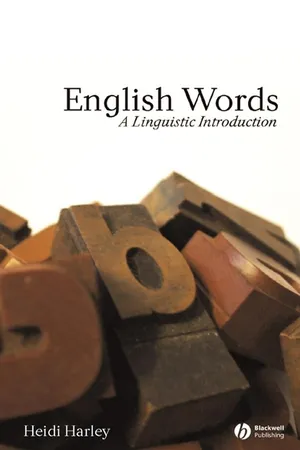
English Words is a comprehensive and accessible introduction to the study of English words from a theoretically informed linguistic perspective.
Information
1
What Is a Word?
/ˈwʌt ɪz ə ˈwərd/
In this chapter, we look at the intuitive notion of what a word is and see that there are several perspectives on wordhood. A word has different properties depending on whether you’re looking at it phonologically, morphologically, syntactically or semantically. Essentially, we end up with two different notions of word: a listeme – a sound–meaning correspondence – and a phonological word, a sound unit on which the spacing conventions of written English are based. Finally, we distinguish between necessary and conventional aspects of wordhood.
1.1 Explaining Word in Words
Stop. Before reading any further, get out a sheet of paper and a pencil (or fire up a word processor, or just introspect), and try to compose a definition of the word word.
Exercise 1.1 Compose a definition of word.
Throughout this text, there will occasionally be exercises inserted in the middle of discussion. You should stop and try to answer them before reading on. Answers to the exercises are often given in the text immediately below; you’ll be able to compare the response you came up with to the discussion in the text, and think about any differences between the answer in the text and your own answer.
Here’s one possible first try:
Definition 1
word: a sequence of letters that we write consecutively, with no spaces.
How does that definition compare with your own? Yours is probably better. One thing that is obviously wrong with this one is that it depends crucially on the conventions of writing. Languages have words before they’re written down. Let’s try again, trying to eliminate the reference to writing:
Definition 2
word: a sequence of sounds that we pronounce consecutively, with no pauses.
Hang on a minute – when we’re talking, there’s not usually any pauses between words. (Try listening for a moment to someone talking. Is there a pause before and after every word? Where are the pauses?) We do know, though, that it is at least possible to put pauses between words when talking. Imagine you are speaking to someone for whom English is a second language, and who is hard of hearing besides. To give them the best chance of understanding you, you . . . would . . . probably . . . talk . . . rather . . . like . . . this, inserting big spaces between words. (People talk like this when dictating, as well.) You certainly wouldn’t insert spaces inside them. No one would say “y . . . ou . . . wou . . . ld . . . pro . . . b . . . abl . . . y . . .” etc. Maybe we can use the possibility of spaces in our definition:
Definition 3
word: a sequence of sounds which can be pronounced on its own, with pauses on either side.
Hang on again! A word is not just any old sequence of sounds that can be pronounced on its own. According to that definition, spimble or intafulation or pag are words, and so are raise your arm or how are you (you can pronounce them with space on either side, can’t you?). The former, however, are sequences of sounds that don’t have any meaning associated with them, and the latter are sequences of sounds that have too much meaning associated with them. Intuitively, the former are not words, and the latter are groups of words.
To help make the text clearer, when we’re discussing the linguistic properties of some word, the word will appear in italics. This indicates that the word is just being mentioned – that is, being discussed – rather than being actually used. This mention/use distinction is hard to keep track of when it’s not indicated by some distinguishing feature, such as italics.
It seems fairly clear that we have to include meaning in our definition. The sounds that make up, for instance, the word word have a certain meaning in combination that they don’t have by themselves, or when they appear in other words (like water or murder). So the w sound in word doesn’t mean anything by itself, nor does the -ord sequence, but together, they have a meaning, even if it’s a meaning that’s hard to pin down. So for our final try, let’s look at the relevant definition in the Oxford English Dictionary (OED), which is listed as definition number 12a in their entry for the word word:
Definition 4 (final)
word: A combination of vocal sounds, or one such sound, used in a language to express an idea (e.g. to denote a thing, attribute, or relation), and constituting an ultimate minimal element of speech having a meaning as such; a vocable.
This is probably fairly close ...
Table of contents
- Cover
- Table of Contents
- THE LANGUAGE LIBRARY
- Title
- Copyright
- Dedication
- Preface
- IPA Transcription Key
- 1 What Is a Word?
- 2 Sound and Fury: English Phonology
- 3 Phonological Words: Calling All Scrabble Players!
- 4 Where Do Words Come From?
- 5 Pre- and Suf-fix-es: Engl-ish Morph-o-log-y
- 6 Morphological Idiosyncrasies
- 7 Lexical Semantics: The Structure of Meaning, the Meaning of Structure
- 8 Children Learning Words
- 9 Accidents of History: English in Flux
- Glossary
- Works Consulted
- Index
- End User License Agreement
Trusted by 375,005 students
Access to over 1.5 million titles for a fair monthly price.
Study more efficiently using our study tools.
Frequently asked questions
Yes, you can cancel anytime from the Subscription tab in your account settings on the Perlego website. Your subscription will stay active until the end of your current billing period. Learn how to cancel your subscription
No, books cannot be downloaded as external files, such as PDFs, for use outside of Perlego. However, you can download books within the Perlego app for offline reading on mobile or tablet. Learn how to download books offline
Perlego offers two plans: Essential and Complete
- Essential is ideal for learners and professionals who enjoy exploring a wide range of subjects. Access the Essential Library with 800,000+ trusted titles and best-sellers across business, personal growth, and the humanities. Includes unlimited reading time and Standard Read Aloud voice.
- Complete: Perfect for advanced learners and researchers needing full, unrestricted access. Unlock 1.5M+ books across hundreds of subjects, including academic and specialized titles. The Complete Plan also includes advanced features like Premium Read Aloud and Research Assistant.
We are an online textbook subscription service, where you can get access to an entire online library for less than the price of a single book per month. With over 1.5 million books across 990+ topics, we’ve got you covered! Learn about our mission
Look out for the read-aloud symbol on your next book to see if you can listen to it. The read-aloud tool reads text aloud for you, highlighting the text as it is being read. You can pause it, speed it up and slow it down. Learn more about Read Aloud
Yes! You can use the Perlego app on both iOS and Android devices to read anytime, anywhere — even offline. Perfect for commutes or when you’re on the go.
Please note we cannot support devices running on iOS 13 and Android 7 or earlier. Learn more about using the app
Please note we cannot support devices running on iOS 13 and Android 7 or earlier. Learn more about using the app
Yes, you can access English Words by Heidi Harley in PDF and/or ePUB format, as well as other popular books in Languages & Linguistics & Linguistics. We have over 1.5 million books available in our catalogue for you to explore.