This book presents the principles of non-linear integrated optics. The first objective is to provide the reader with a thorough understanding of integrated optics so that they may be able to develop the theoretical and experimental tools to study and control the linear and non-linear optical properties of waveguides. The potential use of these structures can then be determined in order to realize integrated optical components for light modulation and generation. The theoretical models are accompanied by experimental tools and their setting in order to characterize the studied phenomenon. The passage from theory to practice makes the comprehension of the physical phenomena simple and didactic. The book also gives a presentation of the industrial applications of the integrated optical components. The studied topics range from the theory of waveguides and the linear and non-linear optical characterization techniques to photonic crystals. This last field constitutes a major challenge of photonic technologies of the 21st century.
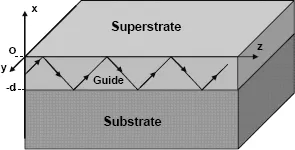
Optical waveguides are structures with three layers controlling light confinement and propagation in a well defined direction inside the central layer (Figure 1.1).
Figure 1.1.Planar optical waveguide
Light confinement is carried out by successive total reflections on the two interface guides – substrate and guide – superstrate.
Light propagation is governed by an interference phenomenon which occurs inside the guide between two waves; one of them undergoes two successive total reflections. For a better understanding of the guided wave propagation, we will recall the main principles of these two phenomena, total reflection and interference, inside a transparent plate with parallel faces.
1.1. Principles of optics
1.1.1. Total reflection phenomenon
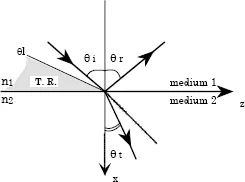
Let us consider an interface separating two mediums 1 and 2, which are dielectric, lossless, homogenous and isotropic with refractive indices n1 and n2, respectively. An electromagnetic wave propagates from 1 to 2 with an angle of incidence θi related to the normal of the interface (Figure 1.2).
Figure 1.2.Reflection on an interface (medium 1/medium 2)
The electric field of the incident wave is given by:
[1.1]
[1.2]
is the wave vector in the vacuum (λ: wavelength in the vacuum) and Ei0 is the incident wave amplitude. The electric fields of the reflected and transmitted waves can be written:
[1.3]
[1.4]
In addition, refraction law is given by:
[1.5]
[1.6]
In the case of n1 > n2, there is an incident angle θl, as:
[1.7]
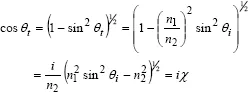
For θi > θl, the incident wave is totally reflected into medium 1 (total reflection) and the angle θt of the transmitted wave is complex [Bor 1999, War 1988]:
[1.8]
From [1.4], the transmitted wave can be written as:
[1.9]
This wave propagates in the Oz direction with an amplitude exponentially decreasing in the Ox direction. This is called an evanescent wave. Also, according to Fresnel’s formulae, the considered wave undergoes a phase shift compared to the incident wave, given by [Bor 1999]:
[1.10]
[1.11]
Relations [1.9] and [1.10] will be used throughout this chapter in order to study the propagation of guided waves. Note that evanescent waves have been experimentally investigated and they are currently utilized in the field of integrated optics. A similar phenomenon appears at the interface between a dielectric and a metallic layer generating, under specific conditions, a surface plasmon [Rae 1997].
1.1.2. Parallel-face plate
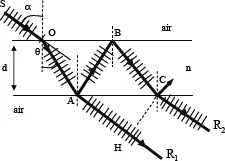
Let us consider a transparent plate with parallel faces (Figure 1.3), with refractive index n and a thickness d, placed in air (index = 1). We will focus on the calculation of the difference of the optical path (δ) between the first two rays transmitted throughout the plate (the same approach can be applied for the first two reflected rays).
[1.12]
We can easily show that δ is given by:
[1.13]
where θ is the propagation angle within the plate.
Figure 1.3.Interference between two rays transmitted by a parallel face plate with a thickness d and a refractive index n
In these conditions the parallel-face plate introduces a phase shift between the two rays R1 and R2 given by the following relation:
[1.14]
The latter is at the origin of the interference between the two rays R1 and R2. The transmitted rays are parallel, thus the interference phenomenon is located at infinity. However, we can observe the interference fringes in the Fresnel’s field on a screen placed at the focal distance of a convergent lens [Bor 1999, War 1988, ...
Chapter 4: Non-linear Effects in Integrated Optics
Chapter 5: The Electro-optic Effect in Waveguides
Chapter 6: Photonic Crystal Waveguides
Conclusion
Index
Trusted by 375,005 students
Access to over 1.5 million titles for a fair monthly price.
Study more efficiently using our study tools.
Frequently asked questions
Yes, you can cancel anytime from the Subscription tab in your account settings on the Perlego website. Your subscription will stay active until the end of your current billing period. Learn how to cancel your subscription
No, books cannot be downloaded as external files, such as PDFs, for use outside of Perlego. However, you can download books within the Perlego app for offline reading on mobile or tablet. Learn how to download books offline
Perlego offers two plans: Essential and Complete
Essential is ideal for learners and professionals who enjoy exploring a wide range of subjects. Access the Essential Library with 800,000+ trusted titles and best-sellers across business, personal growth, and the humanities. Includes unlimited reading time and Standard Read Aloud voice.
Complete: Perfect for advanced learners and researchers needing full, unrestricted access. Unlock 1.5M+ books across hundreds of subjects, including academic and specialized titles. The Complete Plan also includes advanced features like Premium Read Aloud and Research Assistant.
Both plans are available with monthly, semester, or annual billing cycles.
We are an online textbook subscription service, where you can get access to an entire online library for less than the price of a single book per month. With over 1.5 million books across 990+ topics, we’ve got you covered! Learn about our mission
Look out for the read-aloud symbol on your next book to see if you can listen to it. The read-aloud tool reads text aloud for you, highlighting the text as it is being read. You can pause it, speed it up and slow it down. Learn more about Read Aloud
Yes! You can use the Perlego app on both iOS and Android devices to read anytime, anywhere — even offline. Perfect for commutes or when you’re on the go. Please note we cannot support devices running on iOS 13 and Android 7 or earlier. Learn more about using the app
Yes, you can access Photonic Waveguides by Azzedine Boudrioua in PDF and/or ePUB format, as well as other popular books in Physical Sciences & Waves & Wave Mechanics. We have over 1.5 million books available in our catalogue for you to explore.