- English
- ePUB (mobile friendly)
- Available on iOS & Android
eBook - ePub
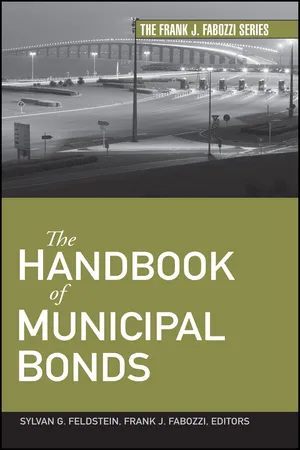
The Handbook of Municipal Bonds
About this book
In The Handbook of Municipal Bonds, editors Sylvan Feldstein and Frank Fabozzi provide traders, bankers, and advisors—among other industry participants—with a well-rounded look at the industry of tax-exempt municipal bonds. Chapter by chapter, a diverse group of experienced contributors provide detailed explanations and a variety of relevant examples that illuminate essential elements of this area. With this book as your guide, you'll quickly become familiar with both buy side and sell side issues as well as important innovations in this field.
PART One
The Sell Side: The Originators of Deals
CHAPTER 1
The Central Place of States and Local Governments in American Federalism
Richard Briffault
Joseph P. Chamberlain Professor of Legislation
Columbia University School of Law
Joseph P. Chamberlain Professor of Legislation
Columbia University School of Law
Writing in Federalist Number 45, James Madison predicted that the states would dominate the new federal union created by the Constitution. The powers of the federal government were “few and defined,” he pointed out, limited primarily to “external objects, as war, peace, negotiation, and foreign commerce.” By contrast, the states, he explained, would have authority over “all the objects which, in the ordinary course of affairs, concern the lives, liberties and properties of the people, and the internal order, improvement, and prosperity of the State.” As a result of their greater role in governance and their closer ties to the people, the states would also enjoy stronger popular support than the distant national government. Madison assumed the principal problem of federalism would be protecting a fragile federal government from the states, not protecting the states from the federal government.
For more than a century, American federalism developed largely as Madison forecast, with the federal government exercising a limited role in peacetime domestic life, and most government power wielded at the state and local levels. On the eve of the Great Depression, federal spending accounted for barely one-sixth of total domestic government—federal, state, and local—spending. The federal government provided few services directly to the people and only a modest amount of financial assistance to state and local governments.1
Over the course of the twentieth century, this situation changed dramatically. The emergence of a national—and increasingly global—economy, two world wars, the rise of the United States to superpower status, and the ongoing cultural and technological transformations of our society have been accompanied by a tectonic shift in power to the federal government. The federal government now plays an enormous role in regulating the economy, promoting social welfare, enforcing political and civil rights, and protecting the environment.
Yet states and local governments remain central to American governance. As in Madison’s day, “the ordinary course of affairs” is dominated by state and local governments. The rules that structure civil society—contract law, tort law, property and land use law, criminal law, family law, the incorporation of businesses, the regulation of the professions—are developed, implemented, and enforced primarily at the state and local levels. So, too, most public services that affect people in their homes and families—public schools, policing, incarceration of offenders, fire safety, clean water, removal of solid wastes and sewage, maintenance of roads and streets, public parks, public hospitals and emergency medical services—are provided by states and localities, not the federal government. The vast majority of the opportunities for participation in political life—such as running for office, campaigning for or against a ballot proposition, or appearing before such critical governing institutions as the school board, the planning and zoning commission or a town meeting—are at the state and local level, too.
The centrality of states and local governments to our federal system was dramatically underscored by three recent events: the 2000 Presidential election and the bitter postelection battle over Florida’s 25 electoral votes; the terrorist attacks on the World Trade Center and the Pentagon on September 11, 2001; and Hurricane Katrina’s devastation of New Orleans and the Gulf Coast in 2005.
The 2000 election reminded us that there is no national presidential election. Instead we undertake 50—actually, 51 including the District of Columbia—separate state elections. The winner is determined not by the national popular vote, but by the states’ electoral votes, which are based in part on state population but also provide representation for the states as states. The collection, tabulation, and recounting of presidential votes is conducted by state officials, pursuant to state rules. Moreover, the states often delegate critical issues—selection of voting machinery, ballot design, whether to undertake a manual recount, whether to accept a technically flawed absentee ballot, whether dangling or dimpled chad is sufficient to mark the intent of a voter—to local officials. To be sure, as the Supreme Court’s Bush v. Gore, 525 U.S. 98 (2000), decision indicates, the federal constitution constrains state and local decision making. And Congress reacted to the events of 2000 with new legislation increasing the federal role in the mechanics of voting. But the 2000 election remains a stunning reminder of how even with respect to our most important national office, states and local governments play a vital role.
September 11, 2001—9/11—demonstrated the crucial role of the states and especially local governments in dealing with issues of public safety and security. Although the terrorist attacks were an assault on our nation, most of the domestic response involved local governments. New York City police, firefighters, and emergency medical personnel responded to the attacks on the World Trade Center. Local public health and safety workers from the District of Columbia and various Virginia and Maryland counties battled the consequences of the terrorist attack on our most important federal military installation, the Pentagon. The vast bulk of the subsequent public effort to increase the security of public buildings, public spaces, and vulnerable infrastructure facilities has involved state and local security officers, not the federal government. More generally, in detecting and pursuing terrorists and preventing future terrorist attacks, the 600,000 local police officers are likely to play at least as great a role as the FBI and its 11,000 agents. This is not simply a matter of numbers—although the enormous difference in the magnitude of the local versus federal police forces is surely relevant. Local police forces are likely to have far greater knowledge of local conditions and dangers, including access to informants and awareness of unusual or suspicious incidents.2
The central role of states and local governments was underscored again in the aftermath of Hurricane Katrina. Once again, states and local governments were called upon to make critical decisions concerning evacuations, public safety, emergency health and medical assistance, and the provision of basic services. State and local actions directly affected the lives and property of hundreds of thousands, if not millions, of people. State and local governments are also continuing to play a key role in aiding victims of the disaster, rebuilding stricken areas, and planning future development in light of the needs of disaster prevention and preparedness.
The centrality of the states and local government is not simply a lingering aftermath of an earlier era. In recent years, the federalizing trend that marked the middle decades of the twentieth century has flattened, and the federal system has witnessed a modest tilt away from the federal government and back to the states and localities. This can be seen in the enhanced state and local share of public employment and public spending; in the greater discretion accorded to states and local governments in the management of federally funded programs; and in the many policy initiatives that have sprung from the states and localities.
In 2002, the federal government civilian workforce was 2,690,000—down 13% from nearly 3.1 million federal employees 15 years earlier, and 170,000 workers smaller than the federal civilian workforce of 1966. By contrast, the combined state and local workforce in 2002 was 15,602,000—or nearly six times the federal. And while the federal workforce has been stagnating, the state and local workforce has been growing. The number of state and local employees in 2002 was 11% higher than in 1990—and roughly double the state and local workforce of 1966.
The state and local share of total government spending is also on the rise. In 1980, federal spending was 87% greater than state and local spending. In 2003, federal spending was just 48% greater than state and local spending. If federal spending on defense and foreign affairs, interest on the national debt, and the two major social insurance programs—Medicare and Social Security—are subtracted from the federal total, so that the focus is on domestic regulation and public services, then state and local spending actually dominates federal spending—by roughly 2:1. Moreover, although the federal government provides significant financial assistance to local governments, the federal aid share of state and local funds has been dropping. Federal aid amounted to 23% of state and local spending in 1980, and was slightly less than that in 2003. States and localities have not only expanded their programs but have also become more successful at cultivating their own resources.
Moreover, in recent years the federal government has given the states greater flexibility in spending federal dollars. The most famous instance of this is the 1996 welfare reform law, which gave the states broad new authority over federally funded welfare programs. Other federal aid programs in such areas as transportation and pollution control have been revised to reduce federal regulatory controls. This trend, however, is not unmixed, as the federal role has also increased in some areas, like primary and secondary education, that have traditionally been reserved to the states and localities.
States and localities have also been more aggressive in addressing a wide range of domestic policy issues. This is reflected in the unprecedented leadership role assumed by the state attorneys general in shaping national policy on tobacco; the initiatives underway in nearly a dozen states to tackle the sprawling pattern of urban growth; the states’ exploration of new forms of school finance, HMO regulation, income assistance, and health insurance for the uninsured; the combination of voter-initiated and legislatively adopted measures to promote campaign finance reform; and the state and local legislative and judicial decisions reexamining family and marriage relationships. These developments demonstrate that states and localities are important, independent policymakers within the federal system.
THE STATES
The 50 states are the basic components of the United States. Although not all American land or residents are found within the states—the District of Columbia, the Commonwealth of Puerto Rico, and territories such as American Samoa, Guam, the Northern Marianas Islands, and the Virgin Islands are also parts of the United States—the federal government is structurally constituted out of the United States. As the Supreme Court has observed, “[t]he Constitution, in all its provisions, looks to an indestructible Union, composed of indestructible States.” (Texas v. White, 74 U.S. 700, 725 (1869)).
The U.S. Constitution and the States
The Constitution includes multiple protections of the autonomy and equality of the states. The Constitution guarantees the territorial integrity of the states. No state may be created out of the territory of another state without its consent. So, too, no state may be deprived of its equal suffrage in the Senate. Under the Guarantee Clause, the United States is committed to protecting the states from invasion and domestic violence.
The states are in no sense arms of the federal government. They are not like federal administrative agencies or regional offices; the federal government does not appoint state officers. The states can legislate without having to demonstrate any authorization from the federal Constitution or by the federal government. Under the Tenth Amendment, the states have residual power over all aspects of government not granted to the federal government or not constrained by the Constitution or by the federal government acting pursuant to the Constitution. To be sure, the federal Constitution does impose significant restrictions on the scope of state law-making authority, and Congress acting pursuant to the Constitution’s grant of power to the federal government can impose further limitations on the states. Nonetheless, the states continue to possess and exercise broad police power authority over their territory and their citizens.
Several recent Supreme Court decisions have underscored the protections that the Constitution provides for the autonomy of the states and their localities. Under New York v. United States, 505 U.S. 144 (1992) and Printz v. United States, 521 U.S. 898 (1997), Congress cannot “commandeer” states and localities to serve federal ends; that is, they cannot require the states to pass certain laws or enforce a federal regulatory program. Under the Court’s recent Eleventh Amendment cases, Congress lacks the power to subject nonconsenting states to private damages actions in either federal, Seminole Tribe of Florida v. Florida, 517 U.S. 44 (1996), or state, Alden v. Maine, 527 U.S. 706 (1999), courts. Principles of federalism also limit the ability of Congress to enact legislation intended to remedy state and local violations of constitutional rights; such measures must be “congruent” with and “proportional” to the scope of state violations (see City of Boerne v. Flores, 521 U.S. 507 (1997), Board of Trustees v. Garrett, 531 U.S. 356 (2001)). Of course, Congress has broad powers under the Commerce Clause and other provisions of the Constitution to adopt economic and social legislation, preempt inconsistent state laws (see, e.g., Lorillard Tobacco Co. v. Reilly, 533 U.S. 525 (2001)), regulate state and local activity that affects commerce or constitutional rights (see e.g., Garcia v. San Antonio Metropolitan Transit Auth., 469 U.S. 528 (1985), Nevada Dep’t of Human Resources v. Hibbs, 538 U.S. 721 (2003)), and use conditions attached to federal grants to influence state and local actions (see South Dakota v. Dole, 483 U.S. 203 (1987)).
The inherent law-making power of the states includes fiscal affairs. Although the Constitution prohibits certain specific forms of state taxation and imposes other more general rules, such as nondiscrimination against interstate commerce, the states have enormous autonomy with respect to taxation, borrowing, spending, and lending money. They may innovate new forms of revenue-raising and new types of debt instruments, they may adopt new taxes and raise tax rates, and they may incur debt to raise the funds they need to pay for the programs they ...
Table of contents
- The Frank J. Fabozzi Series
- Title Page
- Copyright Page
- Foreword
- Preface
- Acknowledgments
- About the Editors
- Contributing Authors
- PART One - The Sell Side: The Originators of Deals
- PART Two - The Sell Side: Distribution and Market-Making Roles
- PART Three - Compliance Issues
- PART Four - Fixed Income Analysis of Municipal Products
- PART Five - The Buy Side: Institutional Investors
- PART Six - Credit Analysis
- PART Seven - Special Security Structures and Their Analysis
- Case Studies of Innovative and Other Security Structures
- APPENDIX A - A Pictorial History of Municipal Bonds
- APPENDIX B - Glossary of Terms
- Index
Trusted by 375,005 students
Access to over 1.5 million titles for a fair monthly price.
Study more efficiently using our study tools.
Frequently asked questions
Yes, you can cancel anytime from the Subscription tab in your account settings on the Perlego website. Your subscription will stay active until the end of your current billing period. Learn how to cancel your subscription
No, books cannot be downloaded as external files, such as PDFs, for use outside of Perlego. However, you can download books within the Perlego app for offline reading on mobile or tablet. Learn how to download books offline
Perlego offers two plans: Essential and Complete
- Essential is ideal for learners and professionals who enjoy exploring a wide range of subjects. Access the Essential Library with 800,000+ trusted titles and best-sellers across business, personal growth, and the humanities. Includes unlimited reading time and Standard Read Aloud voice.
- Complete: Perfect for advanced learners and researchers needing full, unrestricted access. Unlock 1.5M+ books across hundreds of subjects, including academic and specialized titles. The Complete Plan also includes advanced features like Premium Read Aloud and Research Assistant.
We are an online textbook subscription service, where you can get access to an entire online library for less than the price of a single book per month. With over 1.5 million books across 990+ topics, we’ve got you covered! Learn about our mission
Look out for the read-aloud symbol on your next book to see if you can listen to it. The read-aloud tool reads text aloud for you, highlighting the text as it is being read. You can pause it, speed it up and slow it down. Learn more about Read Aloud
Yes! You can use the Perlego app on both iOS and Android devices to read anytime, anywhere — even offline. Perfect for commutes or when you’re on the go.
Please note we cannot support devices running on iOS 13 and Android 7 or earlier. Learn more about using the app
Please note we cannot support devices running on iOS 13 and Android 7 or earlier. Learn more about using the app
Yes, you can access The Handbook of Municipal Bonds by Frank J. Fabozzi,Sylvan G. Feldstein in PDF and/or ePUB format, as well as other popular books in Business & Finance. We have over 1.5 million books available in our catalogue for you to explore.