- In-depth empirical research spanning a variety of world regions
- A range of topics including homelessness, comparative politics, economic development and social policy
- Reviews how neoliberalism is enacted as a way to highlight the complexity and contingency of this economic model
- Engages in debates within anthropology, gender studies, geography, health studies, international studies, planning, political science and sociology
eBook - ePub
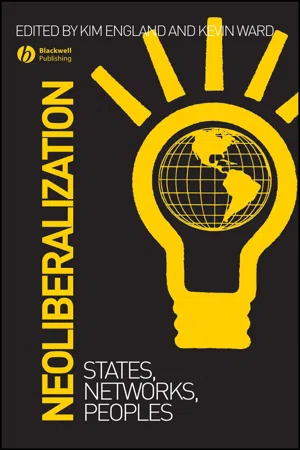
Neoliberalization
States, Networks, Peoples
- English
- ePUB (mobile friendly)
- Available on iOS & Android
eBook - ePub
About this book
The book is an analysis of cultural, social as well as political economic expressions of neoliberalization and argues for an appreciation of the relational geographies of neoliberalization.
Information
1
Introduction: Reading Neoliberalization
Ideologically, the novelty of the present situation stands out in historical view. It can be put like this. For the first time since the Reformation there are no longer any significant oppositions – that is systematic rival outlooks – within the thought-world of the West; and scarcely any on a world scale either … What limitations persist to its practice, neo-liberalism as a set of principles rules undivided across the globe; the most successful ideology in world history (Anderson 2000a: 17).
The dilemma we all face as citizens is that, with few exceptions here and there … neo-liberalism has swallowed up the world in its clutches, with grave consequences for democracy and the physical environment that can be neither underestimated nor dismissed (Said 2000: 1).
There has everywhere been an emphatic turn towards neo-liberalism in political-economic practices and thinking since the 1970s (Harvey 2005: 2).
Perry Anderson, Edward Said, and David Harvey. Three of the most well-regarded social scientists of their generation. Each has written about the origins, rise, and consequences of neoliberalism for different parts of the world. Tying it into wider discussions of globalization, American Imperialism, imperial hegemony, and Empire, these three public standard bearers of the Left have each provided insightful accounts of the current phase of capitalism. Was this convergence by three eminent thinkers not enough to get most scholars (those for whom this book is the primary, but hopefully not the exclusive audience) interested in neoliberalism, then surely the changes under way around us should be. Rising inequalities of different types of capital – cultural, economic, environmental, social, and political – between as well within nations are frequently cited as tangible indicators of the imprint of neoliberalization. Wounds run deep and provide points of connection and alliances across space, across particular issues, even across perhaps otherwise disparate social groups, in ways that undermine the claims of those who remain committed to Margaret Thatcher’s famous assertion “there is no alternative” (TINA) (MacEwan 1999; Harvey 2005). Neoliberalism as a “radical-theoretical slogan” (Peck 2004: 403) might have its limits, but it does serve to unite. It offers a reference point, against which those who oppose it can define themselves, as Harvey (2006) has argued, for example as in the “another world is possible” maxim of the anti-capitalist-globalization movement, initially coined by the World Social Forum to capture its commitment to build alternatives to the free-market economics espoused by the World Economic Forum. As Susan George (2001: 4) put it (referring to Davos, Switzerland where the WEF meets annually): “Homo davosiensis wants all the resources, all the wealth, all the power and all the freedom to extend his ascendancy across time and space” (see Beneria 1999, for a feminist analysis of the Davos man). Neoliberalism – in spirit if not in words – also binds together those with a stake in its continued reproduction. Government ministers, venture capitalists, the chief executives of multinationals, the largest owners of the media, the officials in international institutions: all are involved in practicing neoliberalization (Bourdieu 1998; Harvey 2006). The consequences of the actions of the “transnational capital class,” as Leslie Skair (2000) terms them, can be seen around the world: on the streets of the poorest cities of the global South, in the former coalmines of Eastern Europe, and in the Latin American rural villages decimated economically by the slump in the global price of coffee. And yet, it remains politically important to constantly draw attention to the links between those in positions of power and the inequalities witnessed in geographically dispersed yet socially interconnected areas of the world.
Neoliberalism does appear to have become the ubiquitous political commonsense condition of recent years – used in all but name on the Right and used quite deliberately by those on the Left. Its widespread usage has led the sociologists Pierre Bourdieu and Loïs Wacquant (2001) to describe neoliberalism as a new “planetary vulgate.” Certainly now more is known about the personalities, the places, and the institutions involved in the transformation of neoliberalism from the “abstract intellectualism of Hayek and Friedman to the state-authored restructuring projects of Thatcher and Reagan” (Peck and Tickell 2002: 41) and beyond, to what many consider, despite the protestations of Anthony Giddens (2000), to be neoliberalism with a friendly face – the Third Way of Britain’s Tony Blair, Gerhard Schroder in Germany, Australia’s Mark Latham, and Ricardo Lagos in Chile (see Larner, Le Heron, and Lewis, this volume, for a discussion of the Third Way in New Zealand). These developments suggested to us that the current moment provides an opportunity to take stock of what is known about neoliberalism in its many geographical configurations, to examine differences and similarities between how neoliberalism has been introduced, resisted, and challenged in particular contexts. And in turn, it offers the possibilities of reflecting on the meaning and usefulness of grand abstractions, such as “neoliberalism.” The two of us thought this would be a worthwhile exercise, in both political and intellectual terms. As the book’s title indicates, we make a distinction between neoliberalism as an end-state and neoliberalization as a process, consisting of a multiplicity of openings and closures. Adam Tickell and Jamie Peck (2003: 165) describe neoliberalization as being “contradictory, having the capacity to bring forth countertendencies, and as existing in historically and contingent forms … analyses of this process should properly focus on change – on systems and logics, dominant patterns of restructuring and so forth rather than on binary and/or static comparisons between a past state and its erstwhile successor.” This collection, then, is intended to expose neoliberalization in all its variants, all its guises, all its hybrid formations, in all its subject-forming strands.
Increasingly, standard textbook definitions of neoliberalism are not hard to find, nor are accounts of how “it” went from the ideological wilderness to the political mainstream (see our summary in Table 1.1). Most writers refer to it as an economic and political orthodoxy marked by commitments to policies of free trade, privatization, deregulation, and welfare state retrenchment (MacEwan 1999; Peet and Hartwick 1999; Campbell and Pedersen 2001; Brenner and Theodore 2002a; Peck and Tickell 2002; Harvey 2005). The majority of accounts of the emergence of neoliberalism tend to focus on the reforms delivered by University of Chicago-educated economists in Latin America; or detail the structural adjustment programs of the International Monetary Fund and the World Bank. There are of course exceptions, such as the account offered by Jan Nederveen Pieterse (2004). He documents the reforms pursued in the American South as a means of offering an alternative account of the rise of neoliberalism. As he puts it, “the material matrix of real neo-liberalism is the American South … The Chicago School provided an economic rationale and intellectual gloss to what was, and remains for the majority, a backward, conservative and impoverished economic condition” (Nederveen Pieterse 2004: 2). And then, of course, there are other accounts that argue for multiple developments and trajectories, in geographically discrete but increasingly interconnected places, in which the origins of neoliberalism cannot be reduced to the mere exporting of policies and programs from the US “diffusion centers” of New York and Washington (Wacquant 1999). Despite these differences in the accounts of what we might think of as the historical geographies of neoliberalism (Peck and Tickell 2002; Harvey 2005), there is some agreement over baseline definitions, at least regarding the philosophical and programmatic underpinnings of neoliberalism (see, for example, the well-known and frequently cited pieces by Elizabeth Martinez and Arnoldo Garcia 1997; and Susan George 2001).
Table 1.1 From philosophy to practices: details of neoliberalism
Source: Treanor (2005: np)
|
Based on the Ricardian notion that countries, cities, and regions prosper when they specialize in producing goods and services for which they have the greatest comparative advantage, neoliberalism is “the doctrine that economic growth is maximized when movement of goods, services and capital, but not labor, are un-impeded by government regulations” (Peet 2001: 330, summarizing MacEwan 1999). We accept that this is a rather abstract definition, and, for instance, does not explicitly address issues such as the cutting of public expenditures on social services, the elimination of the concept of “public goods,” and the restructuring of the welfare state. However, these sorts of basic definitions are a useful starting point even if they seem more appropriately the stuff of neoclassical economic textbooks than of the empirical-cum-theoretical explications of contemporary neoliberalization. Remaining for the moment in the wholly abstract, neoliberalism, with its deepest roots in Adam Smith and newer roots in the work of Friedrich von Hayek and Milton Friedman, also has clear philosophical underpinnings. For instance:
Neo-liberalism is a philosophy in which the existence and operation of a market are valued in themselves, separately from any previous relationship with the production of goods and services, and without any attempt to justify them in terms of their effect on the production of goods and services; and where the operation of a market or market-like structure is seen as an ethic in itself, capable of acting as a guide for all human action, and substituting for all previously existing ethical beliefs (Treanor 2005: np).
Of course, in its translation into actually existing neoliberalism (Brenner and Theodore 2002a; K. Mitchell 2004) this philosophy becomes something “more complex, diverse, contested and open to interpretation than is often recognized” (Campbell and Pederson 2001: 3). Moreover, we agree with the political scientists Deborah Johnston and Alfredo Saad-Filho’s (2005: 1) contention that “[n]eoliberalism straddles a wide range of social, political, and economic phenomena at different levels of complexity” (see Table 1.1; see also Peet and Hartwick 1999).
In Table 1.1 we detail the foundational principles underscoring efforts to intensify and expand the market, by increasing the number, frequency, repeatability, and formalization of transactions (Harvey 2005). For many of us this is the stuff of dry textbooks. We recognize it, though, when the philosophy is translated into policy, in the form of the “liberalization,” the “privatization,” and the “re-regulation” of markets. The way these policies are restructured requires increased auditing and evaluating – in other words, the mundane practices that Larner (2003) writes about, and these are as important in the becoming and accomplishment of neoliberalization (see Ward, this volume). There is evidence of this all around the world. The details are important and may suggest differences, but there are also similarities, discursively and materially, in the “restructuring” of markets for currency, energy, public services, transportation, and so on. These “neo-liberal policy fixes” (Peck 2001a: 448), while subject to critical scrutiny on their own terms, have only just begun to be elements in a wider study of the “pervasive metalogic” (Peck and Tickell 2002: 36) that appears to be at work.
Once we move away from these basic philosophical and programmatic definitions of neoliberalism it becomes much harder to find definitional consensus (a theme we pick up later in this chapter and one explored by a number of the contributors). There almost appears to be an inverse relationship between the volume of scholarship produced on neoliberalism and the agreement over exactly what it means! Perhaps this is not that surprising. As academics from a range of social science disciplines (and increasingly the humanities) have pushed, prodded, and cajoled, asking the term “neoliberalism” to do more work for them, so we have become more attuned to its vagaries, its variations, its multiples. At the same time as the empirical gaze of geographers has widened to include analyses of neoliberalism and, for example, cities (Brenner and Theodore 2002b; N. Smith 2002; Hackworth 2004; L. Smith 2004; Leitner, Peck, and Sheppard 2006), citizenship (K. Mitchell 2004), development (Rankin 2004; Bondi and Laurie 2005), nature (Mansfield 2004; McCarthy and Prudham 2004; Bakker 2005), and sexuality (Hubbard 2004), so there has been a parallel movement around decoding the various meanings and understandings of neoliberalism. In particular, critical human geographers, including contributors to this collection, have already provided a series of geographically attuned accounts of the historical geographies of neoliberalism and, in doing so, have challenged a range of assumptions over the meanings of, and relations between, “cores” and “peripheries,” “north” and “south,” “center” and “margins” (for example, M. Power 2003; Rankin 2004; also see Rankin and Shakya, and Phelps, Power, and Wanjiru in this volume). These insights trouble otherwise excellent analyses in which space, place, and, particularly, geographical relationships are often absent (see, for example, MacEwan’s [1999] otherwise splendid account).
Thinking through the nature of the spatial relationships and how the movements of neoliberal ideas, policies, and programs “do not necessarily flow in the directions expected,” Wendy Larner (2003: 510) has argued that “[d]evelopments in the ‘periphery’ may be as significant, if not more so, as those in the ‘core’ in explaining the spread of neoliberalism.” Reflecting on Larner’s methodological and empirical challenge, and other scholarship on geopolitical transformations that troubles “core/periphery” relations, Jamie Peck (2004: 403, original emphasis) seeks to capture a sense of relationality in claiming that “the state project of neoliberalism was not constructed solely in the global North, nor exclusively in the South, but both.” Examining the relational geographies of neoliberalization is one of the central objectives of this edited collection. Our choice of empirical cases reflects this. Thinking relationally about neoliberalization demands that each of the studies be read not as an island of neoliberalism but rather as open and relationally produced (Massey 2005). As we explain in each of the book’s three section prefaces, the examples – cities, regions, nations – in the chapters that follow this one are the products of relations that spread way beyond them. In recognizing the relationality of space we point out an intellectual and a political need to think about connectivities. That is, to build through imaginations and practices a means of resisting the creative destruction of neoliberalism. In terms of this book’s empirical material we can understand the “in here” accounts of East Asia (Beeson, this volume), Nepal (Rankin and Shakya, this volume), Argentina (North, this volume), and Ontario (England, Eakin, Gastaldo, and McKeever, this volume), to name just four, as products of current and past “in heres” from around the world. Distant places are implicated in our “here,” wherever that “here” is, as Massey (2005) argues. We return to this point in the book’s conclusion, in light of the material presented in the chapters.
Elsewhere in the social sciences, scholars who provide accounts of what Matt Sparke (2006: 1) calls the big “N” of neoliberalism increasingly stress the role of space, place, and geography. Anthropologists Akhil Gupta and James Ferguson (2002), for example, document the changing state spatialities through detailed ethnographic studies; while economists Gérard Duménil and Dominique Lévy (2005: 9) have recently argued that “neo-liberalism refers to new rules of functioning capitalism, which affect the centre...
Table of contents
- Cover
- Series Page
- Title page
- Copyright Page
- Dedication
- List of Figures
- List of Plates
- List of Tables
- List of Contributors
- Preface
- 1: Introduction: Reading Neoliberalization
- Part I: “Mainstream” Economic Development and its Alternatives
- Part II: Within and between States and Markets: the Role of Intermediaries
- Part III: States and Subjectivities
- Bibliography
- Index
Trusted by 375,005 students
Access to over 1.5 million titles for a fair monthly price.
Study more efficiently using our study tools.
Frequently asked questions
Yes, you can cancel anytime from the Subscription tab in your account settings on the Perlego website. Your subscription will stay active until the end of your current billing period. Learn how to cancel your subscription
No, books cannot be downloaded as external files, such as PDFs, for use outside of Perlego. However, you can download books within the Perlego app for offline reading on mobile or tablet. Learn how to download books offline
Perlego offers two plans: Essential and Complete
- Essential is ideal for learners and professionals who enjoy exploring a wide range of subjects. Access the Essential Library with 800,000+ trusted titles and best-sellers across business, personal growth, and the humanities. Includes unlimited reading time and Standard Read Aloud voice.
- Complete: Perfect for advanced learners and researchers needing full, unrestricted access. Unlock 1.5M+ books across hundreds of subjects, including academic and specialized titles. The Complete Plan also includes advanced features like Premium Read Aloud and Research Assistant.
We are an online textbook subscription service, where you can get access to an entire online library for less than the price of a single book per month. With over 1.5 million books across 990+ topics, we’ve got you covered! Learn about our mission
Look out for the read-aloud symbol on your next book to see if you can listen to it. The read-aloud tool reads text aloud for you, highlighting the text as it is being read. You can pause it, speed it up and slow it down. Learn more about Read Aloud
Yes! You can use the Perlego app on both iOS and Android devices to read anytime, anywhere — even offline. Perfect for commutes or when you’re on the go.
Please note we cannot support devices running on iOS 13 and Android 7 or earlier. Learn more about using the app
Please note we cannot support devices running on iOS 13 and Android 7 or earlier. Learn more about using the app
Yes, you can access Neoliberalization by Kim England, Kevin Ward, Kim England,Kevin Ward in PDF and/or ePUB format, as well as other popular books in Ciencias sociales & Geografía humana. We have over 1.5 million books available in our catalogue for you to explore.