Solid-State Physics for Electronics
eBook - ePub

Solid-State Physics for Electronics

  1. English
  2. ePUB (mobile friendly)
  3. Available on iOS & Android
eBook - ePub

Solid-State Physics for Electronics

About this book

Describing the fundamental physical properties of materials used in electronics, the thorough coverage of this book will facilitate an understanding of the technological processes used in the fabrication of electronic and photonic devices. The book opens with an introduction to the basic applied physics of simple electronic states and energy levels. Silicon and copper, the building blocks for many electronic devices, are used as examples. Next, more advanced theories are developed to better account for the electronic and optical behavior of ordered materials, such as diamond, and disordered materials, such as amorphous silicon. Finally, the principal quasi-particles (phonons, polarons, excitons, plasmons, and polaritons) that are fundamental to explaining phenomena such as component aging (phonons) and optical performance in terms of yield (excitons) or communication speed (polarons) are discussed.

Tools to learn more effectively

Saving Books

Saving Books

Keyword Search

Keyword Search

Annotating Text

Annotating Text

Listen to it instead

Listen to it instead

Information

Publisher
Wiley-ISTE
Year
2013
Print ISBN
9781848210622
eBook ISBN
9781118623244

Chapter 1

Introduction: Representations of Electron-Lattice Bonds

1.1. Introduction

This book studies the electrical and electronic behavior of semiconductors, insulators and metals with equal consideration. In metals, conduction electrons are naturally more numerous and freer than in a dielectric material, in the sense that they are less localized around a specific atom.
Starting with the dual wave-particle theory, the propagation of a de Broglie wave interacting with the outermost electrons of atoms of a solid is first studied. It is this that confers certain properties on solids, especially in terms of electronic and thermal transport. The most simple potential configuration will be laid out first (Chapter 2). This involves the so-called flat-bottomed well within which free electrons are simply thought of as being imprisoned by potential walls at the extremities of a solid. No account is taken of their interactions with the constituents of the solid. Taking into account the fine interactions of electrons with atoms situated at nodes in a lattice means realizing that the electrons are no more than semi-free, or rather “quasi-free”, within a solid. Their bonding is classed as either “weak” or “strong” depending on the form and the intensity of the interaction of the electrons with the lattice. Using representations of weak and strong bonds in the following chapters, we will deduce the structure of the energy bands on which solid-state electronic physics is based.

1.2. Quantum mechanics: some basics

1.2.1. The wave equation in solids: from Maxwell’s to Schrödinger’s equation via the de Broglie hypothesis

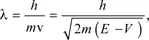
In the theory of wave-particle duality, Louis de Broglie associated the wavelength (λ) with the mass (m) of a body, by making:
[1.1]
image
For its part, the wave propagation equation for a vacuum (here the solid is thought of as electrons and ions swimming in a vacuum) is written as:
[1.2]
image
If the wave is monochromatic, as in:
image
then Δs = ΔAeiωt and
image
(without modifying the result we can interchange a wave with form s = A(x, y, z)eiωt = A(x, y, z)ei 2πvt). By introducing
image
(length of a wave in a vacuum), wave propagation ω equation [1.2] can be written as:
[1.3]
image
[1.3’]
image
A particle (an electron for example) with mass denoted m, placed into a time-independent potential energy V(x, y, z), has an energy:
image
(in common with a wide number of texts on quantum mechanics and solid-state physics, this book will inaccurately call potential the “potential energy” – to be denoted V).
The speed of the particle is thus given by
[1.4]
image
The de Broglie wave for a frequency
image
can be represented by the function Ψ (which replaces the s in equation [1.2]):
[1.5]
image
Accepting with Schrödinger that the function ψ (amplitude of Ψ) can be used in an analogous way to that shown in equation [1.3’], we can use equations [1.1] and [1.4] with the wavelength written as:
[1.6]
image
so that:
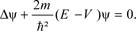
[1.7]
image
This is the Schrödinger equation that can be used with crystals (where V is periodic) to give well defined solutions for the energy of electrons. As we shall see,
these solutions arise as permitted bands, otherwise termed valence and conduction bands, and forbidden bands (or “gaps” in semiconductors) by electronics specialists.

1.2.2. Form of progressive and stationary wave functions for an electron with known energy (E)

In general terms, the form (and a point defined by a vector
image
) function for an electron of known energy (E) is given by: of a wave
image
where ψ(
image
) is the wave function at amplitudes which are in accordance with Schrödinger’s equat...

Table of contents

  1. Cover
  2. Titlepage
  3. Copyright
  4. Foreword
  5. Introduction
  6. Chapter 1: Introduction: Representations of Electron-Lattice Bonds
  7. Chapter 2: The Free Electron and State Density Functions
  8. Chapter 3: The Origin of Band Structures within the Weak Band Approximation
  9. Chapter 4: Properties of Semi-Free Electrons, Insulators, Semiconductors, Metals and Superlattices
  10. Chapter 5: Crystalline Structure, Reciprocal Lattices and Brillouin Zones
  11. Chapter 6: Electronic Properties of Copper and Silicon
  12. Chapter 7: Strong Bonds in One Dimension
  13. Chapter 8: Strong Bonds in Three Dimensions: Band Structure of Diamond and Silicon
  14. Chapter 9: Limits to Classical Band Theory: Amorphous Media
  15. Chapter 10: The Principal Quasi-Particles in Material Physics
  16. Bibliography
  17. Index

Frequently asked questions

Yes, you can cancel anytime from the Subscription tab in your account settings on the Perlego website. Your subscription will stay active until the end of your current billing period. Learn how to cancel your subscription
No, books cannot be downloaded as external files, such as PDFs, for use outside of Perlego. However, you can download books within the Perlego app for offline reading on mobile or tablet. Learn how to download books offline
Perlego offers two plans: Essential and Complete
  • Essential is ideal for learners and professionals who enjoy exploring a wide range of subjects. Access the Essential Library with 800,000+ trusted titles and best-sellers across business, personal growth, and the humanities. Includes unlimited reading time and Standard Read Aloud voice.
  • Complete: Perfect for advanced learners and researchers needing full, unrestricted access. Unlock 1.4M+ books across hundreds of subjects, including academic and specialized titles. The Complete Plan also includes advanced features like Premium Read Aloud and Research Assistant.
Both plans are available with monthly, semester, or annual billing cycles.
We are an online textbook subscription service, where you can get access to an entire online library for less than the price of a single book per month. With over 1 million books across 990+ topics, we’ve got you covered! Learn about our mission
Look out for the read-aloud symbol on your next book to see if you can listen to it. The read-aloud tool reads text aloud for you, highlighting the text as it is being read. You can pause it, speed it up and slow it down. Learn more about Read Aloud
Yes! You can use the Perlego app on both iOS and Android devices to read anytime, anywhere — even offline. Perfect for commutes or when you’re on the go.
Please note we cannot support devices running on iOS 13 and Android 7 or earlier. Learn more about using the app
Yes, you can access Solid-State Physics for Electronics by Andre Moliton in PDF and/or ePUB format, as well as other popular books in Physical Sciences & Condensed Matter. We have over one million books available in our catalogue for you to explore.