eBook - ePub
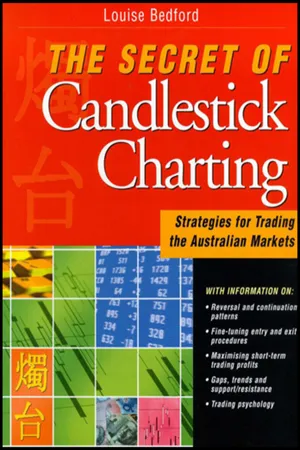
The Secret of Candlestick Charting
Strategies for Trading the Australian Markets
- English
- ePUB (mobile friendly)
- Available on iOS & Android
eBook - ePub
About this book
Most traders on the ASX are familiar with line and bar charts, but there has never before been a book written in Australia on the ancient Japanese art of candlestick charting. Louise Bedford, author of the highly successful The Secret of Writing Options, writes in a clear, concise way and uses plenty of examples to help readers understand candlesticks and use them to profitably trade the markets.
Candlestick Pattern Secrets
Chapter 1
Let’s Get Started
Have you ever seen one of those ‘magic eye’ computer-generated three-dimensional pictures? At first glance it seems to be one-dimensional and quite flat in appearance. However, when you squint and stare at the picture for long enough, an incredible three-dimensional object reveals itself in vivid detail! “Oh, I can see it! It’s a space ship with little aliens inside … it’s amazing,” you exclaim, while the poor person beside you says dejectedly, “Where? Where? I can’t see a thing … ”
Once you know the trick of seeing the images, all of a sudden you can see them easily and everywhere, much to the frustration of your less-enlightened friends. The method of accessing the hidden image is almost impossible to explain until you can do it yourself.
Candlestick charting is very similar. Once you can see the information in the chart, you will probably never want to look at another type of chart again. You will excitedly talk about ‘dark cloud cover’ and ‘raindrops’ until your friends begin to think that you have taken a second job at the weather bureau.
You are about to discover a technique that has the potential to completely alter the way you view charting, yet is complementary to all of the other methods of technical analysis you might use. Technical analysis is defined as the examination of price and volume action on a chart. I predominantly use technical indicators to reach conclusions about the likely direction of share price activity, rather than relying on fundamental data (e.g. balance sheet items such as profit and loss).
Candlesticks form an integral part of my trading activities. If you would like a powerful technique that can pinpoint trend changes prior to many other indicators, show you when a trend is likely to continue and add depth to your existing trading techniques that you never believed would be possible, then candlestick charting is for you.
I have personally found candles to be an invaluable analytical tool. In fact, if all of the technical analysis techniques that I use were forcibly taken away from me due to some bizarre twist of fate, and I had to choose only one to assist in my trading efforts, I would choose the candlestick! Luckily though, I can use the candlestick alongside all of my other favourite analytical methods.
Many advanced traders have developed a high level of sophistication using candlestick analysis. Novice traders will also be greatly assisted by learning about candlestick pattern recognition techniques. Wherever your skills lie on the trading scale from beginner to advanced, the candlestick offers the promise of enhancing your profit potential.
WHY USE CANDLESTICKS?
The visual display of a candlestick chart provides a valuable method of analysing price information. As you attune your eye to candlestick patterns, signals will practically jump off the chart and wrestle you to the ground. You have everything to gain and nothing to lose by using candlesticks, because all of the information in a standard bar chart is already included in a candle chart—it is just represented in a different graphical format. Personally, I always choose candlestick charts in preference to any other chart format because of the depth of information that they present.
An advantage of candlestick charts, compared to standard bar charts, is the level and variety of reversal and continuation patterns that these charts reveal. The majority of these patterns are unique to candlestick charting and are not available by using any other method.
By understanding the psychology behind each pattern, you can reach into the heart of a candle and determine its probable impact on share price action. If you understand the psychological principles driving the creation of a candlestick, you are more likely to understand its potential impact. This skill can be generalised to any new candlestick pattern that you may come across in the future.
There is a continual tug of war in the market, which displays an imbalance of buyer and seller pressure. Whenever a market is in a state of imbalance, the prices will reflect either a bullish or a bearish sentiment. If the market was in perfect agreement about the price a share should be, there would not be any movement in the share price throughout that session. This is a generic principle whether discussing shares, options, warrants, futures or any other market-driven instrument. For this reason, the patterns that are generated by the candles are applicable across any market. This can only add to the widespread acceptance of candlesticks in Western markets in the future. Once you have completed this book, you will be able to use these methods to trade in any market, whether you prefer to trade shares, derivatives or futures. For the sake of simplicity, however, I will predominantly refer to trading shares for examples throughout the book.
There are several candlestick patterns that suggest a trend reversal is imminent, and others designed to imply trend continuation. I’ll show you each of the patterns that I use, and provide you with many opportunities to recognise and practise your newfound skills. By taking the time to understand each concept before you continue reading, and completing the exercises available, you will learn the secrets of using candlesticks.
A QUICK HISTORY LESSON
From 1500 to 1600, Japan was a country constantly at war. Military confrontation had become a way of life as feudal lords fought to control rival territories. This period of time became known as ‘Sengoku Jidai’ or ‘The Age of War’. This helps to explain why many candlestick terms have military connotations.
Over a period of 40 years, three charismatic generals—Nobunga Oda, Hideyoshi Toyotomi and Leyasu Tokagawa—unified Japan. Once relative peace had been established, several new opportunities for expansion developed.
It was during this time that the concept of the Japanese candlestick was being explored and used in the rice markets. Because there was no standardised currency, rice became the predominant medium of exchange. In the late 1600s the Rice Exchange was formed to regulate trading proceedings. By 1710 there were more than 1,300 rice dealers. Rather than just deal in actual rice, rice coupons were issued, and these became one of the first forms of futures contracts ever traded. (The ‘Tulipomania’ that swept the Netherlands in the early 1600s also involved a form of futures contract. During this period in the Netherlands, tulips became the standard medium for exchange and became even more valuable than gold. So, even though we think of ourselves as sophisticated modern traders, many of the basic concepts behind the instruments that we trade today had their origins hundreds of years ago.)
The popularity of these rice coupons in Japan was significant. A ‘bale’ of rice was the standard amount to be traded. By 1749 there were 110,000 bales of rice traded via ‘empty rice coupons’ (where the rice was not in physical possession), even though it is estimated that there were actually only 30,000 bales in all of Japan.
In 1724, Munehisa Homma was born into a wealthy farming family. Homma had an aptitude for business and he ultimately became a dominant trader in the Japanese rice market. Although candlesticks were not actually developed by Homma, he studied the psychology of investors and formulated several key trading principles. These concepts eventually evolved into the candlestick charting techniques that we know today.
Candlestick charts were, of course, originally plotted painstakingly by hand. This labour-intensive step, as well as the fact that many Japanese traders could not release their trading methods due to language barriers, meant that the use of the candle was not widespread until recent times. It is only since the early 1990s that candlesticks were discussed in Australian trading circles without the audience expecting a follow-up discussion on macramé and knitting lessons! (After I told my friends that I was interested in candlesticks, some were convinced that I had a penchant for handicrafts!) Luckily, candlesticks are now included in the majority of charting packages as a standard method of analysis, alongside the more traditional bar charts and line charts.
A Japanese mentor of mine from the corporate world has t...
Table of contents
- Cover
- Title page
- Copyright page
- Acknowledgments
- PART I: Candlestick Pattern Secrets
- PART II: Analysis Secrets
- PART III: Trading Secrets
- Further Education
- Glossary
- Index
Trusted by 375,005 students
Access to over 1.5 million titles for a fair monthly price.
Study more efficiently using our study tools.
Frequently asked questions
Yes, you can cancel anytime from the Subscription tab in your account settings on the Perlego website. Your subscription will stay active until the end of your current billing period. Learn how to cancel your subscription
No, books cannot be downloaded as external files, such as PDFs, for use outside of Perlego. However, you can download books within the Perlego app for offline reading on mobile or tablet. Learn how to download books offline
Perlego offers two plans: Essential and Complete
- Essential is ideal for learners and professionals who enjoy exploring a wide range of subjects. Access the Essential Library with 800,000+ trusted titles and best-sellers across business, personal growth, and the humanities. Includes unlimited reading time and Standard Read Aloud voice.
- Complete: Perfect for advanced learners and researchers needing full, unrestricted access. Unlock 1.5M+ books across hundreds of subjects, including academic and specialized titles. The Complete Plan also includes advanced features like Premium Read Aloud and Research Assistant.
We are an online textbook subscription service, where you can get access to an entire online library for less than the price of a single book per month. With over 1.5 million books across 990+ topics, we’ve got you covered! Learn about our mission
Look out for the read-aloud symbol on your next book to see if you can listen to it. The read-aloud tool reads text aloud for you, highlighting the text as it is being read. You can pause it, speed it up and slow it down. Learn more about Read Aloud
Yes! You can use the Perlego app on both iOS and Android devices to read anytime, anywhere — even offline. Perfect for commutes or when you’re on the go.
Please note we cannot support devices running on iOS 13 and Android 7 or earlier. Learn more about using the app
Please note we cannot support devices running on iOS 13 and Android 7 or earlier. Learn more about using the app
Yes, you can access The Secret of Candlestick Charting by Louise Bedford in PDF and/or ePUB format, as well as other popular books in Business & Finance. We have over 1.5 million books available in our catalogue for you to explore.