Together Bennis, Goleman, and O'Toole explore why the containment of truth is the dearest held value of far too many organizations and suggest practical ways that organizations, their leaders, their members, and their boards can achieve openness. After years of dedicating themselves to research and theory, at first separately, and now jointly, these three leadership giants reveal the multifaceted importance of candor and show what promotes transparency and what hinders it. They describe how leaders often stymie the flow of information and the structural impediments that keep information from getting where it needs to go. This vital resource is written for any organization–business, government, and nonprofit–that must achieve a culture of candor, truth, and transparency.
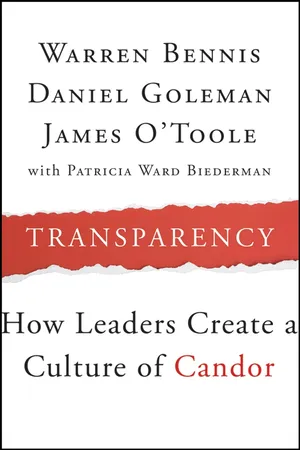
eBook - ePub
Transparency
How Leaders Create a Culture of Candor
- English
- ePUB (mobile friendly)
- Available on iOS & Android
eBook - ePub
Transparency
How Leaders Create a Culture of Candor
About this book
In Transparency, the authors–a powerhouse trio in the field of leadership–look at what conspires against "a culture of candor" in organizations to create disastrous results, and suggest ways that leaders can achieve healthy and honest openness. They explore the lightning-rod concept of "transparency"–which has fast become the buzzword not only in business and corporate settings but in government and the social sector as well.
Information
1
CREATING A CULTURE OF CANDOR
Warren Bennis, Daniel Goleman, and Patricia Ward Biederman
In the spring of 2007 something unprecedented happened in the southern Chinese city of Xiamen. In a nation notorious for keeping citizens in the dark, word got out that a petrochemical plant was to be built near the center of the lovely port city. The factory would have produced toxic paraxylene, and residents who learned of the plans were understandably alarmed. A decade ago, concerned Chinese citizens could have done little to stop the plant’s construction. But this is a new age, not just in China but throughout the world. Via e-mail, blogs, and text messages, word of the plan spread and a protest was organized against it. As the Wall Street Journal reported, hundreds, perhaps thousands of protesters gathered at Xiamen’s city hall to oppose the plant.1 Chinese officials refused to acknowledge the protest and shut down Web sites that opposed the plant. But using today’s ubiquitous communication technology protestors were able to circumvent the official silence. Participants took photos of the protest with their cell phones and posted them on the Web. Much to the chagrin of Chinese officials, some photos were transmitted straight to sympathetic media. The result was a victory of electronics-driven light over official darkness. City officials have postponed construction of the plant until a new study of its environmental impact is completed.
Today the word transparency pops up in stories about everything from corporate governance to the activities of the U.S. Justice Department. In the mouths of those in power, its meaning tends to be fuzzy, although, as New York Times essayist John Schwartz writes, when officials say they are being transparent, “what they really mean is ‘not lying’ and ‘not hiding what we’re really doing.’ But that doesn’t sound as nice or vague, does it?”2 The vagueness is understandable, however. As we all know, claiming to be transparent is not the same as actually being transparent. Even as many heads of corporations and even of states boast about their commitment to transparency, the containment of truth continues to be a dearly held value of many organizations. Sadly, you can say you believe in transparency without practicing it or even aspiring to it.
While opacity is far less of a problem in the United States than in some other nations, it continues to characterize many, if not most, American organizations. And lack of transparency is usually no accident. It is often systematically built into the very structure of an organization. In the following pages, we look at the forces that conspire against an organizational culture of candor and transparency, and the often disastrous results when those qualities are lacking. We also show that the effort to withhold information from the public has become an all-but-impossible task because of profound changes in the global culture. Most important of these is the emergence of electronic technology that facilitates sunlight, and the rise, over the last decade, of the blogosphere—a development that has made transparency all but inevitable. In today’s gotcha culture, no men’s room tryst is sure to remain secret, no racial slur goes unrecorded, no corporate wrongdoing can be safely entombed forever in a company’s locked file cabinets. A decade ago, secrets often remained buried until a professional journalist could be persuaded to reveal them. Today anyone with a cell phone and access to a computer has the power to bring down a billion-dollar corporation or even a government.
WHAT IS A CULTURE OF CANDOR?
When we speak of transparency and creating a culture of candor, we are really talking about the free flow of information within an organization and between the organization and its many stakeholders, including the public. For any institution, the flow of information is akin to a central nervous system: the organization’s effectiveness depends on it. An organization’s capacity to compete, solve problems, innovate, meet challenges, and achieve goals—its intelligence, if you will—varies to the degree that information flow remains healthy. That is particularly true when the information in question consists of crucial but hard-to-take facts, the information that leaders may bristle at hearing—and that subordinates too often, and understandably, play down, disguise, or ignore. For information to flow freely within an institution, followers must feel free to speak openly, and leaders must welcome such openness.
No matter the official line, true transparency is rare. Many organizations pay lip service to values of openness and candor, even writing their commitment into mission statements. Too often these are hollow, if not Orwellian, documents that fail to describe the organization’s real mission and inspire frustration, even cynicism, in followers all too aware of a very different organizational reality.
When we talk about information flow, we are not talking about some mysterious process. It simply means that critical information gets to the right person at the right time and for the right reason. Although the successful flow of information is not automatic and often requires the leader’s commitment, if not intervention, it happens every day in organizational life, often in the most mundane ways. For instance, a few years ago, General Electric became alarmed about a precipitous drop in appliance sales. At meetings on the matter, the conversation soon narrowed to how the problem could be solved by improving marketing: should GE focus on pricing? On advertising? On some other change in marketing strategies?
Then someone from the company’s financial services arm, GE Capital, spoke up. He put up a PowerPoint presentation showing that consumer debt had reached near-saturation levels. The problem wasn’t that GE was failing to market its appliances successfully. The likelier problem was that customers were too strapped to buy the big-ticket items that GE sold. That single crucial bit of information swiftly shifted the conversation from marketing to financing, as the company began seeking ways to help customers pay for appliances. The right information had found its way to the right people at the right time.
Just as the free flow of information can maximize the likelihood of success, damming its flow can have tragic consequences. An instructive example is the decision of Guidant executives to continue selling their Contak Renewal defibrillators even after they learned that the implanted heart regulators were prone to electrical failures implicated in the deaths of at least seven patients.
Because company officials remain silent on the matter, we can only speculate on why the firm decided not to recall the devices until 2005, three years after insiders learned of the flaw. Perhaps the health-sciences firm was blinded by its then-anticipated acquisition by Johnson & Johnson (it has since been acquired by Boston Scientific). Perhaps its corporate judgment was clouded by its Yale-Harvard-like competition with Medtronic, the leading manufacturer of implantable defibrillators. Whatever Guidant’s reasoning, the result was not only needless deaths but a catastrophic trust problem with its primary customers—not heart patients but the physicians who prescribe the lucrative life-saving devices. According to the New York Times, Guidant’s share of the defibrillator market dropped from 35 percent to about 24 percent after the recall, apparently because of the disgust many physicians felt at the company’s decision to conceal an embarrassing truth on which patients’ lives literally depended. As one angry physician wrote to the firm: “I am not critical of Guidant’s device problems—these devices are so complex, issues are expected. I will not, however, work with a company that put profit and image in front of good patient care and honesty in device manufacturing.”3
CHOOSING TRANSPARENCY
It almost goes without saying that complete transparency is not possible—nor is it even desirable, in many instances. Just as national security concerns may justify limiting access to certain information to a small number of carefully vetted individuals, an organization may have a legitimate interest in holding close and guarding from competitors information about innovations, original processes, secret recipes, or corporate strategies. Such secrets are reasonable. However, secretiveness is often simply reflexive. And secretive organizations are vulnerable to exposure by both the mainstream media and their growing legions of amateur competitors. But even when lack of candor is likely to be harmful, many organizations continue to choose it over openness, as Guidant appears to have done.
Because the term transparency, like courage and patriotism, has the exalted ring of eternal truth, it is easy to forget that transparency is a choice. Writer Graeme Wood gives a vivid illustration of this in his analysis in the Atlantic of how differently recent U.S. administrations have treated sensitive information. 4 Arguing that the administration of President George W. Bush is unprecedented in its insistence on secrecy, Wood says the current trend began in 1982 with Ronald Reagan, whose philosophy was, in effect, “When in doubt, classify.” By 1985, 15 million documents had been classified, far more than had been shrouded under President Carter. President Bill Clinton, who favored declassification, ushered in a new era, saying, in effect, “When in doubt, let it out.” Classification surged again under George W. Bush. In 2006, 20.6 million documents were classified, more than six times the 3.6 million classified under Clinton. “Leaving aside the blinkering effect it has on congressional oversight, too much secrecy impedes the routine functioning of the executive branch, by making useful information difficult for many government employees to see,” Wood argues. Ironically, he points out, secrecy also has the unintended consequence of making leaks more likely.
Another dramatic example of transparency as choice was the 2007 decision by the Central Intelligence Agency director, General Michael V. Hayden, to declassify the agency’s so-called family jewels. Buried by Director William E. Colby in 1973, these are internal documents relating to some of the agency’s most controversial activities, including attempts to assassinate Cuban leader Fidel Castro. Hayden appears to have opted for sunlight because he believes revealing even ugly truths would ultimately help the agency. As the New York Times reported: “Hayden said it was essential for the C.I.A., an organization built on a bedrock of secrecy, to be as open as possible in order to build public trust and dispel myths surrounding its operations. The more that the agency can tell the public, he said, the less chance that misinformation among the public will ‘fill the vacuum.’”5
But few leaders in either the public or private sector have been willing, as Hayden was, to choose voluntary transparency. Following Enron’s meltdown and the other transparency-related scandals that did such damage to the American economy in recent years, long-needed reforms were enacted. Though flawed, and with unintended consequences of its own, the Sarbanes-Oxley Act has helped make corporate governance more transparent. But legislation alone cannot make organizations open and healthy. Only the character and will of those who run them and participate in them can do that. New regulations can help restore much-needed trust, but they can only go so far. If a culture of collusion exists instead of a culture of candor, participants will find ways around the rules, new or old, however stringent. Candor and transparency become widespread only when leaders make it clear that openness is valued and will be rewarded. Openness happens only when leaders insist on it.
The influence of a leader committed to transparency was evident in the 2007 decision by heads of the New York City Health and Hospitals Corporation to release information on mortality and infection rates at the eleven hospitals it operates.6 The largest public health system in the United States, the corporation decided to act in spite of opposition from a notoriously secretive hospital industry in hopes of reducing the rising number of preventable infections and subsequent deaths among the 1.3 million patients treated in its hospitals each year. The corporation was encouraged in its pioneering move by New York City Mayor Michael R. Bloomberg. A crusader for transparency, who believes it encourages collaboration and positive change, Mayor Bloomberg created a free 311 phone line so New Yorkers can directly report their concerns (more than 49 million so far). According to a 2007 profile in Business Week, the 311 line is an example of bottom-up transparency that allows Bloomberg to gauge New Yorkers’ attitudes as well as their problems .7 Bloomberg also eschews a private office to work among his aides in a “see-through city hall” with windows in the meeting rooms so the public can literally watch the city’s business being conducted.
WHISTLE BLOWERS, THEN AND NOW
The most damaging secrets within organizations are often those that deal with activities that cause harm—exploding gas tanks, brittle O-rings, secret prisons where a jauntily named horror called water-boarding takes place. The exposure of such embarrassing, even shameful, secrets is transparency at its best and most difficult. Traditionally, such secrets have come to public attention because of whistleblowers, courageous individuals who expose their organizations’ deepest secrets, often at considerable peril to themselves. (In Essay Two, James O’Toole continues the discussion of whistleblowers. ) Sociologist Myron Glazer has studied several hundred whistleblowers in government and industry, and found that almost inevitably the person who exposes wrongdoing suffers, usually by being shunned, demoted, fired, or otherwise punished.
A classic example is Specialist Samuel J. Provance, who revealed that detainees at Iraq’s Abu Ghraib prison were being abused by their American captors. A U.S. Army intelligence officer, Provance went public only after he was unable to galvanize his superiors to take action. As an apparent result of his candor, Provance was demoted, lost his security clearance, and was sent to Germany, where, he says, he is assigned to “picking up trash and guard duty.”8
That kind of retaliation is what keeps most people from telling explosive secrets, whether in families or organizations. Although whistleblowers are often exiled from their organizations for their unwanted candor, Glazer’s study revealed that they almost always found the courage to speak out in their deep commitment to the core values of the organization. Even when labeled traitors by their colleagues, such tellers of unsettling truths often feel passionate loyalty to the organization and act because they feel the secret activity violates its mission and ethical core.
While we believe leaders must set the example for their organizations by demanding candor and transparency, current leaders have less and less choice in the matter. In today’s world, where information travels globally with the click of a mouse, transparency is no longer simply desirable, it is becoming unavoidable.
Many leaders continue to act as if they can hold awkward or damaging truths so close that the outside world will not learn of them. Those days are over. The rise of the blog has transformed the very idea of transparency. There was a time when the worst thing that could happen to an organization with nasty secrets was the emergence of a determined and credible insider with the ear of a respected journalist. But with the rise of blogs, the once vulnerable and isolated whistleblower has ready access to an electronic ally with a new set of superpowers. Whistleblowers no longer have to make their case to a reporter or put their career at risk by going public. They can now make their charges anonymously, and when they do, blogs allow the information to be disseminated throughout cyberspace at the speed of light.
It was Lian Yue, for example, who raised the alarm about the proposed chemical plant in Xiamen, China. According to Xiao Qiang, a cyber-editor who runs the China Internet Project at the University of California, Berkeley, Lian is one of 16 million Chinese bloggers with increasing clout despite government efforts to control cyberspace, which include hiring “tens of thousands of personnel . . . to police the Internet.” As Xiao wrote in the Wall Street Journal, Chinese bloggers feel increasing safety in numbers and have growing public support: “Facing these independent voices, the old ideological machine starts to crumble.”9
But traditional whistleblowers who live in the wrong country at the wrong time still put their lives at risk. In 2001 Antonio Siba-Siba Macuacua, a bank official in Mozambique, discovered that one of the country’s banks was being looted by well-connected citizens, including government officials.10 Siba-Siba outed them, revealing in the country’s leading newspaper the names of more than a thousand people who had taken out loans they never intended to repay. Not long after his explosive revelation, Siba-Siba was thrown to his death down a stairwell in one of the banks he was investigating. His murder has never been solved.
Few modern American whistleblowers have been murdered, the suspicious death of anti-nuclear and labor activist Karen Silkwood in 1976 notwithstanding. And today they are almost certain to be heard, if only by blogging their way to public notice. But the hit-or-miss nature of old-style whistle-blowing could make for heart-stopping drama, as fictionalized in director Sidney Pollack’s 1975 thriller, Three Days of the Condor. The film’s protagonist, played by Robert Redford, works for the Central Intelligence Agency. When his entire department is wiped out, he threatens to go to the New York Times to reveal that the C.I.A. has assassinated half a dozen innocent Americans. “How do you know they’ll print it?” his superior at the agency asks the would-be whistleblower. Today if the New York Times won’t print your story, any number of blog...
Table of contents
- Title Page
- Copyright Page
- PREFACE
- Chapter 1 - CREATING A CULTURE OF CANDOR
- Chapter 2 - SPEAKING TRUTH TO POWER
- Chapter 3 - THE NEW TRANSPARENCY
- NOTES
- THE AUTHORS
Trusted by 375,005 students
Access to over 1.5 million titles for a fair monthly price.
Study more efficiently using our study tools.
Frequently asked questions
Yes, you can cancel anytime from the Subscription tab in your account settings on the Perlego website. Your subscription will stay active until the end of your current billing period. Learn how to cancel your subscription
No, books cannot be downloaded as external files, such as PDFs, for use outside of Perlego. However, you can download books within the Perlego app for offline reading on mobile or tablet. Learn how to download books offline
Perlego offers two plans: Essential and Complete
- Essential is ideal for learners and professionals who enjoy exploring a wide range of subjects. Access the Essential Library with 800,000+ trusted titles and best-sellers across business, personal growth, and the humanities. Includes unlimited reading time and Standard Read Aloud voice.
- Complete: Perfect for advanced learners and researchers needing full, unrestricted access. Unlock 1.5M+ books across hundreds of subjects, including academic and specialized titles. The Complete Plan also includes advanced features like Premium Read Aloud and Research Assistant.
We are an online textbook subscription service, where you can get access to an entire online library for less than the price of a single book per month. With over 1.5 million books across 990+ topics, we’ve got you covered! Learn about our mission
Look out for the read-aloud symbol on your next book to see if you can listen to it. The read-aloud tool reads text aloud for you, highlighting the text as it is being read. You can pause it, speed it up and slow it down. Learn more about Read Aloud
Yes! You can use the Perlego app on both iOS and Android devices to read anytime, anywhere — even offline. Perfect for commutes or when you’re on the go.
Please note we cannot support devices running on iOS 13 and Android 7 or earlier. Learn more about using the app
Please note we cannot support devices running on iOS 13 and Android 7 or earlier. Learn more about using the app
Yes, you can access Transparency by Warren Bennis,Daniel Goleman,James O'Toole,Patricia Ward Biederman in PDF and/or ePUB format, as well as other popular books in Business & Leadership. We have over 1.5 million books available in our catalogue for you to explore.