An Introduction to Organic Geochemistry explores the fate of organic matter of all types, biogenic and man-made, in the Earth System.
investigates the variety of pathways and biogeochemical transformations that carbon compounds can experience over a range of time scales and in different environments
scope widened to provide a broad and up-to-date background - structured to accommodate readers with varied scientific backgrounds
essential terminology is defined fully and boxes are used to explain concepts introduced from other disciplines
further study aided by the incorporation of carefully selected literature references
It investigates the variety of pathways and biogeochemical transformations that carbon compounds can experience over a range of time scales and in different environments.
In its broadest sense, organic geochemistry concerns the fate of carbon, in all its variety of chemical forms, in the Earth system. Although one major form of carbon is strictly inorganic, carbon dioxide, it is readily converted by photosynthesis into the stuff of life, organic compounds (see Box 1.9), and so must be included in our consideration of organic geochemistry. From chiefly biological origins, organic compounds can be incorporated into sedimentary rocks (Box 1.1) and preserved for tens of millions of years, but they are ultimately returned to the Earth’s surface, by either natural processes or human action, where they can participate again in biological systems. This cycle involves various biochemical and geochemical transformations, which form the central part of the following account of organic geochemistry. To understand these transformations and the types of organic compounds involved we must first consider the origins and evolution of life and the role played by carbon.
Growth and reproduction are among the most obvious characteristics of life, and require the basic chemicals from which to build new cellular material, some form of energy to drive the processes and a means of harnessing and distributing this energy. There is an immense range of compounds involved in these processes. For example, energy is potentially dangerous; the sudden release of the energy available from complete oxidation of a single molecule of glucose is large when considered at a cellular level. Therefore, a range of compounds is involved in bringing about this reaction safely by a sequence of partial oxidations, and in the storage and transport to other sites in the cell of the more moderate amounts of energy released at each step. We look at the geochemically important compounds involved in life processes in Chapter 2.
What makes carbon such an important element is its ability to form an immense variety of compounds—primarily with the elements hydrogen, oxygen, sulphur and nitrogen, as far as natural products are concerned—with an equally wide range of properties; this is unparalleled by other elements. This variety of properties allows carbon compounds to play the major role in the creation and maintenance of life. The strength of the chemical bonds in organic compounds is sufficiently high to permit stability, which is essential in supportive tissue, for example, but low enough not to impose prohibitive energy costs to an organism in synthesizing and transforming compounds.
Box 1.1 Sediments and sedimentary rocks
Sediment is the solid material, inorganic or organic, that settles out of suspension from a fluid phase (normally water, ice or air) in which it has been transported. Over time, under the right conditions, it can undergo lithification (i.e. conversion into a solid body of rock). Various processes can be involved in lithification: compaction, cementation, crystallization and desiccation.
Inorganic sediment is supplied by erosion of material from exposed areas of high relief, and can be transported a considerable distance to the area of deposition. The composition of this detrital (or clastic) material varies, but aluminosilicate minerals are usually important. There are also biogenic sediments, resulting from the remains of organisms (e.g. calcareous and siliceous tests, peat) and chemical sediments formed by precipitation of minerals from solution (e.g. evaporites, some limestones and authigenic infills of pores by quartz and calcite cements).
The nature of the sediments accumulating in a particular location can change over time, allowing the recognition of different bodies of sedimentary rock. Such a body is termed a facies, and it displays a set of characteristic attributes that distinguish it from vertically adjacent bodies. Various distinguishing attributes include sedimentary structures, mineral content and fossil assemblages. Organofacies can also be recognized, based on compositional differences in the organic material present (Jones 1987; Tyson 1995).
Another prerequisite for life is liquid water, the medium in which biochemical reactions take place and usually the main constituent of organisms. Although bacteria, and even some simple animals, like the tardigrade, can survive in a dormant state without water, the processes that we associate with life can only take place in its presence. This requirement obviously imposes temperature limits on environments that can be considered suitable for life; hence one of the criteria in the search for life on other planets is evidence for the existence of liquid water at some stage of a planet’s life.
1.2 Chemical elements, simple compounds and their origins
1.2.1 Origin of elements
Carbon is the twelfth most abundant element in the Earth’s crust, although it accounts for only c.0.08% of the combined lithosphere (see Box 1.2), hydrosphere and atmosphere. Carbon-rich deposits are of great importance to humans, and comprise diamond and graphite (the native forms of carbon), calcium and magnesium carbonates (calcite, limestone, dolomite, marble and chalk) and fossil fuels (gas, oil and coal). Most of these deposits are formed in sedimentary environments, although the native forms of C require high temperature and pressure, associated with deep burial and metamorphism.
Where did the carbon come from? The universe is primarily composed of hydrogen, with lesser amounts of helium, and comparatively little of the heavier elements (which are collectively termed metals by astronomers). The synthesis of elements from the primordial hydrogen, which was formed from the fundamental particles upon the initial stages of cooling after the Big Bang some 15 Gyr ago, is accomplished by nuclear fusion, which requires the high temperatures and pressures within the cores of stars. Our Sun is relatively small in stellar terms, with a mass of c.2 × 1030 kg, and is capable of hydrogen fusion, which involves the following reactions:
[Eqn 1.1]
[Eqn 1.2]
[Eqn 1.3]
(where 2H can also be written as D, or deuterium, and the superscript numbers represent the mass numbers as described in Box 1.3). Because of the extremely high temperatures and pressures, electrons are stripped off atoms to form a plasma and it is the remaining nuclei that undergo fusion reactions. Ultimately, when enough helium has been produced, helium fusion can then begin. This process is just possible in stars of the mass of our Sun, and results in the creation of carbon first and then oxygen:
[Eqn 1.4]
[Eqn 1.5]
Box 1.2 Earth’s structure
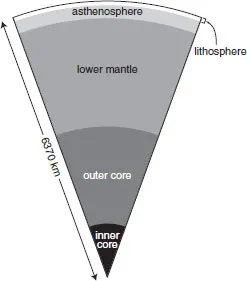
Temperature and pressure both increase with depth in the Earth and control the composition and properties of the material present at various depths. The Earth comprises a number of layers, the boundaries between which are marked by relatively abrupt compositional and density changes (Fig. 1.1). The inner core is an iron–nickel alloy, which is solid under the prevailing pressure and temperature ranges. In contrast, the outer core is molten and comprises an iron alloy, the convection currents within which are believed to drive the Earth’s magnetic field. The core–mantle boundary lies at c. 2900km depth and marks the transition to rocky material above. The mantle can be divided into upper and lower parts, although the boundary is quite a broad transitional zone (c.1000–400km depth). It behaves in a plastic, ductile fashion and supports convection cells. The upper mantle layer from c.100 to 400km depth is called the asthenosphere, and its convection system carries the drifting continental plates.
With decreasing temperature towards the surface, the top part of the mantle is sufficiently cool that it behaves as a strong, rigid solid. The cold, relatively thin, layer of solid rock above the mantle is the crust, which is c.5–7km thick under the oceans but c.30–70km thick on the continents. The topmost mantle and crust are often considered together as lithosphere. Under excessive strain, such as during earthquakes, the lithosphere undergoes brittle failure, in contrast to the ductile deformation that occurs within the asthenosphere.
Fig. 1.1 Simplified layering within the Earth.
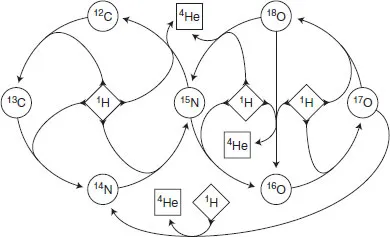
There is still usually plenty of hydrogen left in a star when helium fusion starts in the core. If the products of helium fusion mix with the outer layers of the star it is possible for other elements to be formed. The CNO cycle is an important fusion pathway (Fig. 1.2), which primarily effects the conversion of H to He. However, the cycle can be broken, resulting in the formation of heavier elements; for example, by the fusion reaction shown in Eqn 1.5.
Only more massive stars can attain the higher temperatures needed for the synthesis of heavier elements. For example, magnesium can be produced by fusion of carbon nuclei and sulphur by fusion of oxygen nuclei. Fusion of this type can continue up to 56Fe, and ideal conditions are produced in novae and supernovae explosions. Heavier elements still are synthesized primarily by neutron capture.
Our Sun is too young to have produced carbon and heavier elements. These elements in the nebula from which the Solar System was formed c.4.6 Gyr ago, together with the complex organic molecules in our bodies, owe their existence to an earlier generation of stars.
1.2.2 The first organic compounds
Away from the nuclear furnaces of the stars elements can exist as the atoms we are familiar with, which in turn can form simple compounds if their concentrations are sufficiently great that atomic encounters can occur. The highest concentrations are found in interstellar clouds, and in particular in molecular clouds, where densities of 109–1012 particles per m3 can exist. This is still a very low density, and the most common constituents of these clouds are H (atomic hydrogen), H2 (molecular hydrogen) and He, which can be ionized by bombardment with high-energy particles, originating from phenomena like supernovae, and can then take part in ion–molecule reactions, such as:
[Eqn 1.8]
[Eqn 1.9]
[Eqn 1.10]
[Eqn 1.11]
Fig. 1.2 Hydrogen fusion via the CNO cycle.
Among the eventual products of these react...
Table of contents
Cover
Contents
Title Page
Copyright
Preface
Acknowledgments
1 Carbon, the Earth and life
2 Chemical composition of organic matter
3 Production, preservation and degradation of organic matter
4 Long-term fate of organic matter in the geosphere
5 Chemical stratigraphic concepts and tools
6 The carbon cycle and climate
7 Anthropogenic carbon and the environment
Appendix 1 SI units used in this book
Appendix 2 SI unit prefixes
Appendix 3 Geological time scale
References
Index
Trusted by 375,005 students
Access to over 1.5 million titles for a fair monthly price.
Study more efficiently using our study tools.
Frequently asked questions
Yes, you can cancel anytime from the Subscription tab in your account settings on the Perlego website. Your subscription will stay active until the end of your current billing period. Learn how to cancel your subscription
No, books cannot be downloaded as external files, such as PDFs, for use outside of Perlego. However, you can download books within the Perlego app for offline reading on mobile or tablet. Learn how to download books offline
We are an online textbook subscription service, where you can get access to an entire online library for less than the price of a single book per month. With over 1.5 million books across 990+ topics, we’ve got you covered! Learn about our mission
Look out for the read-aloud symbol on your next book to see if you can listen to it. The read-aloud tool reads text aloud for you, highlighting the text as it is being read. You can pause it, speed it up and slow it down. Learn more about Read Aloud
Yes! You can use the Perlego app on both iOS and Android devices to read anytime, anywhere — even offline. Perfect for commutes or when you’re on the go. Please note we cannot support devices running on iOS 13 and Android 7 or earlier. Learn more about using the app
Yes, you can access Introduction to Organic Geochemistry by Stephen D. Killops,Vanessa J. Killops in PDF and/or ePUB format, as well as other popular books in Physical Sciences & Geology & Earth Sciences. We have over 1.5 million books available in our catalogue for you to explore.