Your all-inclusive guide to all the latest technologies
Providing you with a better understanding of the latest technologies, including Cloud Computing, Software as a Service, Service-Oriented Architecture (SOA), Open Source, Mobile Computing, Social Networking, and Business Intelligence, The Next Wave of Technologies: Opportunities in Chaos helps you know which questions to ask when considering if a specific technology is right for your organization.
Demystifies powerful but largely misunderstood technologies
Explains how each technology works
Provides key guidance on determining if a particular technology is right for your organization
Contains contributions from experts on Cloud Computing, Service-Oriented Architecture (SOA), Software as a Service (SaaS), Open Source, Mobile Technologies, Enterprise Risk Management, Social Media, Business Intelligence, and more
More of a management text than a technical guide, the book is designed to help your organization better understand these exciting new technologies and their potential impact. The Next Wave of Technologies: Opportunities in Chaos will help you determine if your organization is ready for a specific technology, how to prepare for its successful adoption, how to measure success, and the key risks and red flags to recognize.
Chapter 1 The Changing Landscapes of Business and Technology
Phil Simon
Ex chaos facultas. Latin, “From chaos comes opportunity.”
Introduction
The worlds of technology and business are colliding faster and more intensely than ever. Organizations today are facing increasing pressures with respect to innovation, operational excellence, and financial performance while concurrently keeping costs at an absolute minimum. Relatively recent technologies provide enormous possibilities for organizations to confront everyday and long-term business challenges. The need for organizations to understand how to use these new technologies—and then actually utilize them effectively—has never been greater.
At best, organizations slow to embrace these opportunities often cost themselves money, via reduced revenue, profits, and market share or via higher expenses. First-mover advantage has arguably never been more pronounced, as organizations such as Google, Twitter, and Facebook can go from anonymous to ubiquitous almost overnight. At worst, technological laggards may no longer be around to eventually get with the program. Along these lines, Jim Collins's latest book, How the Mighty Fall: And Why Some Companies Never Give In, addresses the five stages of organizational decline. This prompts the question: What, if anything, can information technology (IT) do to stop an organization's demise? (Chapter 3 addresses this topic.)
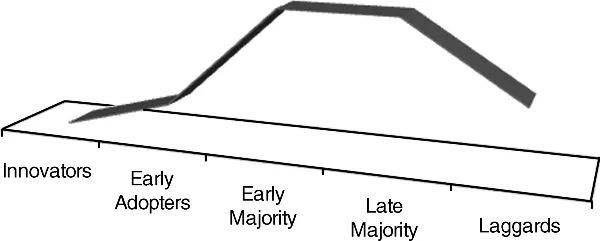
Of course, not every organization embraces new technologies as quickly as others. This concept is known as the Technology Adoption Life Cycle (TALC).1 TALC is used to describe the adoption of new technologies, typically including the stages of innovators, early adopters, early majority, late majority, and technology laggards. In a nutshell, very few organizations implement new technologies right after their introduction; graphically represented in Figure 1.1.
Figure 1.1 The Technology Adoption Life Cycle (TALC)
In his well-researched book Does IT Matter?: Information Technology and the Corrosion of Competitive Advantage, Nicholas Carr makes the case that most organizations should learn from the competition; they should wait for other organizations to make IT-related mistakes. He deftly points out examples such as United Parcel Service (UPS) successfully adopting a “follow, don't lead” IT approach. Carr writes that “UPS was often attacked through the 1980s and 1990s for being a technological slowpoke. All the while, though, UPS was carefully following in FedEx's tracks, learning not just how to copy its rival's systems but often how to make them better and cheaper. When UPS rolled out its own logistics-management software, for instance, it went with a more open system than FedEx's, making it easier for customers to incorporate UPS's technology into their existing systems.”
A thorough discussion on how, why, and when organizations should implement technologies is not warranted here. For now, suffice it to say that the vast majority of organizations echoes Carr's sentiment; they wait until a new technology has become pervasive and mature before deciding to use it, if at all. In other words, very few tend to be “on the left side of the curve.”
Enterprise 2.0: What's in a Name, Anyway?
Some of the topics in this book have been collectively dubbed “Enterprise 2.0,” a term originally coined by Harvard Business School associate professor Andrew McAfee in a 2006 Sloan Management Review article. McAfee defined Enterprise 2.0 as “the use of emergent social software platforms within organizations, or between organizations and their partners or customers.”
Along those lines, in a 2008 report for the Association for Information and Image Management (AIIM), Carl Frappaolo and Dan Keldsen defined Enterprise 2.0 as “a system of web-based technologies that provide rapid and agile collaboration, information sharing, emergence and integration capabilities in the extended enterprise.”
This book intentionally uses the term Enterprise 2.0 more broadly than those definitions. I admit that it is quite difficult to succinctly distill all of the aspects of the next wave of technologies into a few sentences. Because of this, perhaps Enterprise 2.0 is best defined in the negative against “Enterprise 1.0.”
Now, I'm no revisionist. I know that the term Enterprise 1.0 never formally existed back in the 1990s and early 2000s. I was there. With the benefit of hindsight, however, what I'm calling Enterprise 1.0 ultimately represented organizations' initial efforts to democratize computing in the workplace. They replaced their clunky mainframes and ugly boxes previously confined to hard-core programmers with more user-friendly personal computers (PCs) that the everyday employee could use. Enterprise systems replaced paper-driven and manual processes. The PC became part and parcel of almost every corporate white-collar job as organizations moved from memos to emails. Examples of 1.0 technologies included Enterprise Resource Planning (ERP) systems, relational databases such as Oracle and SQL Server, client-server applications, email (arguably the era's killer app), and corporate web sites and intranets.
In short, Enterprise 1.0 represented the first technological wave that allowed organizations to do the following:
Increase the level of enterprise integration.
Allow employees to access information away from traditional mainframes.
Begin to knock down organizations' information silos.
Embrace email and the Internet.
Dabble with different communication and collaboration tools.
Conversely, Enterprise 2.0 represents the next wave of technologies. In this book, I define Enterprise 2.0 as organizations' efforts to deploy and utilize emerging technologies, systems, applications, platforms, social media, and software development methodologies. Examples of these technologies include: cloud computing, social networking, business intelligence (BI), software as a service (SaaS), enterprise search and retrieval (ESR), and open source (OS) applications.
In other words, for the purposes of this book, Enterprise 2.0 means going beyond the basics. It assumes that organizations can already accurately run financial reports, pay employees, communicate with customers and employees, track inventory, and the like. (At a high level, this was the entire point of Enterprise 1.0.) Note, however, that there is almost always room for improvement, as many organizations may not be performing these activities in an optimal manner.
Enterprise 2.0 consists of three general and intertwined principles:
Managing systems and data in a better, more integrated fashion.
Interpreting data to allow for higher-level analytics.
Enhancing communication among organizations, vendors, suppliers, employees, and customers.
Enterprise 2.0 versus Web 2.0
Enterprise 2.0 should not be confused with Web 2.0. The latter presently consists largely of social networking sites such as Twitter and Facebook, wikis, and mashups that people use for entertainment or personal reasons. Families, friends, and strangers can communicate online and share information outside of organizational walls.
For their part, Enterprise 2.0 technologies exist inside organizations—though this is a far cry from being closed off from the rest of the world. The primary objective of Enterprise 2.0 technologies is not to connect family, friends, or strangers. Rather, these technologies aim to improve productivity and enhance communication and collaboration among vendors, suppliers, customers, and employees. As such, emerging technologies need to provide greater security than Web 2.0 technologies. What's more, they should ...
Table of contents
Cover
Title Page
Copyright
Foreword
Preface
Acknowledgments
About the Contributors
Part I: Introduction, Background, and Definitions
Part II: Architecture, Software Development, and Frameworks
Part III: Data, Information, and Knowledge
Part IV: Management and Deployment
Part V: Conclusion
Bibliography
About the Author
Index
End User License Agreement
Trusted by 375,005 students
Access to over 1.5 million titles for a fair monthly price.
Study more efficiently using our study tools.
Frequently asked questions
Yes, you can cancel anytime from the Subscription tab in your account settings on the Perlego website. Your subscription will stay active until the end of your current billing period. Learn how to cancel your subscription
No, books cannot be downloaded as external files, such as PDFs, for use outside of Perlego. However, you can download books within the Perlego app for offline reading on mobile or tablet. Learn how to download books offline
Perlego offers two plans: Essential and Complete
Essential is ideal for learners and professionals who enjoy exploring a wide range of subjects. Access the Essential Library with 800,000+ trusted titles and best-sellers across business, personal growth, and the humanities. Includes unlimited reading time and Standard Read Aloud voice.
Complete: Perfect for advanced learners and researchers needing full, unrestricted access. Unlock 1.5M+ books across hundreds of subjects, including academic and specialized titles. The Complete Plan also includes advanced features like Premium Read Aloud and Research Assistant.
Both plans are available with monthly, semester, or annual billing cycles.
We are an online textbook subscription service, where you can get access to an entire online library for less than the price of a single book per month. With over 1.5 million books across 990+ topics, we’ve got you covered! Learn about our mission
Look out for the read-aloud symbol on your next book to see if you can listen to it. The read-aloud tool reads text aloud for you, highlighting the text as it is being read. You can pause it, speed it up and slow it down. Learn more about Read Aloud
Yes! You can use the Perlego app on both iOS and Android devices to read anytime, anywhere — even offline. Perfect for commutes or when you’re on the go. Please note we cannot support devices running on iOS 13 and Android 7 or earlier. Learn more about using the app
Yes, you can access The Next Wave of Technologies by Phil Simon in PDF and/or ePUB format, as well as other popular books in Business & Information Management. We have over 1.5 million books available in our catalogue for you to explore.