- English
- ePUB (mobile friendly)
- Available on iOS & Android
eBook - ePub
Essentials of WNV Assessment
About this book
Essentials of WNV Assessment provides practitioners with practical, step-by-step advice for administering, scoring, and interpreting the Wechsler Nonverbal Scale of Ability (WNV), a nonverbal assessment used to assess a wide variety of individuals. Written by Kimberly Brunnert, Jack Naglieri, and Steven Hardy-Braz, the test is especially well suited for those who are not proficient in English, such as young children, recent immigrants, ESL students, and the deaf and hard of hearing. This essential guide provides you with illuminating case reports and valuable advice on its clinical applications.
Information
Seven
ILLUSTRATIVE CASE REPORTS
This chapter provides psychological assessment reports from six case studies of children who were referred for psychoeducational assessments in different school settings. They are presented to demonstrate the use and versatility of the WNV as a major component of a psychological assessment. Please note that these illustrative cases are provided with informed consent of the parent(s), no compensation was offered to any of the individuals involved, and all identifying information has been altered to protect their privacy. Any and all resemblance to an actual person is coincidental. Identifyable information about the children has been altered to protect their identity (e.g., children’s names, teacher’s names).
The first case report (Jacob) involves a young child who is Deaf, uses American Sign Language (ASL) at home with his Deaf mother and his hearing father (who has Deaf parents himself), and who was referred for an assessment regarding his potential qualification for a gifted and talented program at his state-run residential school for deaf students. The second case report (Alice) involves a child who is deaf and uses a cochlear implant and oral communication. She had been referred at her school for an assessment to examine the possibility that she has a comorbid learning disability in reading. The third case report (Jeremy) involves a child who is suspected of having Attention-Deficit/Hyperactivity Disorder (ADHD).There are other concerns about this child including suspected speech and language delays, excessive activity, and achievement problems. The fourth illustrative case report (Luis) is about a child who speaks English as a second language.The fifth case report (Ryan) involves a child who is deaf and blind and has multiple medical and developmental concerns related to CHARGE syndrome. The referral for a triennial assessment was made for the purpose of gathering information regarding his current level of functioning and monitoring her academic progress.The reason for the referral for the sixth case report (Gene) is also a reevaluation. This case involves a young child previously identified as being autistic who is now entering the local public school system.
Psychological Evaluation Report Confidential
REASON FOR REFERRAL:
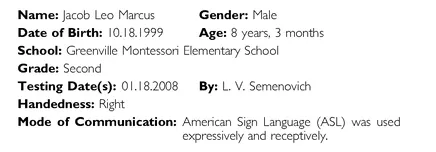
Jacob was assessed as part of a referred assessment at the Greenville Montessori Elementary School as requested by his mother and his school-based Gifted Review Committee. The committee requested that this school psychologist formally assess Jacob’s intellectual ability for potential qualification for services as a gifted student. Neither his mother nor his primary teacher, Mrs. Laney, expressed concerns related to Jacob and his behaviors, but both independently stated that they were concerned about his apparent boredom in school and with his homework. Results of this assessment will be used to assess the appropriateness of Jacob’s educational classification, placement, and educational programming in accordance with the education procedures and criteria established by the state of North Carolina. This report is considered a confidential record and the results should only be interpreted by knowledgeable and properly licensed professionals.
EVALUATION TECHNIQUES:
The examiner administered the following techniques:
Parental Interview
Teacher Interview
Classroom Observations
Academic Work Samples
Wechsler Nonverbal Scale of Ability (WNV)
Teacher Interview
Classroom Observations
Academic Work Samples
Wechsler Nonverbal Scale of Ability (WNV)
SOURCES OF DATA:
1. Record Review:
Jacob’s educational, audiological, medical, and psychological files were reviewed as an integral part of this assessment.
2. Direct Observations:
Jacob was observed by this examiner in his regular classroom taught by his teacher during both American History and English lessons. His teacher was unable to communicate directly with Jacob beyond using a few simple signs (e.g., Pay Attention,Work, Start, Open, Book), and most of the interactions between the teacher and Jacob were facilitated by the class’s sign-language interpreter, Ms. Lara Alice. Ms. Alice is an RID, certified educational interpreter who works primarily with Jacob. The communication and interaction between Ms. Alice and Jacob was fluent and flowed without any apparent difficulties.Whenever Jacob asked any clarifying questions, Ms. Alice appeared to understand his expressive signs with ease and was able to clarify the interpretation. Jacob displayed a tendency to direct all of his questions to Ms. Alice instead of his teacher. Furthermore, during snack and lunchtime, Jacob stated that he preferred to sit with Ms. Alice because “they could talk.” Jacob was also observed in his general school environment (e.g., activities, playground, cafeteria, while transitioning between classes). No physical or motor difficulties were noted. Jacob, however, did tend to walk and run with a slightly wider than typical stance. This very slight difference did not appear to interfere in any way with his mobility. This type of stance can be common with young children with sensorineural hearing losses, like Jacob’s. Often times, information from the vestibular system to the brain is also limited because it uses the same cranial nerve for transmitting information. Several items from Jacob’s homework and class work were also reviewed by this examiner; they were completed in a very neat and orderly fashion. His teacher explained that Jacob was working on long-division problems with older children (by 2 years) in his multiaged classroom and that he was beginning to read book series by himself.
3. Educator Interview:
Jacob’s primary teacher, Mrs. Laney, was also asked about his academic and social performance to date. Mrs. Laney stated that Jacob was a bright student who did not display any behavioral or emotional concerns. She stated that she felt limited in her ability to teach Jacob directly since she only knew a few hundred ASL signs. Mrs. Laney added that she appreciated Ms. Alice and felt that she would be at a “total loss” without the interpreting help. She stated Jacob was very interested in space and astronomy and that he loved to play “Lego Star Wars” with some of his classmates on the weekends.
4. Parental Interview:
Jacob’s mother, Mrs. Marcus, served as the primary reporter for him and was interviewed by this examiner in ASL. She stated that Jacob was an exceptional reader and that most academic topics came easy for him. She explained that she had some developmental concerns earlier in his preschool years, but that he was doing very well now. She did express some concerns about his difficulties in making friends with other children his own age since many of his classmates were unable to sign fluently. She, too, stated that Jacob enjoyed playing with friends his own age or slightly older and that they tended to play videogames, like the Lego Star Wars, together. Mrs. Marcus felt that Jacob was not being challenged enough at school or at home and was hoping that an advanced program would be more stimulating for him. She was concerned that the program support for hearing-impaired students at the local school was “good but that they do not know a great deal about deaf culture and how to teach smart deaf kids.” She also stated her concerns regarding the lack of visual fire alarms throughout the old school building and that she was concerned if an alarm occurred while her son was in the bathroom that he would not be able to hear it. She explained that she had never needed to worry about these issues at his previous school (a residential school for deaf students in another state), but since her husband (Jacob’s father) had been deployed overseas with his National Guard unit, she had moved back home with her parents. She elaborated that both of their mothers were Deaf, but Jacob’s father was able to hear, and he was a CODA (Child of Deaf Adults). Mrs. Marcus requested this assessment in order to glean a better understanding of her son’s abilities and academic needs.
5. Test Instruments Used:
The Wechsler Nonverbal Scale of Ability (WNV; Wechsler & Naglieri, 2006a) is an individually administered clinical instrument designed to measure of the cognitive ability of students between the ages of 4 years and 21 years, 11 months. The WNV was used to measure Jacob’s cognitive ability by using a variety of subtests.The administration of the WNV yielded subtest scores and an overall Full Scale score. Pictorial directions were used during the WNV administration to minimize verbal requirements of both the examiner and Jacob. At the time of testing Jacob was 8 years and 3 months old (8:03), and therefore, he was administered the four subtests in the age-appropriate battery for individuals between the ages of 8 years and 21 years, 11 months. Those subtests were: Matrices, Coding, Spatial Span, and Picture Arrangement. Subtest T scores, Full Scale Standard Scores, Confidence Intervals, Percentile Rankings, and Test Age-Equivalent Scores were obtained. Subtest T scores have a mean of 50 and standard deviation of 10; the Full Scale score has a mean of 100 and a standard deviation of 15. Optional scores were also computed for further analysis of Jacob’s performance on the Spatial Span subtest by examining his Spatial Span Forward (SSpF) and Spatial Span Backward (SSpB) scores and comparing them. Jacob’s performance was further examined by comparing his raw scores in terms of the Longest Spatial Span Forward (LSSpF) and Longest Spatial Span Backward (LSSpB). The WNV’s normative sample consists of information on the performance of 1,350 individuals who were matched in terms of age, sex, geographic region, education level, and race/ethnicity as specified in the 2003 U.S. Census data.
NOTE
For an actual case study, ensure that the examiner and/or location of testing are noted like the fictitious ones included here.
BACKGROUND INFORMATION:
1. Developmental History
Jacob was born at the Pitt Memorial Hospital at 39 weeks gestation. No complications occurred during the pregnancy or birth. His mother reported that she needed no medications nor did she drink or smoke. During the two-day stay in the hospital, the newborn hearing screening test was conducted and a bilateral, sensorineural inability to hear was identified.While the etiology of his deafness is unknown, every member of Jacob’s maternal family displays a similar history of deafness, as do the majority of his paternal family members. Developmental milestones were reported to have been obtained within normal parameters except for a slight delay in walking. Mrs. Marcus stated that Jacob did not start walking without holding onto furniture until he was almost 2 years old. He was reported as having signed his first signs around 7 months of age. No allergies, injuries, hospitalizations, or medical problems were reported. No problems with sleeping through the night except for the first week of his father’s deployment were mentioned.
His most recent audiogram (12.22.2007 by H. B. Stevens) confirmed the existence of a bilateral, profound hearing loss at all frequencies.
His vision was screened by the school nurse for both far- and near-vision prior to this assessment (08.06.2007), and no difficulties were reported.
2. Previous Assessments
Previous psychoeducational information was available from one evaluation of Jacob. The results of that evaluation were as follows:

Cognitive functioning is a very complex concept, and the reduction of a description of Jacob’s abilities to a single number may be misleading. Readers are strongly encouraged to refer to the complete reports of the previous evaluations as well as to be cognizant of the fact that various standardized tests with various normative samples and characteristics have been used.
NATURAL OBSERVATIONS:
Rapport was easily established with Jacob. On the day of this evaluation, Jacob was very well groomed, neatly dressed, and he behaved in a well-mannered fashion. The communication between Jacob and the examiner was conducted in American Sign Language and this appeared to be effective. Jacob was attentive, engaging, and curious about the testing materials and the examiner. No physical limitations were noted as he sat in an appropriately sized chair and worked on a desktop in the school psychologist’s office. The room was well lit and free from any distracters. His interpreter, his mother, and his teacher observed the assessment session through a one-way glass observation window, and they reported that his behavior and effort were very similar to what they regularly see.
Jacob sat upright with good posture and both of his feet stabilized on the floor in front of his body throughout the session, and he used a well-developed dynamic tripod grasp when writing and did not appear to have any physical limitations. During the hour-long standardized assessment session, Jacob was able to remain on task and work without any reminders to work carefully and continuously. He appeared to enjoy the tasks and often commented on the fun nature of some of the test items.
TEST RESULTS AND INTERPRETATIONS:
Due to the match between his characteristics and the task demands of the test, the WNV was selected for use with Jacob as a standardized measure of gathering information of his cognitive ability and level of intellectual development. This scale consisted of four different subtests. His performance on each contributed to the overall or Full Scale score. Jacob obtained a Full Scale score of 142. At the 95% confidence interval, this performance would range between 130 and 146, yielding a 99.7th percentile ranking.This is reflective of a performance better than 99 % of the normative sample and is considered in the Very Superior range of ability.
The Matrices subtest required Jacob to look at an incomplete figural matrix and then select the missing related portion from four or five response options provided. He was able to solve many of these items with ease and often explained the solution he used. His performance resulted in aTscore of 77. The Coding subtest required Jacob to copy symbols that are paired with simple geometric shapes or numbers. Using a key provided at the top of the page, Jacob had to draw each ...
Table of contents
- Essentials of Psychological Assessment Series
- Title Page
- Copyright Page
- Dedication
- SERIES PREFACE
- One - INTRODUCTION AND OVERVIEW
- Two - HOW TO ADMINISTER THE WNV
- Three - HOW TO SCORE THE WNV
- Four - INTERPRETATION OF THE WNV
- Five - STRENGTHS AND WEAKNESSES
- Six - CLINICAL APPLICATIONS OF THE WNV
- Seven - ILLUSTRATIVE CASE REPORTS
- REFERENCES
- ANNOTATED BIBLIOGRAPHY
- INDEX
- ABOUT THE AUTHORS
Trusted by 375,005 students
Access to over 1.5 million titles for a fair monthly price.
Study more efficiently using our study tools.
Frequently asked questions
Yes, you can cancel anytime from the Subscription tab in your account settings on the Perlego website. Your subscription will stay active until the end of your current billing period. Learn how to cancel your subscription
No, books cannot be downloaded as external files, such as PDFs, for use outside of Perlego. However, you can download books within the Perlego app for offline reading on mobile or tablet. Learn how to download books offline
Perlego offers two plans: Essential and Complete
- Essential is ideal for learners and professionals who enjoy exploring a wide range of subjects. Access the Essential Library with 800,000+ trusted titles and best-sellers across business, personal growth, and the humanities. Includes unlimited reading time and Standard Read Aloud voice.
- Complete: Perfect for advanced learners and researchers needing full, unrestricted access. Unlock 1.5M+ books across hundreds of subjects, including academic and specialized titles. The Complete Plan also includes advanced features like Premium Read Aloud and Research Assistant.
We are an online textbook subscription service, where you can get access to an entire online library for less than the price of a single book per month. With over 1.5 million books across 990+ topics, we’ve got you covered! Learn about our mission
Look out for the read-aloud symbol on your next book to see if you can listen to it. The read-aloud tool reads text aloud for you, highlighting the text as it is being read. You can pause it, speed it up and slow it down. Learn more about Read Aloud
Yes! You can use the Perlego app on both iOS and Android devices to read anytime, anywhere — even offline. Perfect for commutes or when you’re on the go.
Please note we cannot support devices running on iOS 13 and Android 7 or earlier. Learn more about using the app
Please note we cannot support devices running on iOS 13 and Android 7 or earlier. Learn more about using the app
Yes, you can access Essentials of WNV Assessment by Kimberly A. Brunnert,Jack A. Naglieri,Steven T. Hardy-Braz in PDF and/or ePUB format, as well as other popular books in Psychology & Research & Methodology in Psychology. We have over 1.5 million books available in our catalogue for you to explore.