- Presents an up-to-date review of the knowledge base behind the discipline of counselling psychology that addresses the notion of human wellbeing and critiques the concept of 'psychopathology'
- Includes an assessment of the contributions that counselling psychology makes to understanding people as individuals, in their working lives, and in wider social domains
- Offers an overview of counselling psychology's contributions beyond the consulting room, including practices in the domain of spirituality, the arts and creative media, and the environmental movement
- Critiques contemporary challenges facing research as well as the role that research methods have in responding to questions about humanity and individual experience
eBook - ePub
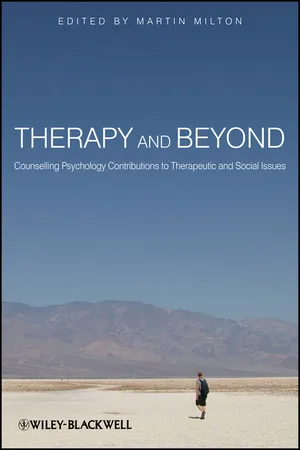
Therapy and Beyond
Counselling Psychology Contributions to Therapeutic and Social Issues
- English
- ePUB (mobile friendly)
- Available on iOS & Android
eBook - ePub
Therapy and Beyond
Counselling Psychology Contributions to Therapeutic and Social Issues
About this book
Therapy and Beyond: Counselling Psychology Contributions to Therapeutic and Social Issues presents an overview of the origins, current practices, and potential future of the discipline of counselling psychology.
Information
Section 1
Fundamentals of Counselling Psychology
There are some aspects of counselling psychology which underpin every aspect of the profession and the tasks that counselling psychologists undertake. These aspects are fundamental in character and ever present whether they are overt or covert. While aspects of our practice change over time — sometimes in quite significant ways — in light of the therapeutic model embraced, the research method used or the contexts in which we work, these fundamentals remain central to the integrity of the profession. What are these fundamental characteristics, so crucial to the profession and the contribution counselling psychology makes to therapy and to the wider world? This section looks at just a few of them, including pluralism, relational ways of understanding the world, the understanding of distress, research and enquiry, ethics and the therapeutic relationship.
Such fundamental aspects are not easy, clear-cut phenomena and certainly not unidimensional in nature. Quite the contrary, these are sometimes rather ethereal, complex domains, requiring open, ongoing and curious engagement. In some contexts (e.g., in the debates about statutory regulation, the setting-up of professional bodies and the writing of therapeutic ‘guidelines’) the debates can be characterised by conflict, reliance on the exercise of power and the influence of status. This array of responses highlights the crucial nature of these fundamentals.
In light of this, it will come as no surprise to readers that the contributors to section 1 approach their topics — and, I suspect, the profession — from different positions. And in doing so, these six chapters draw readers' attention to the complexity of human experience and the ways in which counselling psychology knowledge and practice engage with this complexity so as to be of benefit to all involved.
In Chapter 1, Donal McAteer introduces the reader to the concept of pluralism and the epistemological tensions with which we live today and in which counselling psychologists function. Donal reminds us that counselling psychology eschews dogma and encourages an attitude of curiosity and continuous questioning of the assumptions we make in our daily lives both as counselling psychology practitioners and as human beings. As in the wider world, this presents a challenge to the profession and its practitioners as we attempt to negotiate with different theoretical and professional perspectives and as we wrestle with our own certainties or biases. This chapter also considers one of the core tensions experienced in the profession: ‘directiveness and non-directiveness’. The chapter does not ask whether we influence people, but how we do, why we do, when we do, when we should, how we can communicate this, and what shapes the ways in which we influence.
This is followed by Elena Manafi's first chapter, which looks at counselling psychology's relational framework, well known when we think about therapy, but ever-present in all our professional activities and roles. The chapter outlines the different epistemological positions that counselling psychologists draw on and how these come together in a view of human experience as constructed and intersubjective. Counselling psychology shows just how crucial it is that we move beyond the traditional view of people as self-contained to understand them as intentional and relational in all aspects of our experience and behaviour. This has implications for understanding people, understanding ‘pathology’ and ways of preventing psychological distress.
In Chapter 3, Deborah Rafalin looks at one of our key activities – research – and the ways in which counselling psychology engages with the challenges and opportunities that psychological enquiry provides us. The discipline explicitly engages even-handedly with both quantitative and qualitative paradigms to answer its burning questions and to explore the nature of the questions being asked of it. This chapter explores how the counselling psychologist responds to the calls for ‘scientific evidence’ to support their clinical choices whilst valuing the subjective phenomenological experiences shared by their clients.
That emotional pain and distress are inescapable features of the human condition is not in doubt and when working with people experiencing this, the applied psychologies often have to engage with the notion of ‘psychopathology’. There is a social and cultural acceptance of the logic of a medical model of distress and has seen a steady increase in the pathologisation of everyday life. In Chapter 4, Mark Craven, Adrian Coyle and I take a different stance and consider human distress through a postmodern lens, to highlight the benefits of relational frameworks when meeting clients in pain and to remind us of some of the damage that can be incurred when using outmoded, individualistic ways of understanding people. The chapter looks at ‘psychopathology‘ in relation to the discipline of counselling psychology, which historically provides an alternative view of human functioning and dis-ease to that contained in the medical model.
As a profession, counselling psychology emerged from a desire to move towards a way of being with clients that would be non-directive, egalitarian and would take a holistic approach to understanding human wellbeing. So, in Chapter 5 Frances Gillies looks at one of counselling psychology's key foci – the therapeutic relationship — and suggests that this crucial aspect of practice benefits not only from being seen as a current relationship between the therapist and client in the consulting room, but also a relationship embedded in time. To this end, she shows how an evolutionary lens can usefully contribute to understanding the complexity of this key relationship.
The final chapter in this section is by Camilla Olsen, who considers ethics as a fundamental dimension of counselling psychology. In this chapter consideration is given to the ethical boundaries psychological therapy is governed by and the rationale for these boundaries. Attention is also given to how these same ethical boundaries can create difficulties between human beings, in particular where you as a person have contradictory ethical responsibilities. Many of us have experienced this in our workplace, and this can be particularly difficult when multidisciplinary input is required. It is also true for training institutions as well as for supervision.
These contributors show that whether thinking about epistemological positions, the ways individuals relate to self, others and the wider world, whether we explore a phenomenon in relation to the meaning it has for clients or the role it plays in the wider world, counselling psychologists draw on relational frameworks in an ever-changing landscape and this is done with an ethical mindset – how to do the best possible work so that people are helped and harm is avoided. The contributors also highlight the complexity in this endeavour and offer fruitful ways of orienting ourselves to this challenge.
Chapter 1
Philosophical Pluralism: Navigating the Sea of Diversity in Psychotherapeutic and Counselling Psychology Practice
‘Ever not quite’ has to be said of the best attempts made anywhere in the universe at attaining all-inclusiveness.
(James, 1909, p. 322)
This standpoint, articulated by the American philosopher William James in the first decade of the twentieth century, highlights a central tenet of the postmodern view: that there is no overarching truth to elucidate everything. Moreover, to aim for such certainty would inevitably leave some things unexplained, while excluding other legitimate explanations in the process. The concept of pluralism stems from such a view in that it puts forward a case for recognising the validity of multiple competing perspectives in answering the questions we are faced with in our personal and professional lives and in the wider world.
This chapter discusses how the notion of a pluralistic perspective applies to therapeutic practice and how it constitutes the very foundation of a counselling psychology approach to working with clients and to the realms beyond the consulting room, including such areas as research, service development and how we relate to each other in our lives. It also incorporates the dialectical element of counselling psychology, referring to the negotiation of opposing and at times seemingly incommensurable viewpoints, and the promotion of active engagement with them. Through an emphasis on this dialectical stance, we shall see how the adoption of pluralism brings with it both great opportunities and significant challenges. This will include a discussion of one of the main challenges to pluralism in the profession – namely, directiveness and the degree to which we can, do or should influence clients in therapy or others around us.
Defining Pluralism
From Metanarratives to Pluralism
Given that the world in which we live consists of a multiplicity of people, of experiences, attitudes, beliefs and claims to the truth, counselling psychology, as a part of this world, adopts a pluralistic standpoint which recognises the variety within it. To foreground the notion of pluralism, it is necessary to give a brief account of the postmodern philosophy to which it is closely related.
As a philosophical movement, postmodernism arose in response to modernism and the Age of Enlightenment. The modern era had seen the rapid advancement of scientific enquiry and a search for universal laws to explain the world in which we live. It was felt that objective laws would be free from the myths, stories and beliefs that characterised premodern thinking to allow humankind to see the world as it ‘really’ is (Grenz, 1996). Postmodernism saw these laws and principles as essentially myths in themselves and as ‘metanarratives’ that serve to supersede all other claims to the ‘truth’. Therefore, while science was concerned with the search for a theory of everything, postmodernism cautioned against this, challenging the notion that we can access the truth, and displaying what Lyotard (1984, p. xxiv) has referred to as ‘incredulity toward metanarratives’. This position argues that instead of a single unifying answer to a given question or conundrum, we live in a complex world (or worlds) and there are multiple answers depending on a multitude of personal, political, cultural, linguistic and social factors.
In light of this postmodern counterargument to metanarratives or truths, pluralism emerged as a doctrine that valued the diversity of perspectives inherent in any conversation. Fundamentally, pluralism aims to avoid the dogmatic prescription of any particular epistemology in explaining our world or the people in it. This pluralistic epistemology is at the core of counselling psychology and represents its engagement with a wide variety of perspectives that clients bring to therapy, or that are evident when conducting research or when working with service and policy development. It could not be more clearly stated in the guidelines for practice in this profession, whereby models of therapy seek ‘to elucidate, interpret and negotiate between perceptions and world views but not to assume the automatic superiority of any one way of experiencing, feeling, valuing and knowing’ (Division of Counselling Psychology, 2008, pp. 1–2). Indeed, the definition of pluralism extended here is founded on this deliberate engagement and negotiation with diversity rather than simply a recognition that there are multiple viewpoints on offer. This engagement is not without its challenges though, whether that is in offering therapy or in navigating the vast array of perspectives we encounter in the world we inhabit. These challenges are explored in a later section, but first we must further elucidate the nature of pluralism as it applies to the field of therapy and to the particular discipline of counselling psychology.
Pluralism in Therapeutic Practice
There exist several hundred individually defined approaches to therapeutic practice (Cooper, C., 2003; Kazdin, 2000; Tillet, 1999). In fact, it is difficult to arrive at an exact number and no doubt it will have increased by the time you read this book. This makes it difficult to refer purely to ‘therapeutic practice’. As Rowan (cited in House, 1997) argues, any attempt to represent the field of therapy as a single, cohesive profession fails to account for the fundamental differences in worldview that exist between these various schools and approaches. In light of this variety, the benefits of a pluralistic perspective in counselling psychology become apparent through an awareness of the different positions and an emphasis on their validity. Pluralism in this sense stems from a respect for the ‘Other’, and Cooper and McLeod discuss the importance of this stance in therapy:
Pluralism, then, is not just an epistemological position, but an ethical and political commitment to respecting, valuing and being inclusive towards Otherness: other worldviews, other counsellors and psychotherapists and … respectful to our clients.
(2007, p. 136)
However, this valuing of otherness in a pluralistic approach does not always run smoothly. With such a variety of outlooks comes disagreement and, put simply, the therapeutic field is ‘full of dispute’ (Feltham, 1997, p. 119). For instance, major disputes have historically taken place between psychiatry and clinical psychology, between the various applied psychologies, and between particular approaches that endeavour to claim pre-eminence. It is with this dispute in mind that another element of the pluralistic focus of counselling psychology is utilised – this discipline not only acknowledges the variety, but enters into the arena of disagreement with a view to actively participating in it. Indeed, Samuels contends that ‘the trademark of pluralism is competition and its way of life is bargaining’ (1997, p. 201). This highlights the dialectical nature of pluralism. While it involves an attitude of recognition, respect and inclusivity towards different positions, it also promotes an engagement with this difference and the tension that it can bring. It is perhaps no wonder then that counselling psychologists can be found in the field of mediation and conflict resolution, given this emphasis within the discipline on dispute and negotiation (Spinelli, 2004; Strasser & Randolph, ...
Table of contents
- Cover
- Title Page
- Copyright
- Dedication
- Notes on Contributors
- Foreword
- Acknowledgements
- Introduction: Therapy and Beyond: Counselling Psychology Contributions to Therapeutic and Social Issues
- Section 1: Fundamentals of Counselling Psychology
- Section 2: Models of Practice
- Section 3: Counselling Psychology and the Wider World
- Epilogue: And Finally. . .
- Index
Trusted by 375,005 students
Access to over 1.5 million titles for a fair monthly price.
Study more efficiently using our study tools.
Frequently asked questions
Yes, you can cancel anytime from the Subscription tab in your account settings on the Perlego website. Your subscription will stay active until the end of your current billing period. Learn how to cancel your subscription
No, books cannot be downloaded as external files, such as PDFs, for use outside of Perlego. However, you can download books within the Perlego app for offline reading on mobile or tablet. Learn how to download books offline
Perlego offers two plans: Essential and Complete
- Essential is ideal for learners and professionals who enjoy exploring a wide range of subjects. Access the Essential Library with 800,000+ trusted titles and best-sellers across business, personal growth, and the humanities. Includes unlimited reading time and Standard Read Aloud voice.
- Complete: Perfect for advanced learners and researchers needing full, unrestricted access. Unlock 1.5M+ books across hundreds of subjects, including academic and specialized titles. The Complete Plan also includes advanced features like Premium Read Aloud and Research Assistant.
We are an online textbook subscription service, where you can get access to an entire online library for less than the price of a single book per month. With over 1.5 million books across 990+ topics, we’ve got you covered! Learn about our mission
Look out for the read-aloud symbol on your next book to see if you can listen to it. The read-aloud tool reads text aloud for you, highlighting the text as it is being read. You can pause it, speed it up and slow it down. Learn more about Read Aloud
Yes! You can use the Perlego app on both iOS and Android devices to read anytime, anywhere — even offline. Perfect for commutes or when you’re on the go.
Please note we cannot support devices running on iOS 13 and Android 7 or earlier. Learn more about using the app
Please note we cannot support devices running on iOS 13 and Android 7 or earlier. Learn more about using the app
Yes, you can access Therapy and Beyond by Martin Milton in PDF and/or ePUB format, as well as other popular books in Psychology & Psychotherapy. We have over 1.5 million books available in our catalogue for you to explore.